 BUSINESSTECHNOLOGYMicrosoft Ignite 2026: Satya Nadella Puts AI Agents, Copilot and Enterprise Cloud at the Centre of Microsoft's Next Technology RevolutionFlipFileZone · Read Fullopen_in_new
Apple’s AI‑Powered Camera AirPods Could Launch in 2026, Not 2027
Apple may debut camera‑enabled AirPods this fall, turning earbuds into visual AI assistants and reshaping wearable privacy standards.
FlipFileZone · TECHNOLOGY
shareShare this post


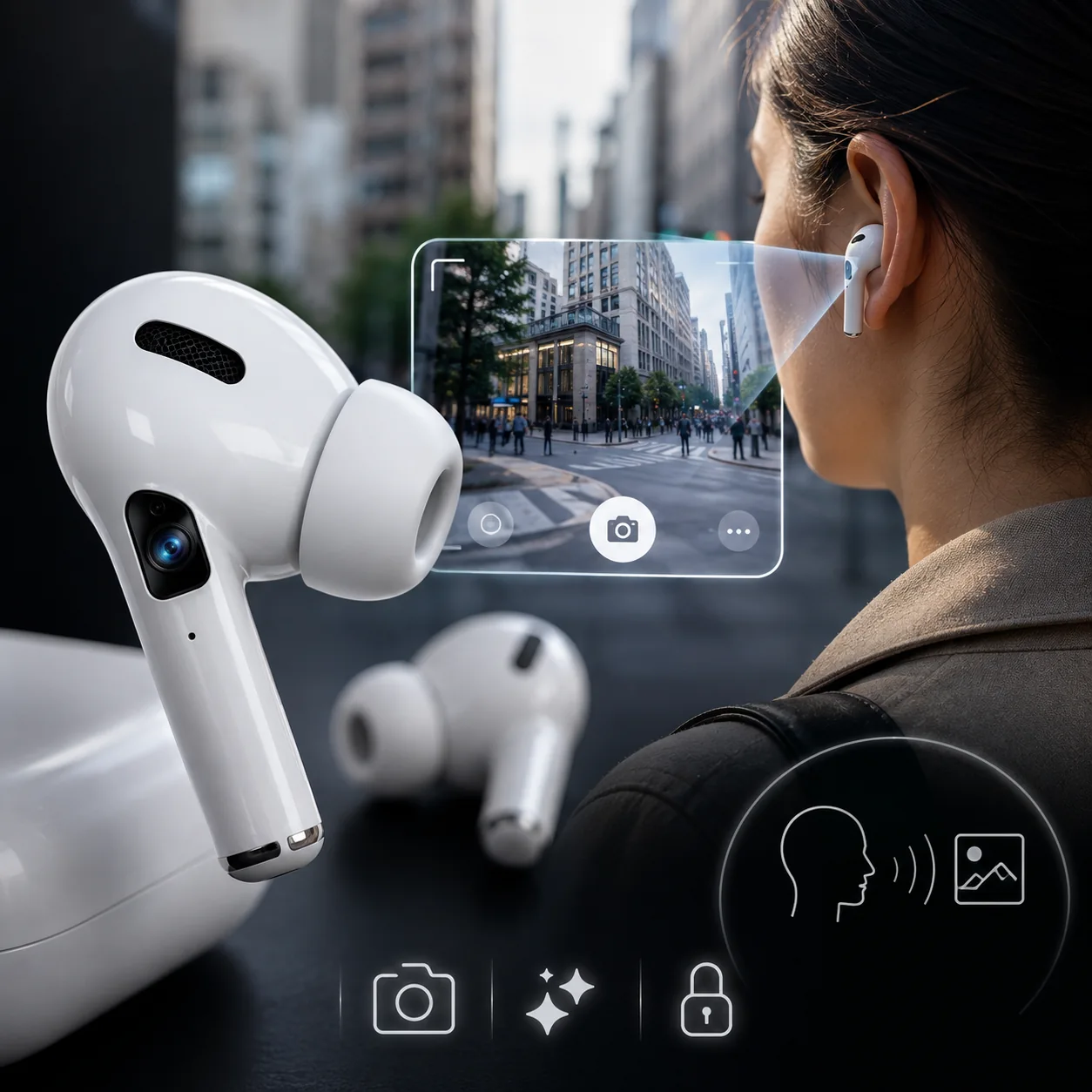
Apple’s AI‑Powered Camera AirPods Could Launch in 2026, Not 2027
Why the Camera AirPods Matter
Apple’s next‑generation AirPods are set to do more than stream audio. By embedding tiny visual sensors inside the earbuds, the company aims to give Siri a real‑world view of the wearer’s environment. This shift marks the first time Apple is positioning a wearable as an AI‑focused device rather than a pure audio accessory.
The concept emerged publicly after a video surfaced in a macOS 26.7 release candidate. In the clip, Siri says, “With Visual Intelligence, your world becomes savable,” while a user holds up a book and asks the assistant to save the information. The demo also warns users to keep the buds uncovered for accurate sensing, hinting at a practical, day‑to‑day use case.
Two internal code names have been identified: B798, which has been tracked for months, and B790, a newer iteration that appears further along in development. References to B790 in iOS 27 beta code suggest Apple’s engineering teams are already testing the sensor pipeline and the associated AI models.
Historically, Apple rolls out major AirPods updates alongside its September iPhone events. The AirPods 4 arrived in 2024, while the Pro line saw a refresh in 2025. If the timeline holds, a September 2026 launch would align the camera‑enabled buds with the debut of the iPhone 18, giving the product a high‑visibility platform.
✦✦✦
What the Cameras Actually Do
The lenses are not meant for user‑initiated photo or video capture. Instead, they act as visual perception modules that feed live scene data into on‑device machine‑learning algorithms. Siri could then identify objects, read text, or recognize landmarks without the user having to point a phone camera at them.
Apple’s description of the feature as “Visual Intelligence” underscores the emphasis on context. For example, a user could ask, “What’s the name of this plant?” while walking, and the earbuds would analyze the foliage, match it against a database, and reply instantly.
Because the processing happens primarily on the device, latency stays low and personal data remains under the user’s control. Apple has hinted at leveraging its Neural Engine to run the vision models locally, a move that aligns with its broader privacy‑first strategy.
✦✦✦
Pricing and Design Speculation
Current AirPods pricing provides a baseline: the standard AirPods 4 start at $129, while the over‑ear AirPods Max sit at $549. Adding a camera module and dedicated AI silicon could push the new model into the premium tier, potentially matching or exceeding the Max’s price point.
Design rumors suggest a slightly bulkier stem to house the sensor array, but Apple may keep the overall silhouette familiar to avoid alienating existing users. A subtle LED indicator is expected to flash whenever the camera is active, providing a visual cue to bystanders.
If Apple chooses a naming convention like “AirPods Pro Ultra,” the product would sit above the current Pro line, signaling a distinct AI‑focused experience while preserving the standard AirPods lineup for price‑sensitive customers.
✦✦✦
Privacy Safeguards
Wearable cameras have sparked controversy since Meta launched its Ray‑Ban smart glasses. Apple’s approach appears to pre‑empt criticism by limiting the lenses to perception rather than recording, and by adding an LED that glows whenever visual processing is underway.
Apple will likely embed a hardware kill‑switch that disables the sensor suite entirely, giving users a clear way to opt out. Coupled with on‑device inference, this architecture reduces the risk of remote data harvesting and aligns with the company’s long‑standing privacy narrative.
Regulatory bodies in Europe and the United States have begun drafting rules for “always‑on” cameras. By making the visual module a passive sensor rather than a recorder, Apple may sidestep many of the upcoming compliance hurdles.
✦✦✦
Strategic Implications for Apple’s Wearable Roadmap
The camera AirPods are a logical bridge between Apple’s audio accessories and its long‑delayed mixed‑reality headset. By proving that visual AI can thrive in a discreet form factor, the company gains valuable data on user acceptance, power consumption, and sensor integration.
If the earbuds succeed, Apple may accelerate the rollout of its rumored AR glasses, using the same vision‑processing pipeline across devices. Conversely, a lukewarm market reaction could push the firm to refine its privacy messaging before unveiling any head‑mounted product.
From a developer standpoint, the new hardware opens a sandbox for third‑party apps to request contextual cues from the earbuds. Imagine a translation app that reads signage in real time, or a fitness coach that adjusts workouts based on surrounding obstacles.
Apple’s ecosystem advantage means that once the API surfaces, integration will be seamless across iPhone, iPad, and Mac. Users could start a visual query on their earbuds, receive a spoken answer, and have the result saved to Notes without lifting a finger.
✦✦✦
Potential Challenges and Risks
Battery life remains a critical hurdle. Continuous visual processing, even with low‑power sensors, draws more power than audio playback alone. Apple will need to balance AI responsiveness with a respectable listening time, likely by employing aggressive duty‑cycling and edge‑AI acceleration.
Another risk involves user perception. While the LED indicator offers transparency, many people may still feel uneasy about an “invisible camera” on a device they wear for hours. Effective education and clear opt‑out controls will be essential to avoid backlash.
Supply‑chain constraints could also delay mass production. The miniature lenses and custom AI chips require precision manufacturing, and any hiccup could push the launch into early 2027, aligning with earlier speculation.
Finally, competition is heating up. Google’s Pixel Buds are already experimenting with on‑device translation, and Meta plans to ship its own AI‑enabled glasses later this year. Apple must deliver a compelling, privacy‑first experience to stay ahead.
✦✦✦
What to Expect at the Fall Event
If Apple follows its pattern, the September keynote will feature a short video showcasing the earbuds in everyday scenarios—reading a menu, identifying a plant, or saving a receipt with a voice command. The demo will likely stress the LED indicator and the on‑device nature of the AI to pre‑empt privacy concerns.
Pricing tiers will probably include a base model without the camera for legacy users and a premium “Pro Ultra” version with full visual AI. Pre‑orders could open within days of the announcement, with shipments slated for late October or early November.
Developers should watch for an upcoming WWDC session that outlines the new Vision API for earbuds. Early access will likely be granted to a select group of partners, setting the stage for a wave of third‑party experiences once the hardware lands.
In short, Apple’s camera‑equipped AirPods could redefine how users interact with their surroundings, turning a simple audio accessory into a contextual AI assistant. The product’s success will hinge on seamless integration, transparent privacy safeguards, and a price point that justifies the added sensor suite.
shareShare this post
recommendYou may also like
BUSINESSTECHNOLOGYMicrosoft Ignite 2026: Satya Nadella Puts AI Agents, Copilot and Enterprise Cloud at the Centre of Microsoft's Next Technology RevolutionFlipFileZone · Read Fullopen_in_new BUSINESSTECHNOLOGYChina Uses American AI Models to Train Domestic Rivals as US Chip Restrictions Intensify the Global Artificial Intelligence RaceFlipFileZone · Read Fullopen_in_new
 BUSINESSTECHNOLOGYNvidia Leadership Turmoil Raises Concerns Over AI Industry Financing as Investors Rethink the Future of the AI BoomFlipFileZone · Read Fullopen_in_new
 TECHNOLOGYGovernor Gulab Chand Kataria launches Shaheed Bhagat Singh Youth Facilitation Centre in LudhianaFlipFileZone · Read Fullopen_in_new
 TECHNOLOGYInstinct AI Assistant Secures $350M Funding, Hits $2.5B Valuation in Record TimeFlipFileZone · Read Fullopen_in_new
 TECHNOLOGYXiaomi Unveils Xring Chip with TSMC Partnership, Redefining Its Global Hardware StrategyFlipFileZone · Read Fullopen_in_new
 TECHNOLOGYAI Revolution: How Move 37 Changes EverythingFlipFileZone · Read Fullopen_in_new
chatPost a comment
Comments
0