 BUSINESSTECHNOLOGYMicrosoft Ignite 2026: Satya Nadella Puts AI Agents, Copilot and Enterprise Cloud at the Centre of Microsoft's Next Technology RevolutionFlipFileZone · Read Fullopen_in_new
Apple and Google Clash With the European Union Over New AI Rules and Digital Market Control
Apple and Google strongly criticized new European Union proposals targeting AI interoperability, arguing the regulations could weaken user privacy, device security, and platform stability across the technology ecosystem.
FlipFileZone · TECHNOLOGY
shareShare this post






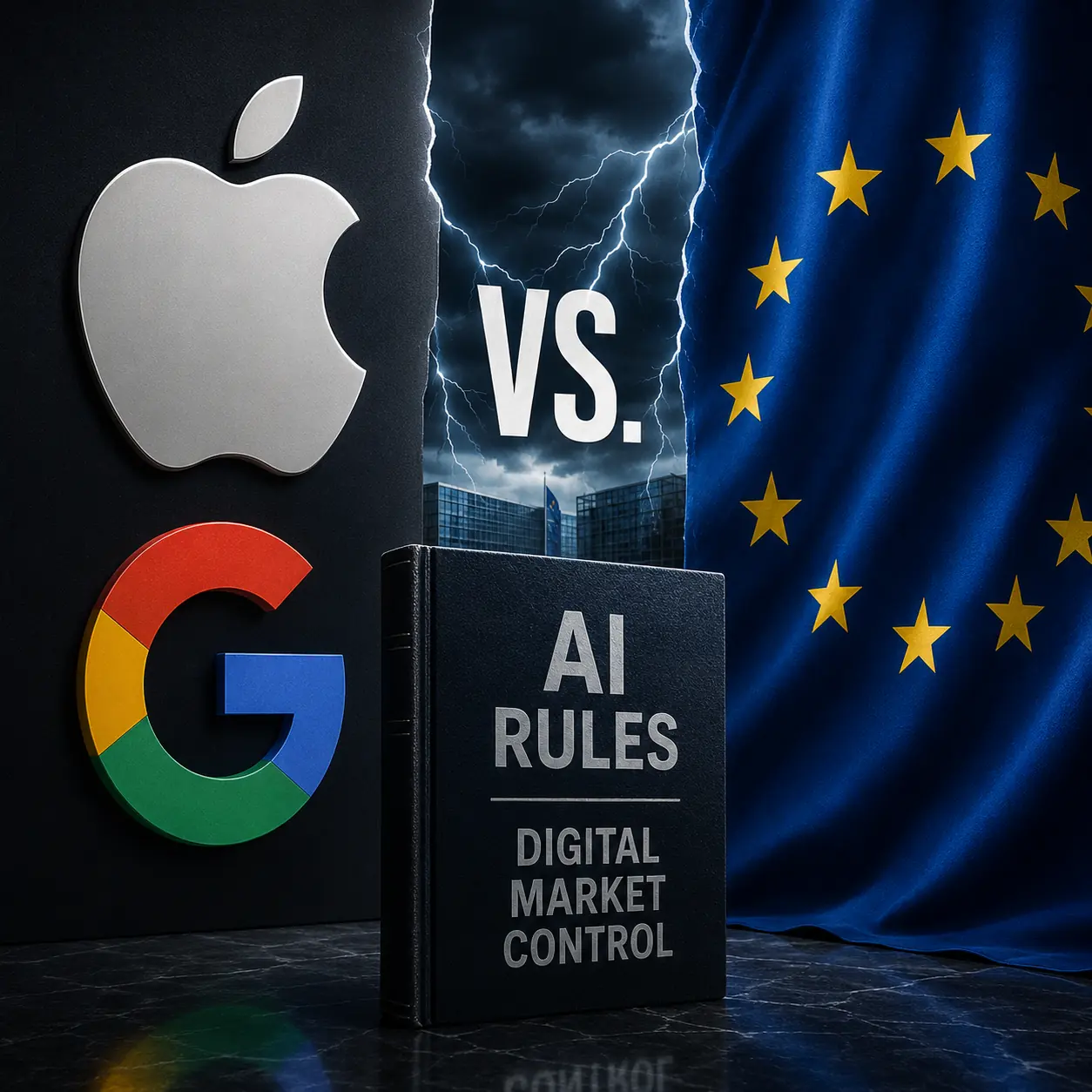
Apple and Google Clash With the European Union Over New AI Rules and Digital Market Control
Apple and Google Clash With the European Union Over New AI Rules and Digital Market Control
The global technology industry entered another major regulatory battle on May 14, 2026, after Apple and Google publicly criticized new European Union proposals designed to expand AI interoperability and reduce platform control within the digital ecosystem.
The proposed measures, introduced as part of the EU’s broader digital competition and artificial intelligence strategy, could force major technology companies to provide deeper access to operating systems, AI assistants, search infrastructure, app ecosystems, and connected services for third-party competitors.
European regulators argue the changes are necessary to ensure fair competition in the rapidly growing artificial intelligence economy. However, Apple and Google warned that the proposed rules could introduce serious security vulnerabilities, weaken user privacy protections, reduce software stability, and create new cybersecurity risks.
The dispute represents one of the most important regulatory confrontations of the AI era.
As artificial intelligence becomes increasingly integrated into smartphones, cloud services, operating systems, search engines, and enterprise software, governments worldwide are racing to determine how digital markets should operate in the age of AI.
The European Union has emerged as one of the most aggressive regulators of large technology companies, frequently challenging the dominance of firms such as Apple, Google, Meta, Amazon, and Microsoft through competition laws, privacy rules, and digital platform regulations.
The latest AI-related proposals could dramatically reshape how future AI ecosystems function across Europe.
The Core of the Dispute
At the center of the conflict is the European Union’s belief that major technology companies hold excessive control over digital ecosystems.
Regulators argue that dominant platforms increasingly act as gatekeepers, limiting competition by controlling app distribution, search visibility, AI integrations, hardware access, and operating system functionality.
European officials believe AI could intensify this problem.
As generative AI systems become deeply embedded into smartphones, browsers, cloud infrastructure, and productivity tools, regulators worry that a small number of corporations could gain unprecedented influence over digital information and online services.
The EU’s proposed interoperability measures are designed to prevent large companies from locking users into closed AI ecosystems.
Under the proposals, companies may be required to allow broader integration of third-party AI assistants, search systems, voice services, messaging tools, and recommendation engines within their platforms.
Supporters argue this would create a more competitive and innovative digital marketplace.
Critics, however, warn that forcing deeper system access could compromise security architecture carefully developed over many years.
Apple’s Privacy and Security Argument
Apple responded aggressively to the proposed measures, arguing that forced interoperability could undermine the company’s long-standing privacy and security model.
Apple executives warned that allowing broader third-party AI access to core operating system functions might increase the risk of data misuse, malware distribution, unauthorized tracking, and system instability.
The company has increasingly positioned itself as a privacy-focused technology provider, often emphasizing its approach to on-device AI processing, encrypted communication systems, and restricted data collection policies.
Apple argues that maintaining tight control over hardware and software integration allows the company to deliver stronger security protections compared to more open ecosystems.
The company fears that mandatory interoperability requirements could weaken those protections.
Security experts note that operating system integrations involve extremely sensitive permissions. AI systems embedded deeply within smartphones could potentially access personal messages, location data, browsing history, health information, financial activity, and voice recordings.
Apple argues that expanding external access to these systems could create entirely new categories of cybersecurity vulnerabilities.
The company also warned that the rules could slow innovation by forcing developers to design around complex regulatory requirements rather than focusing purely on product performance.
Google’s Concerns About Platform Stability
Google also criticized the proposed EU regulations, though its concerns focused more heavily on ecosystem complexity, search integration, and platform consistency.
The company argued that forcing broad interoperability between competing AI systems could reduce software reliability and create fragmented user experiences.
Google’s Android ecosystem powers billions of devices worldwide and relies heavily on interconnected services such as Search, Chrome, Gemini AI, Maps, Gmail, YouTube, and Google Play.
The company believes tighter integration between services improves performance, personalization, and usability.
However, regulators increasingly view this integration as a competitive advantage that may limit rival access to digital markets.
Google warned that opening critical infrastructure layers to external AI systems could create operational complications, increase security risks, and reduce system optimization efficiency.
The company also argued that Europe risks slowing technological progress if regulations become too restrictive.
The European Union’s Bigger Strategy
The dispute reflects a much larger European strategy aimed at reducing the dominance of American technology giants within global digital markets.
Over the past decade, the European Union introduced numerous regulations targeting large technology platforms, including privacy laws, antitrust enforcement actions, digital advertising restrictions, app store competition rules, and content moderation requirements.
European regulators increasingly believe artificial intelligence represents the next major battleground.
The EU wants to ensure that AI ecosystems remain competitive, transparent, and aligned with European standards surrounding privacy, consumer protection, and digital rights.
Officials worry that without strong regulation, a small number of companies could control future AI infrastructure, search systems, recommendation engines, cloud services, and digital assistants.
The European approach differs significantly from the United States and China.
While American regulators often focus more heavily on innovation and market growth, European policymakers place greater emphasis on competition policy, privacy protections, and platform accountability.
China, meanwhile, combines heavy government oversight with strategic industrial policy designed to strengthen domestic technology champions.
This divergence is creating increasingly fragmented global technology governance frameworks.
AI Is Changing the Smartphone Industry
The regulatory battle is occurring at a critical moment for the smartphone industry.
Artificial intelligence is rapidly becoming the central feature layer across modern devices. Companies are integrating AI assistants directly into operating systems, search interfaces, cameras, productivity applications, translation systems, and communication tools.
Google recently expanded Gemini AI integration across Android devices, while Apple continues developing its own AI-powered ecosystem enhancements.
The future smartphone experience increasingly revolves around AI-driven personalization and automation.
AI systems can summarize messages, generate content, automate workflows, manage schedules, translate conversations, recommend actions, and personalize applications in real time.
As these capabilities become more advanced, control over AI ecosystems becomes strategically valuable.
Regulators fear that companies controlling operating systems could use AI integration to strengthen platform dominance even further.
The Cybersecurity Challenge
Cybersecurity experts remain divided regarding the proposed regulations.
Some specialists support interoperability initiatives, arguing that open ecosystems can encourage innovation and reduce dependence on single providers.
Others believe expanding third-party access to operating system infrastructure could significantly increase attack surfaces.
AI systems require access to enormous quantities of contextual information to function effectively. This creates major security and privacy challenges.
Deep AI integration may involve permissions related to contacts, messages, emails, location history, voice data, payment systems, browsing activity, and enterprise workflows.
If poorly managed, expanded interoperability could potentially expose sensitive data to malicious actors.
Technology companies increasingly view cybersecurity as one of the defining challenges of the AI era.
Governments worldwide are also becoming more concerned about AI-powered cyber threats, automated phishing attacks, data manipulation systems, and infrastructure vulnerabilities.
The EU proposals therefore sit directly at the intersection of competition policy and national digital security.
The Economic Stakes
The financial stakes surrounding the dispute are enormous.
Artificial intelligence is expected to become one of the largest economic sectors of the coming decade. Analysts estimate AI could contribute trillions of dollars to the global economy through automation, productivity gains, scientific research acceleration, and enterprise optimization.
Control over AI ecosystems may determine which companies dominate future digital markets.
Search engines, operating systems, cloud platforms, productivity software, voice assistants, and e-commerce platforms are all rapidly evolving around AI capabilities.
This explains why technology companies are fighting aggressively over platform control and ecosystem integration.
The EU’s decisions could influence global technology standards far beyond Europe itself.
Many companies may eventually adopt European compliance standards globally rather than maintaining separate regional systems.
As a result, European regulations often shape international technology practices.
The Growing AI Regulation Wave
The Apple-Google dispute reflects a broader global trend toward increased AI regulation.
Governments worldwide are now examining how artificial intelligence could affect privacy, labor markets, misinformation, competition, national security, intellectual property, and public safety.
The European Union already passed comprehensive AI legislation designed to regulate high-risk AI applications, transparency requirements, and model accountability standards.
Meanwhile, the United States continues debating federal AI oversight frameworks, though American regulation remains less centralized than Europe’s approach.
China has also introduced significant AI rules involving recommendation systems, generative AI services, and online content management.
The result is an increasingly fragmented regulatory environment where technology companies must navigate different legal standards across regions.
This fragmentation could become one of the defining business challenges of the AI era.
Could Regulation Slow Innovation?
One of the biggest questions surrounding the EU proposals is whether aggressive regulation could unintentionally slow technological innovation.
Critics argue that heavy compliance requirements may discourage experimentation and reduce incentives for companies to invest in advanced AI infrastructure.
Supporters disagree.
European officials argue that healthy competition actually strengthens innovation by preventing dominant companies from controlling entire ecosystems.
They believe interoperability requirements could help smaller startups compete more effectively against established technology giants.
Some analysts suggest the long-term outcome may depend on implementation details.
Poorly designed regulations could create operational complexity and security risks. However, carefully structured interoperability frameworks might encourage broader ecosystem participation without compromising user safety.
The challenge is balancing competition with security, privacy, and technical reliability.
The Future of AI Ecosystems
The regulatory battle between the European Union, Apple, and Google may ultimately shape how future AI ecosystems function globally.
If regulators succeed, users may gain greater flexibility to choose competing AI assistants and services across devices.
Developers could receive expanded access to operating system integrations previously restricted to platform owners.
However, technology companies warn that excessive fragmentation could reduce performance consistency and increase security vulnerabilities.
The outcome will likely influence not only smartphones, but also cloud computing, enterprise software, connected devices, automotive systems, smart home platforms, and future AI agents.
Artificial intelligence is becoming deeply integrated into nearly every layer of modern computing infrastructure.
Control over those systems is rapidly becoming one of the most important strategic issues in global technology policy.
Conclusion
The clash between Apple, Google, and the European Union marks one of the most important regulatory confrontations of the AI era.
At stake is far more than smartphone software or app ecosystems. The dispute centers on who will control the future architecture of artificial intelligence across the global digital economy.
European regulators want to prevent excessive platform concentration and ensure open competition within AI markets.
Apple and Google argue that forced interoperability could weaken security, privacy, and system reliability.
Both sides recognize that artificial intelligence is rapidly becoming the foundational layer of future computing experiences.
The decisions made over the next few years may determine how billions of people interact with AI systems across devices, cloud services, enterprise platforms, and digital infrastructure worldwide.
One thing is already clear: the global battle over AI regulation has officially begun.
tagTags
shareShare this post
recommendYou may also like
BUSINESSTECHNOLOGYMicrosoft Ignite 2026: Satya Nadella Puts AI Agents, Copilot and Enterprise Cloud at the Centre of Microsoft's Next Technology RevolutionFlipFileZone · Read Fullopen_in_new BUSINESSTECHNOLOGYChina Uses American AI Models to Train Domestic Rivals as US Chip Restrictions Intensify the Global Artificial Intelligence RaceFlipFileZone · Read Fullopen_in_new
 BUSINESSTECHNOLOGYNvidia Leadership Turmoil Raises Concerns Over AI Industry Financing as Investors Rethink the Future of the AI BoomFlipFileZone · Read Fullopen_in_new
 TECHNOLOGYGovernor Gulab Chand Kataria launches Shaheed Bhagat Singh Youth Facilitation Centre in LudhianaFlipFileZone · Read Fullopen_in_new
 TECHNOLOGYInstinct AI Assistant Secures $350M Funding, Hits $2.5B Valuation in Record TimeFlipFileZone · Read Fullopen_in_new
 TECHNOLOGYXiaomi Unveils Xring Chip with TSMC Partnership, Redefining Its Global Hardware StrategyFlipFileZone · Read Fullopen_in_new
 TECHNOLOGYApple’s AI‑Powered Camera AirPods Could Launch in 2026, Not 2027FlipFileZone · Read Fullopen_in_new
chatPost a comment
Comments
0