 BUSINESSTECHNOLOGYMicrosoft Ignite 2026: Satya Nadella Puts AI Agents, Copilot and Enterprise Cloud at the Centre of Microsoft's Next Technology RevolutionFlipFileZone · Read Fullopen_in_new
Google DeepMind Intensifies the Global AI Race With Next-Generation Gemini and Multimodal AI Systems
Google DeepMind accelerated the global AI competition in May 2026 through major advancements in Gemini, multimodal intelligence, AI agents, and next-generation research infrastructure.
FlipFileZone · TECHNOLOGY
shareShare this post






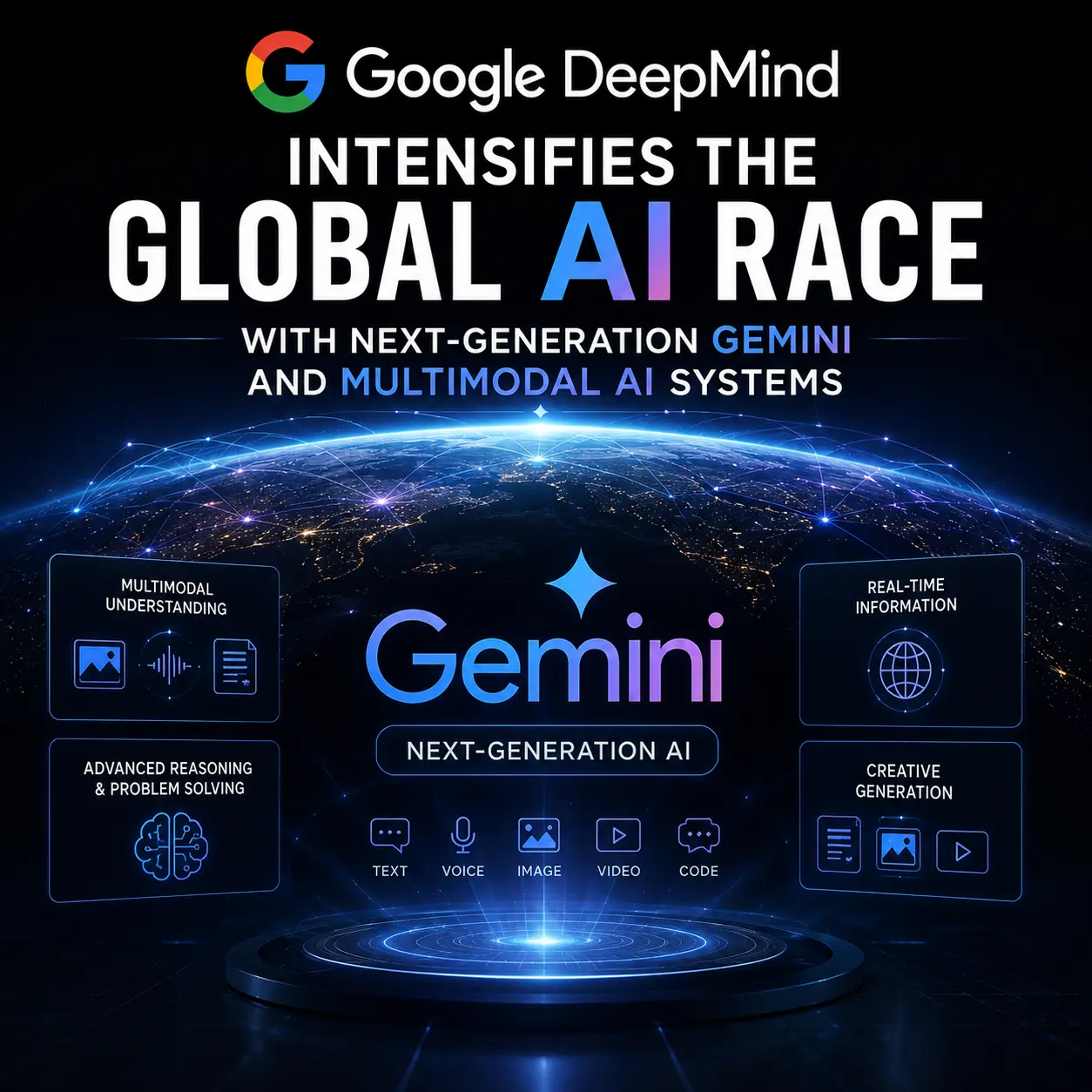
Google DeepMind Intensifies the Global AI Race With Next-Generation Gemini and Multimodal AI Systems
Google DeepMind Intensifies the Global AI Race With Next-Generation Gemini and Multimodal AI Systems
The global artificial intelligence race accelerated again on May 14, 2026, as Google DeepMind unveiled major advancements in Gemini and next-generation multimodal AI systems designed to compete aggressively against OpenAI, Microsoft, Anthropic, Meta, and other leading AI organizations.
The announcements demonstrated how rapidly the frontier AI landscape is evolving. Artificial intelligence companies are no longer competing only on chatbot quality or language generation. The industry is now focused on building highly capable multimodal systems, autonomous AI agents, advanced reasoning models, scientific research tools, and deeply integrated AI ecosystems.
Google DeepMind’s latest developments position the company directly at the center of that transformation.
For years, Google dominated internet search, digital advertising, and mobile ecosystems through products such as Search, Android, Chrome, Gmail, and YouTube. However, the explosive rise of generative AI created one of the biggest competitive disruptions in the company’s history.
The emergence of ChatGPT and advanced conversational AI systems challenged traditional search behavior and forced Google to accelerate AI deployment across nearly every part of its ecosystem.
Google DeepMind now represents one of the company’s most strategically important divisions.
The organization combines advanced AI research, infrastructure development, multimodal systems engineering, reinforcement learning expertise, and scientific discovery initiatives under a single unified effort designed to shape the future of artificial intelligence.
The Evolution of Gemini
Gemini has rapidly become the centerpiece of Google’s AI strategy.
Unlike earlier AI assistants focused primarily on text generation, Gemini is designed as a multimodal system capable of understanding and generating text, images, audio, video, code, and contextual interactions simultaneously.
This multimodal capability is becoming one of the defining trends in frontier artificial intelligence.
Future AI systems are expected to interact more naturally with the world by processing multiple forms of information together rather than relying exclusively on text-based prompts.
Google demonstrated how Gemini can analyze images, interpret documents, summarize videos, assist with coding, automate workflows, manage research tasks, and interact conversationally across devices.
The company believes this broader intelligence layer could fundamentally reshape how people interact with software, search engines, productivity tools, and digital infrastructure.
Gemini is increasingly integrated across Android, Chrome, Workspace, Search, and cloud services, creating a unified AI ecosystem spanning billions of users globally.
The Shift Toward AI Agents
One of the most important developments highlighted by Google DeepMind involves the rise of AI agents.
Traditional chatbots mainly responded to direct prompts. AI agents are designed to perform more autonomous multi-step tasks across applications, services, and digital environments.
Google showcased systems capable of helping users organize schedules, conduct research, automate workflows, summarize information, plan travel, analyze documents, and coordinate tasks across multiple applications.
These systems increasingly behave less like simple assistants and more like digital collaborators.
The rise of AI agents could represent one of the biggest platform transitions in modern computing.
Instead of manually operating software through menus and applications, users may increasingly delegate complex workflows to intelligent systems capable of executing tasks autonomously.
However, this shift also introduces major security, privacy, and reliability challenges.
AI agents require broad access to emails, calendars, enterprise systems, financial tools, cloud services, and personal information to operate effectively.
Ensuring these systems remain secure and trustworthy will become critically important.
The OpenAI Competition
Google DeepMind’s aggressive expansion is heavily influenced by competition with OpenAI.
The explosive popularity of ChatGPT fundamentally changed public expectations surrounding artificial intelligence and created the first major challenge to Google’s information dominance in many years.
For decades, users relied heavily on traditional search engines to access online information. Conversational AI systems introduced a new interaction model where users receive synthesized responses directly instead of navigating through multiple search results.
This represented a serious strategic threat to Google’s core business model.
Google responded by accelerating Gemini development and integrating AI deeply across its ecosystem.
Meanwhile, OpenAI continued expanding GPT-based systems through partnerships with Microsoft and enterprise software providers.
The result is one of the most intense competitive battles in modern technology history.
Every major platform company now views artificial intelligence as essential for long-term survival.
Why Multimodal AI Matters
Multimodal AI represents one of the biggest frontiers in artificial intelligence research.
Human intelligence naturally processes multiple forms of information simultaneously, including language, images, sound, movement, and environmental context.
Researchers believe future AI systems capable of combining these modalities effectively may become dramatically more useful and adaptable.
Google DeepMind is investing heavily into this direction.
Gemini systems can now interpret screenshots, analyze visual interfaces, understand diagrams, summarize videos, and interact with real-world information environments more naturally than earlier text-only systems.
These capabilities may eventually support advanced robotics, augmented reality systems, autonomous assistants, scientific discovery platforms, and more human-like digital interactions.
The transition toward multimodal AI is expected to influence nearly every major technology sector over the coming decade.
AI and Scientific Discovery
Google DeepMind continues emphasizing scientific research as one of the most important long-term applications of artificial intelligence.
The company previously gained global attention through AlphaFold, which significantly advanced protein structure prediction and accelerated biological research.
Now, DeepMind is exploring how advanced AI systems could support broader scientific discovery across medicine, chemistry, materials science, climate modeling, mathematics, and physics.
Researchers believe AI may eventually help accelerate innovation by analyzing complex datasets, generating hypotheses, simulating experiments, and identifying patterns difficult for humans to detect manually.
Governments and research institutions increasingly view AI-assisted science as a strategically important field.
The potential economic and medical implications are enormous.
The Infrastructure Behind Frontier AI
Building frontier AI systems requires enormous computational infrastructure.
Training advanced multimodal models consumes vast quantities of GPU capacity, cloud infrastructure, networking bandwidth, storage systems, and electricity.
Google continues investing billions into hyperscale AI infrastructure to support Gemini and future research systems.
The company’s Tensor Processing Units play a critical role in supporting AI workloads.
Unlike some competitors that rely heavily on third-party hardware suppliers, Google developed significant in-house AI acceleration technology over many years.
This infrastructure advantage may become increasingly important as global demand for AI compute resources continues expanding.
Technology companies are now competing not only through software innovation, but also through infrastructure scale.
Cloud computing, semiconductor manufacturing, data center expansion, and energy access are becoming foundational components of the AI race.
The Search Transformation
One of the biggest strategic questions surrounding Google DeepMind involves the future of search.
Google built one of the world’s most profitable businesses around traditional search advertising. However, conversational AI systems are changing how users access information online.
Instead of manually clicking through multiple search results, users increasingly expect direct AI-generated responses.
This creates both opportunities and risks for Google.
AI-powered search experiences may improve convenience and personalization. However, they could also disrupt traditional web traffic patterns that support publishers, advertisers, and content creators.
Google therefore faces the challenge of integrating AI deeply into search while preserving the broader economics of the web ecosystem.
The company continues experimenting with AI-generated search summaries, conversational interfaces, and hybrid information experiences combining traditional search with generative AI.
The long-term outcome may fundamentally reshape how the internet operates.
The Global AI Arms Race
Google DeepMind’s expansion also reflects the broader geopolitical importance of artificial intelligence.
Governments increasingly view AI leadership as essential for economic competitiveness, cybersecurity, military systems, scientific research, and national infrastructure development.
The United States and China remain heavily engaged in a strategic technology rivalry involving semiconductors, AI infrastructure, cloud systems, and advanced research capabilities.
Meanwhile, Europe, the Middle East, and Asia are investing aggressively into domestic AI ecosystems.
Technology companies increasingly operate within this larger geopolitical environment.
AI infrastructure, semiconductors, and advanced research systems are now treated as strategically important national assets.
Google DeepMind therefore occupies a position extending far beyond consumer technology products.
The organization represents part of the broader global competition over the future architecture of artificial intelligence itself.
The Regulatory Challenge
As AI systems become more powerful, governments are increasing regulatory scrutiny.
Concerns surrounding misinformation, cybersecurity, labor disruption, privacy, intellectual property, and AI safety continue growing.
Google DeepMind repeatedly emphasized responsible AI development and safety research.
The company is investing heavily into alignment research, system evaluation frameworks, security protections, and transparency tools designed to reduce risks associated with advanced AI systems.
However, regulation remains fragmented globally.
The European Union introduced comprehensive AI legislation focused on transparency and high-risk systems. The United States continues debating federal AI oversight frameworks. China maintains strong state oversight of AI development and deployment.
This fragmented regulatory environment may become increasingly difficult for global technology companies to navigate.
The Future of Consumer AI
Google DeepMind’s latest announcements demonstrate how quickly consumer computing is evolving around artificial intelligence.
Smartphones, browsers, productivity software, cloud services, search engines, and digital assistants are all becoming increasingly AI-native.
Over time, users may rely less on manually navigating applications and more on conversational systems capable of understanding goals, context, and intent automatically.
AI systems may eventually coordinate tasks across devices, summarize information continuously, personalize workflows, and automate large portions of daily digital activity.
This transition could become one of the largest platform shifts since the rise of smartphones and cloud computing.
The companies capable of building scalable, trusted, and deeply integrated AI ecosystems may dominate the next era of technology.
Google clearly intends for DeepMind and Gemini to play central roles in that future.
Conclusion
Google DeepMind’s latest Gemini advancements highlight how rapidly the frontier AI race is accelerating.
The company is aggressively expanding multimodal systems, AI agents, infrastructure capabilities, scientific research applications, and consumer AI integrations across its ecosystem.
Competition with OpenAI, Microsoft, Meta, Anthropic, and other AI organizations continues intensifying as artificial intelligence becomes the defining technological platform of the modern era.
Gemini is no longer simply a chatbot product. It represents Google’s broader vision for the future of computing itself.
As AI systems become more capable, autonomous, and integrated into daily life, the global technology industry may undergo one of the largest transformations in its history.
Google DeepMind is positioning itself directly at the center of that transformation.
One thing is already becoming clear: the next phase of artificial intelligence will be larger, more competitive, and more consequential than anything the technology industry has experienced before.
shareShare this post
recommendYou may also like
BUSINESSTECHNOLOGYMicrosoft Ignite 2026: Satya Nadella Puts AI Agents, Copilot and Enterprise Cloud at the Centre of Microsoft's Next Technology RevolutionFlipFileZone · Read Fullopen_in_new BUSINESSTECHNOLOGYChina Uses American AI Models to Train Domestic Rivals as US Chip Restrictions Intensify the Global Artificial Intelligence RaceFlipFileZone · Read Fullopen_in_new
 BUSINESSTECHNOLOGYNvidia Leadership Turmoil Raises Concerns Over AI Industry Financing as Investors Rethink the Future of the AI BoomFlipFileZone · Read Fullopen_in_new
 TECHNOLOGYGovernor Gulab Chand Kataria launches Shaheed Bhagat Singh Youth Facilitation Centre in LudhianaFlipFileZone · Read Fullopen_in_new
 TECHNOLOGYInstinct AI Assistant Secures $350M Funding, Hits $2.5B Valuation in Record TimeFlipFileZone · Read Fullopen_in_new
 TECHNOLOGYXiaomi Unveils Xring Chip with TSMC Partnership, Redefining Its Global Hardware StrategyFlipFileZone · Read Fullopen_in_new
 TECHNOLOGYApple’s AI‑Powered Camera AirPods Could Launch in 2026, Not 2027FlipFileZone · Read Fullopen_in_new
chatPost a comment
Comments
0