 TECH GUIDESConvert XLS to XLSX Online Free — Upgrade Old Excel Files in SecondsFlipFileZone · Read Fullopen_in_new
NASA's Nancy Grace Roman Space Telescope to Discover 100,000 Exoplanets
The Nancy Grace Roman Space Telescope is set to launch in August 2026 and is expected to detect over 100,000 exoplanets, greatly expanding our current understanding of the universe and potentially habitable planets
FlipFileZone · TECH GUIDES
shareShare this post


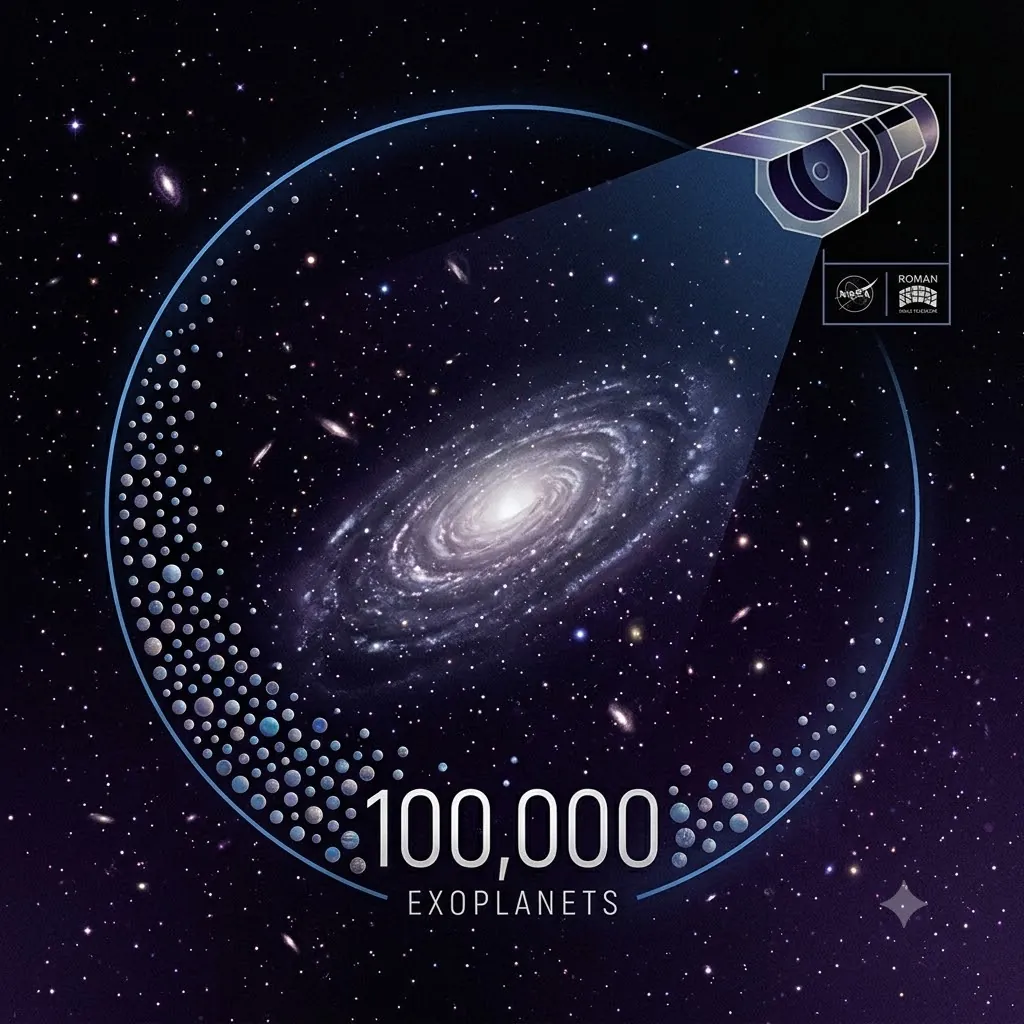
NASA's Nancy Grace Roman Space Telescope to Discover 100,000 Exoplanets
Introduction to the Nancy Grace Roman Space Telescope
The Nancy Grace Roman Space Telescope, named after NASA's first female executive and the agency's first Chief of Astronomy, is set to launch in August 2026. This telescope is the direct successor to the Hubble Space Telescope and is expected to make significant contributions to our understanding of the universe. With its 2.4-m primary mirror and a field of view at least 100 times that of Hubble, the Roman Space Telescope will be able to collect and measure light from a billion galaxies during its 5-year primary mission.
One of the primary goals of the Roman Space Telescope is to detect exoplanets, which are planets that orbit stars outside of our own solar system. Using its coronograph instrument, the telescope will be able to block starlight and directly image exoplanets orbiting closer to their stars, where habitable rocky planets are expected to be found. This will allow scientists to study the properties of these exoplanets and determine their potential for supporting life.
✦✦✦
The Science Behind Exoplanet Detection
The Roman Space Telescope will use a technique called transit spectroscopy to study exoplanets. This involves measuring the light that passes through the atmosphere of an exoplanet as it orbits its star. By analyzing this light, scientists can determine the composition of the exoplanet's atmosphere and identify potential biosignatures, which are signs of biological activity. The telescope will also be able to study the properties of exoplanet host stars, which will help scientists understand the conditions necessary for life to exist on other planets.
In addition to its exoplanet detection capabilities, the Roman Space Telescope will also be used to study the formation and evolution of galaxies. By observing the light from distant galaxies, scientists can learn about the history of the universe and the formation of stars and planets. The telescope will also be used to study the distribution of dark matter and dark energy, which are mysterious components that make up most of the universe's mass-energy budget.
The Impact of the Roman Space Telescope on Our Understanding of the Universe
The Roman Space Telescope is expected to have a significant impact on our understanding of the universe. By detecting thousands of exoplanets and studying their properties, scientists will be able to better understand the conditions necessary for life to exist on other planets. The telescope will also provide new insights into the formation and evolution of galaxies, which will help scientists understand the history of the universe. Additionally, the Roman Space Telescope will be used to study the distribution of dark matter and dark energy, which will help scientists better understand the nature of the universe.
The Roman Space Telescope is a significant step forward in our quest to understand the universe. With its advanced technology and powerful instruments, the telescope will be able to make new discoveries that will help us better understand the cosmos. As we continue to explore the universe, we may uncover new and exciting secrets that will challenge our current understanding of the universe and inspire new generations of scientists and explorers.
✦✦✦
In conclusion, the Nancy Grace Roman Space Telescope is a powerful new tool that will help us better understand the universe. With its advanced technology and powerful instruments, the telescope will be able to detect thousands of exoplanets and study their properties. The Roman Space Telescope will also be used to study the formation and evolution of galaxies, the distribution of dark matter and dark energy, and the conditions necessary for life to exist on other planets. As we continue to explore the universe, we may uncover new and exciting secrets that will challenge our current understanding of the universe and inspire new generations of scientists and explorers.
shareShare this post
recommendYou may also like
TECH GUIDESConvert XLS to XLSX Online Free — Upgrade Old Excel Files in SecondsFlipFileZone · Read Fullopen_in_new TECH GUIDESConvert PNG to ICO Online Free — Create Favicons and Windows Icons in SecondsFlipFileZone · Read Fullopen_in_new
 TECH GUIDESConvert Markdown to PDF Online Free — Turn .md Files Into PDF in SecondsFlipFileZone · Read Fullopen_in_new
 TECH GUIDESConvert SVG to PNG Online Free — Export Vector Graphics as Images in SecondsFlipFileZone · Read Fullopen_in_new
 TECH GUIDESConvert GIF to MP4 Online Free — Turn Animated GIFs Into Video in SecondsFlipFileZone · Read Fullopen_in_new
 TECH GUIDESConvert WAV to MP3 Online Free — Compress Audio Files in SecondsFlipFileZone · Read Fullopen_in_new
 TECH GUIDESConvert MOV to MP4 Online Free — Convert iPhone Videos in SecondsFlipFileZone · Read Fullopen_in_new
chatPost a comment
Comments
0