 BUSINESSTECHNOLOGYMicrosoft Ignite 2026: Satya Nadella Puts AI Agents, Copilot and Enterprise Cloud at the Centre of Microsoft's Next Technology RevolutionFlipFileZone · Read Fullopen_in_new
New 'Snow' Malware Deployed via Microsoft Teams
Threat actor UNC6692 uses social engineering to deploy custom 'Snow' malware suite, stealing sensitive data through credential theft and domain takeover, exploiting Microsoft Teams for initial contact
FlipFileZone · TECHNOLOGY
shareShare this post






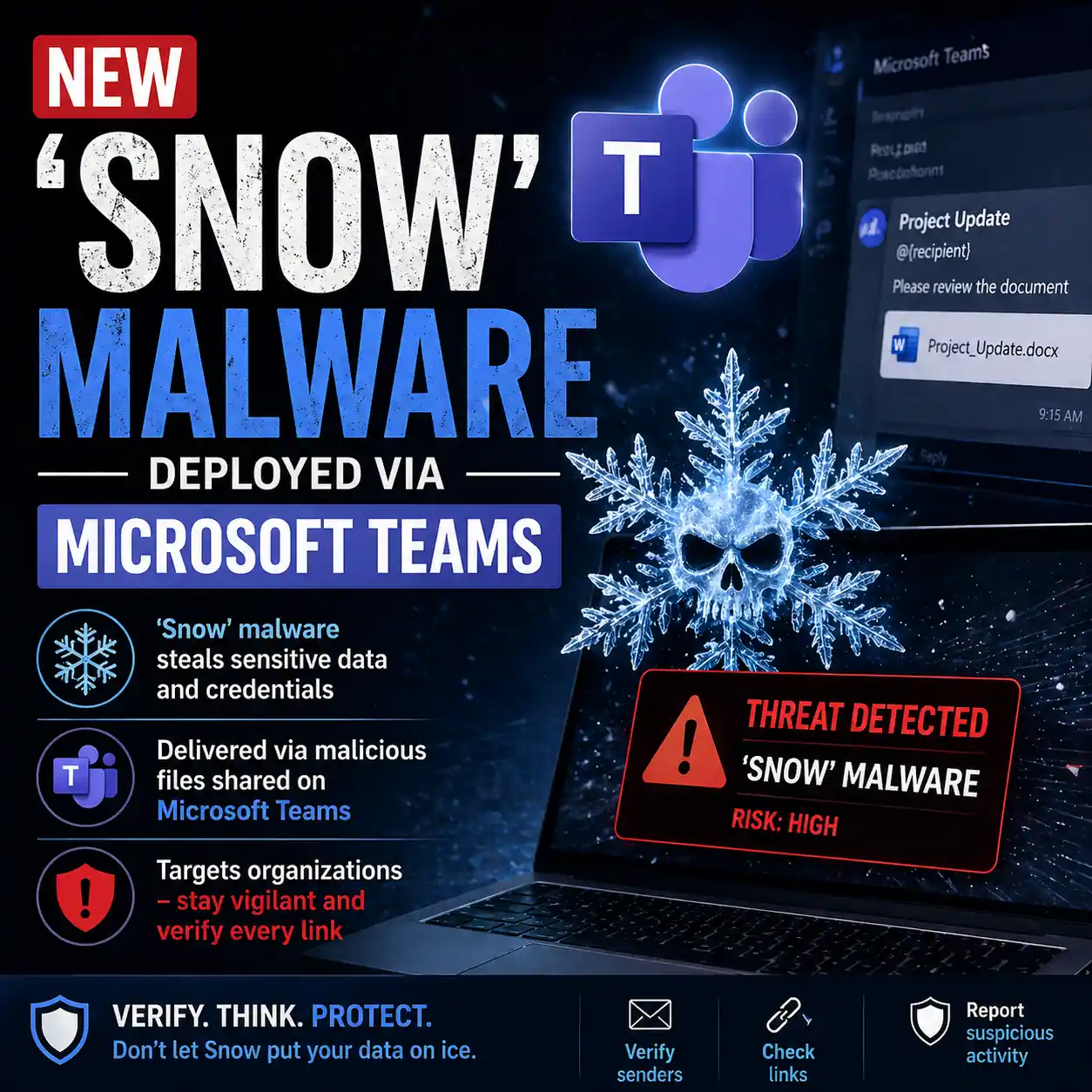
New 'Snow' Malware Deployed via Microsoft Teams
A recently discovered threat actor, tracked as UNC6692, has been using social engineering tactics to deploy a new, custom malware suite named 'Snow'. This malware suite includes a browser extension, a tunneler, and a backdoor, with the goal of stealing sensitive data after deep network compromise through credential theft and domain takeover.
The attackers use 'email bombing' tactics to create urgency, then contact targets via Microsoft Teams, posing as IT helpdesk agents. The victim is prompted to click a link to install a patch that would block email spam, but in reality, the victim gets a dropper that executes AutoHotkey scripts loading 'SnowBelt', a malicious Chrome extension.
SnowBelt serves as a persistence mechanism and a relay mechanism for commands the operator sends to a Python-based backdoor named 'SnowBasin'. Commands are delivered through a WebSocket tunnel established by a tunneler tool called 'SnowGlaze', to mask communications between the host and the command-and-control infrastructure.
The 'Snow' malware suite supports remote shell access, data exfiltration, file download, screenshot capturing, and basic file management operations. The operator can also issue a self-termination command to shut down the backdoor at the host. Post-compromise, the attackers performed internal reconnaissance, scanning for services such as SMB and RDP to identify additional targets, and then moved laterally on the network.
The attackers dumped LSASS memory to extract credential material and used pass-the-hash techniques to authenticate to additional hosts, eventually reaching domain controllers. At the final stage of the attack, the threat actor deployed FTK Imager to extract the Active Directory database, along with SYSTEM, SAM, and SECURITY registry hives. These files were exfiltrated from the network using LimeWire, giving the attackers access to sensitive credential data across the domain.
Impact and Mitigation
The 'Snow' malware suite poses a significant threat to organizations, as it can lead to deep network compromise and sensitive data theft. To mitigate this threat, organizations should be aware of the tactics used by the attackers, including 'email bombing' and social engineering via Microsoft Teams. Employees should be trained to be cautious when receiving urgent emails or messages, and to never click on links or install software from untrusted sources.
Organizations should also implement robust security measures, such as multi-factor authentication, to prevent attackers from gaining access to sensitive data. The report provides extensive indicators of compromise (IoCs) and YARA rules to help detect the 'Snow' toolset, which can be used to improve incident response and threat hunting capabilities.
shareShare this post
recommendYou may also like
BUSINESSTECHNOLOGYMicrosoft Ignite 2026: Satya Nadella Puts AI Agents, Copilot and Enterprise Cloud at the Centre of Microsoft's Next Technology RevolutionFlipFileZone · Read Fullopen_in_new BUSINESSTECHNOLOGYChina Uses American AI Models to Train Domestic Rivals as US Chip Restrictions Intensify the Global Artificial Intelligence RaceFlipFileZone · Read Fullopen_in_new
 BUSINESSTECHNOLOGYNvidia Leadership Turmoil Raises Concerns Over AI Industry Financing as Investors Rethink the Future of the AI BoomFlipFileZone · Read Fullopen_in_new
 TECHNOLOGYGovernor Gulab Chand Kataria launches Shaheed Bhagat Singh Youth Facilitation Centre in LudhianaFlipFileZone · Read Fullopen_in_new
 TECHNOLOGYInstinct AI Assistant Secures $350M Funding, Hits $2.5B Valuation in Record TimeFlipFileZone · Read Fullopen_in_new
 TECHNOLOGYXiaomi Unveils Xring Chip with TSMC Partnership, Redefining Its Global Hardware StrategyFlipFileZone · Read Fullopen_in_new
 TECHNOLOGYApple’s AI‑Powered Camera AirPods Could Launch in 2026, Not 2027FlipFileZone · Read Fullopen_in_new
chatPost a comment
Comments
0