 BUSINESSTECHNOLOGYMicrosoft Ignite 2026: Satya Nadella Puts AI Agents, Copilot and Enterprise Cloud at the Centre of Microsoft's Next Technology RevolutionFlipFileZone · Read Fullopen_in_new
Nvidia Becomes the World’s Most Valuable Tech Company as AI Infrastructure Spending Explodes
Nvidia reached a historic milestone in May 2026 after becoming the world’s most valuable technology company, fueled by massive global demand for AI chips, hyperscale infrastructure, and next-generation data centers.
FlipFileZone · TECHNOLOGY
shareShare this post


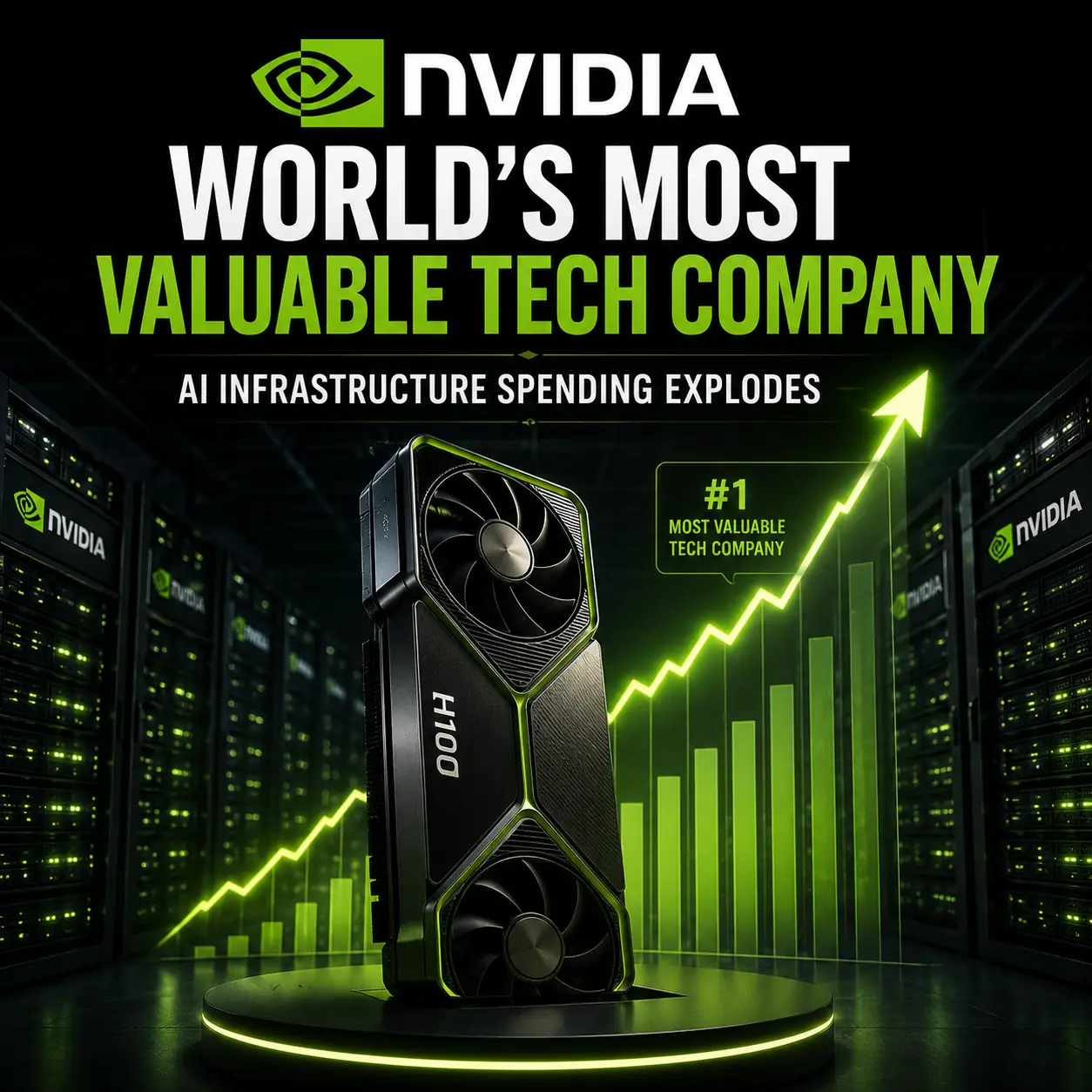
Nvidia Becomes the World’s Most Valuable Tech Company as AI Infrastructure Spending Explodes
Nvidia Becomes the World’s Most Valuable Tech Company as AI Infrastructure Spending Explodes
Nvidia officially cemented its dominance in the global technology industry on May 14, 2026, after reaching a historic valuation milestone that positioned the company as the world’s most valuable technology corporation. The extraordinary rise reflects the unprecedented demand for artificial intelligence infrastructure, AI chips, hyperscale computing, and data center expansion that continues reshaping the global economy.
Only a few years ago, Nvidia was primarily known as a graphics card company popular among gamers and PC enthusiasts. Today, it has evolved into one of the most strategically important corporations on Earth. Governments, cloud providers, AI startups, enterprise software companies, research institutions, and defense organizations now rely heavily on Nvidia hardware to power modern artificial intelligence systems.
The company’s rapid growth has become one of the defining business stories of the AI era. Investors increasingly view Nvidia not simply as a semiconductor company, but as the foundational infrastructure provider powering the future of artificial intelligence itself.
Its GPUs now serve as the computational backbone behind advanced generative AI systems, autonomous technologies, robotics platforms, scientific research, financial modeling systems, and large-scale enterprise automation.
The market reaction has been extraordinary. Nvidia’s valuation surged as investors poured money into companies tied directly to the AI infrastructure boom. Analysts described the current environment as one of the most aggressive technology investment cycles since the early days of the internet revolution.
The AI Boom Changed Everything
The rise of generative AI fundamentally transformed the technology industry. Following the explosive adoption of advanced AI chatbots and multimodal systems, businesses across nearly every industry accelerated investments into AI-powered products and services.
Companies quickly realized that modern AI systems require enormous computational resources. Training frontier AI models involves massive clusters of GPUs operating inside hyperscale data centers capable of processing enormous quantities of data.
This infrastructure demand created the perfect environment for Nvidia’s expansion.
Nvidia’s GPUs became the preferred hardware solution for AI training and inference because of their parallel processing capabilities, mature software ecosystem, and optimization for machine learning workloads.
As organizations rushed to build AI products, demand for Nvidia chips exploded globally.
Cloud providers such as Microsoft Azure, Amazon Web Services, and Google Cloud dramatically increased purchases of Nvidia hardware to support enterprise AI adoption. Startups also competed aggressively for GPU access as venture capital investment into AI companies accelerated.
The result was a supply-demand imbalance unlike anything previously seen in the semiconductor industry.
GPU shortages became common as companies scrambled to secure AI compute resources. Some organizations reportedly waited months to obtain enough high-performance chips for large-scale model training.
This shortage significantly strengthened Nvidia’s market position.
Why Nvidia Dominates AI Computing
Nvidia’s dominance is not solely based on hardware performance. One of the company’s biggest advantages lies in its software ecosystem.
The CUDA platform, developed over many years, became deeply integrated into machine learning development workflows worldwide. AI researchers, engineers, and enterprises built infrastructure pipelines optimized specifically around Nvidia’s architecture.
This ecosystem created powerful network effects.
Switching away from Nvidia hardware often requires major software optimization work, retraining engineering teams, and rebuilding infrastructure systems. As a result, many organizations continue expanding Nvidia deployments rather than adopting alternative solutions.
The company also aggressively invested in AI-focused product development years before the broader generative AI boom arrived.
While competitors focused heavily on traditional computing markets, Nvidia positioned itself directly at the center of AI acceleration, high-performance computing, simulation technology, and autonomous systems.
That long-term strategy now appears extraordinarily successful.
The Global AI Infrastructure Race
Nvidia’s rise is deeply connected to the broader global race for AI infrastructure dominance.
Artificial intelligence systems require enormous computational power. Training frontier models consumes massive amounts of electricity, networking bandwidth, storage capacity, and cooling infrastructure.
As AI capabilities continue improving, governments and corporations increasingly believe that computational infrastructure will determine future economic competitiveness.
This belief triggered a global infrastructure investment wave.
Technology companies are now spending hundreds of billions of dollars building next-generation data centers optimized specifically for AI workloads. These facilities contain enormous GPU clusters connected through ultra-high-speed networking systems.
AI infrastructure spending is growing at extraordinary speed.
Cloud providers are expanding data center capacity globally to meet enterprise demand for AI services. Countries are investing in sovereign AI infrastructure initiatives to reduce dependence on foreign compute providers.
Meanwhile, semiconductor manufacturing companies are scaling production capabilities to support exploding demand for advanced chips.
Nvidia sits directly at the center of this transformation.
Wall Street’s AI Obsession
Investors increasingly see artificial intelligence as the next major technological revolution. This optimism helped drive massive capital inflows into AI-focused companies.
Nvidia became one of the biggest beneficiaries of this trend.
Financial analysts argue that AI infrastructure demand may continue expanding for many years as businesses integrate AI into enterprise software, automation systems, healthcare platforms, cybersecurity tools, robotics, and consumer applications.
Some analysts compare the current AI investment cycle to the early growth of cloud computing or the rise of the internet itself.
Others believe the impact could become even larger.
Technology stocks linked directly to AI infrastructure experienced major gains throughout 2025 and early 2026. Semiconductor companies, cloud providers, networking firms, and energy infrastructure businesses all benefited from growing expectations surrounding long-term AI spending.
Nvidia became the symbolic leader of this movement.
Its financial performance repeatedly exceeded market expectations as demand for AI chips continued accelerating faster than many analysts initially predicted.
The Challenge of AI Energy Consumption
While Nvidia’s growth has impressed investors, the rapid expansion of AI infrastructure also created major concerns surrounding energy usage.
Modern AI systems require enormous amounts of electricity.
Training large language models involves thousands of GPUs operating continuously for extended periods. Inference workloads for millions of users also require substantial ongoing computational resources.
As AI adoption expands globally, energy demand from hyperscale data centers is increasing rapidly.
Utility providers and governments are now examining how AI infrastructure growth could impact electricity grids, renewable energy planning, and long-term sustainability goals.
Technology companies are investing heavily in advanced cooling systems, energy-efficient chips, and renewable power agreements to manage these challenges.
Nvidia itself continues focusing on improving GPU efficiency and performance-per-watt metrics to reduce infrastructure operating costs.
Still, many experts believe AI’s energy footprint will remain one of the defining challenges of the next decade.
Nvidia and Geopolitical Tensions
Nvidia’s strategic importance also placed the company at the center of growing geopolitical tensions between the United States and China.
Advanced AI chips are increasingly viewed as critical national security assets. Governments believe computational superiority could influence military systems, cybersecurity operations, scientific research, autonomous weapons, and economic competitiveness.
The United States expanded export restrictions targeting advanced semiconductor technologies destined for China. These regulations affected Nvidia’s ability to sell some high-performance AI chips into the Chinese market.
China responded by accelerating investments into domestic semiconductor development and AI infrastructure initiatives.
This semiconductor rivalry transformed advanced chips into one of the most strategically important resources of the AI era.
Nvidia now operates within a highly sensitive geopolitical environment where technology policy, export controls, and national security concerns increasingly influence business operations.
The Rise of AI Data Centers
One of the biggest drivers behind Nvidia’s growth is the rapid expansion of AI-focused data centers.
Traditional cloud infrastructure was not originally designed for modern AI workloads. Generative AI systems require far more computational density, networking throughput, and cooling capacity than conventional enterprise applications.
As a result, technology companies are redesigning infrastructure architectures around AI acceleration.
New hyperscale AI facilities are being constructed globally, often containing hundreds of thousands of GPUs connected through ultra-fast networking systems.
These facilities support model training, enterprise AI deployment, autonomous systems development, scientific simulations, and real-time inference services.
The infrastructure costs involved are enormous.
However, businesses increasingly view these investments as essential for maintaining competitiveness in the AI economy.
Nvidia’s hardware remains central to many of these deployments.
Competition Is Intensifying
Despite Nvidia’s dominant position, competition within the AI chip market continues intensifying.
AMD, Intel, Google, Amazon, and several specialized AI hardware startups are investing aggressively into alternative accelerator technologies.
Cloud providers are also developing custom AI chips designed specifically for internal infrastructure optimization.
Google’s Tensor Processing Units and Amazon’s Trainium chips represent major efforts to reduce dependence on third-party hardware providers.
Meanwhile, startups focused on AI acceleration architectures are attracting significant venture capital investment.
Still, Nvidia currently maintains major advantages in ecosystem maturity, software optimization, developer adoption, and manufacturing scale.
Many analysts believe competitors may require years to challenge Nvidia’s dominance meaningfully.
The Broader Economic Impact
Nvidia’s rise reflects broader structural changes occurring across the global economy.
Artificial intelligence is rapidly transforming business operations, investment priorities, labor markets, and infrastructure planning.
Companies across healthcare, finance, logistics, manufacturing, cybersecurity, and retail are integrating AI systems into daily operations.
Governments are funding national AI initiatives designed to strengthen economic competitiveness and technological independence.
Universities are expanding machine learning programs to address growing talent shortages. Venture capital firms continue pouring money into AI startups globally.
The AI boom increasingly influences nearly every major sector of the technology industry.
Nvidia became one of the clearest symbols of this transformation.
The Future of Nvidia
Looking ahead, Nvidia’s future appears closely tied to the continued expansion of artificial intelligence infrastructure.
If enterprise AI adoption continues accelerating, demand for computational resources could remain extremely strong for years.
Emerging technologies such as robotics, autonomous transportation, AI agents, digital twins, and advanced scientific simulations may create entirely new infrastructure requirements.
At the same time, Nvidia faces growing pressure to maintain innovation leadership while navigating geopolitical tensions, supply chain challenges, and increasing competition.
The company must continue improving chip efficiency, scaling production, strengthening software ecosystems, and expanding partnerships globally.
Investors will also closely monitor whether AI spending growth remains sustainable over the long term.
Some analysts warn that the current AI investment cycle could eventually face normalization or market corrections if revenue growth fails to match infrastructure spending.
However, most technology leaders still believe artificial intelligence represents one of the largest economic opportunities of the modern era.
Conclusion
Nvidia’s emergence as the world’s most valuable technology company represents more than just a financial milestone. It reflects the beginning of a new economic era driven by artificial intelligence infrastructure.
The company transformed from a gaming hardware manufacturer into one of the most strategically important corporations powering the future of global computing.
Its GPUs now sit at the center of the AI revolution, supporting everything from generative AI systems and robotics to cybersecurity platforms and scientific discovery.
As governments, enterprises, startups, and cloud providers continue investing aggressively into artificial intelligence, Nvidia remains uniquely positioned to benefit from the global demand for computational power.
The rise of AI infrastructure is reshaping technology markets, business strategy, energy systems, and geopolitical competition simultaneously.
And at the center of that transformation stands Nvidia.
shareShare this post
recommendYou may also like
BUSINESSTECHNOLOGYMicrosoft Ignite 2026: Satya Nadella Puts AI Agents, Copilot and Enterprise Cloud at the Centre of Microsoft's Next Technology RevolutionFlipFileZone · Read Fullopen_in_new BUSINESSTECHNOLOGYChina Uses American AI Models to Train Domestic Rivals as US Chip Restrictions Intensify the Global Artificial Intelligence RaceFlipFileZone · Read Fullopen_in_new
 BUSINESSTECHNOLOGYNvidia Leadership Turmoil Raises Concerns Over AI Industry Financing as Investors Rethink the Future of the AI BoomFlipFileZone · Read Fullopen_in_new
 TECHNOLOGYGovernor Gulab Chand Kataria launches Shaheed Bhagat Singh Youth Facilitation Centre in LudhianaFlipFileZone · Read Fullopen_in_new
 TECHNOLOGYInstinct AI Assistant Secures $350M Funding, Hits $2.5B Valuation in Record TimeFlipFileZone · Read Fullopen_in_new
 TECHNOLOGYXiaomi Unveils Xring Chip with TSMC Partnership, Redefining Its Global Hardware StrategyFlipFileZone · Read Fullopen_in_new
 TECHNOLOGYApple’s AI‑Powered Camera AirPods Could Launch in 2026, Not 2027FlipFileZone · Read Fullopen_in_new
chatPost a comment
Comments
0