 BUSINESSTECHNOLOGYMicrosoft Ignite 2026: Satya Nadella Puts AI Agents, Copilot and Enterprise Cloud at the Centre of Microsoft's Next Technology RevolutionFlipFileZone · Read Fullopen_in_new
Nvidia Sends GPUs to the Moon
Nvidia's GPUs are heading to the moon to power a lunar rover's lidar system, marking a new frontier for AI and robotics in space exploration, with potential applications in scientific research and discovery
FlipFileZone · TECHNOLOGY
shareShare this post


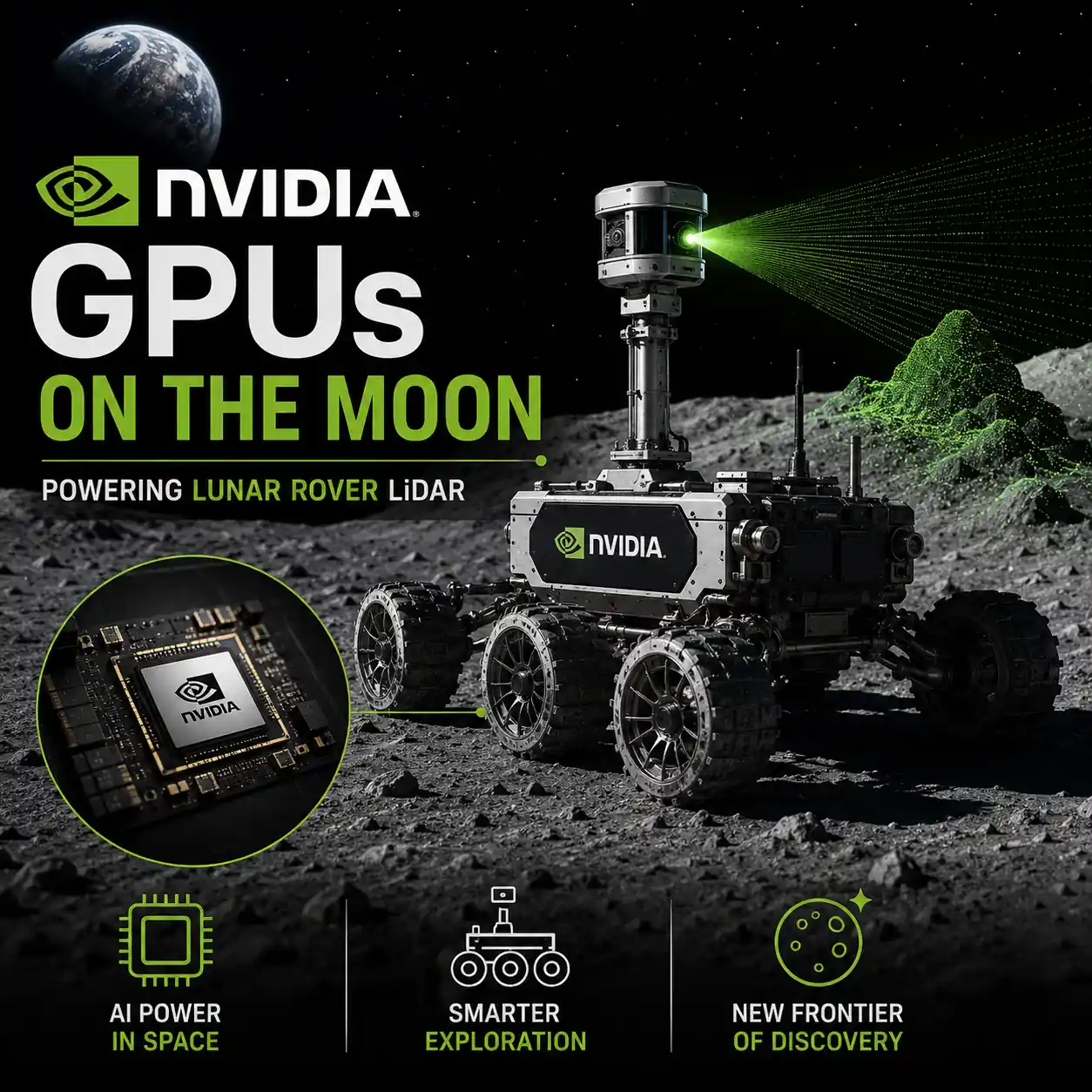
Nvidia Sends GPUs to the Moon
Nvidia's Lunar Ambitions
Nvidia's effort to deploy its GPUs in extreme environments has reached new heights, literally. The company's Jetson chips will be used to control the lidar system on a lunar rover built by Lunar Outpost, a startup focused on space infrastructure. This mission marks the first time a GPU will be used on the lunar surface, paving the way for more advanced AI and robotics applications in space exploration.
The lunar rover is part of a larger initiative by NASA to explore the lunar surface ahead of plans to return human astronauts to the moon by 2028. Private companies like Lunar Outpost and Intuitive Machines are developing vehicles that can carry scientific sensors to the moon, with the goal of understanding the terrain and searching for resources like water that could be exploited in the future.
✦✦✦
The Challenges of Space-Based Computing
Using GPUs in space is a complex task due to the extreme environment. Most space-faring GPUs are used in orbit around the Earth, where they are protected from radiation and temperature fluctuations. The moon, however, is directly exposed to cosmic radiation and experiences dramatic temperature changes, making it a challenging environment for electronic devices to operate in.
To overcome these challenges, Nvidia's Jetson platform is designed to be compact and power-efficient, allowing it to process sensor inputs locally and react to the environment in real-time. The platform's autonomy stack combines deterministic and physical AI, enabling the lunar rover to navigate and explore the lunar surface with greater precision and accuracy.
The use of GPUs in space exploration also raises important questions about the environmental impact of these devices. As the demand for AI and robotics in space grows, so does the need for more powerful and efficient computing systems. However, the production and disposal of these devices can have significant environmental consequences, from the mining of raw materials to the generation of e-waste.
Despite these challenges, the potential benefits of using GPUs in space exploration are significant. From enabling more advanced scientific research to supporting the development of new technologies, the use of AI and robotics in space has the potential to drive innovation and discovery in a wide range of fields.
✦✦✦
The Future of Space-Based Computing
As Nvidia's GPUs head to the moon, the company is also partnering with other organizations to develop new technologies and applications for space exploration. From satellites to lunar rovers, the use of AI and robotics in space is becoming increasingly important, and Nvidia's Jetson platform is at the forefront of this trend.
The future of space-based computing will likely involve the development of even more powerful and efficient computing systems, as well as new technologies and applications that can support the growing demand for AI and robotics in space. As companies like Nvidia continue to push the boundaries of what is possible in space exploration, we can expect to see significant advances in our understanding of the universe and our place within it.
shareShare this post
recommendYou may also like
BUSINESSTECHNOLOGYMicrosoft Ignite 2026: Satya Nadella Puts AI Agents, Copilot and Enterprise Cloud at the Centre of Microsoft's Next Technology RevolutionFlipFileZone · Read Fullopen_in_new BUSINESSTECHNOLOGYChina Uses American AI Models to Train Domestic Rivals as US Chip Restrictions Intensify the Global Artificial Intelligence RaceFlipFileZone · Read Fullopen_in_new
 BUSINESSTECHNOLOGYNvidia Leadership Turmoil Raises Concerns Over AI Industry Financing as Investors Rethink the Future of the AI BoomFlipFileZone · Read Fullopen_in_new
 TECHNOLOGYGovernor Gulab Chand Kataria launches Shaheed Bhagat Singh Youth Facilitation Centre in LudhianaFlipFileZone · Read Fullopen_in_new
 TECHNOLOGYInstinct AI Assistant Secures $350M Funding, Hits $2.5B Valuation in Record TimeFlipFileZone · Read Fullopen_in_new
 TECHNOLOGYXiaomi Unveils Xring Chip with TSMC Partnership, Redefining Its Global Hardware StrategyFlipFileZone · Read Fullopen_in_new
 TECHNOLOGYApple’s AI‑Powered Camera AirPods Could Launch in 2026, Not 2027FlipFileZone · Read Fullopen_in_new
chatPost a comment
Comments
0