 BUSINESSTECHNOLOGYMicrosoft Ignite 2026: Satya Nadella Puts AI Agents, Copilot and Enterprise Cloud at the Centre of Microsoft's Next Technology RevolutionFlipFileZone · Read Fullopen_in_new
The AI Cold War Intensifies: How the Trump–Xi Summit Turned AI Chips Into the World’s Most Powerful Weapon
The May 2026 Trump–Xi summit exposed how AI chips, semiconductor restrictions, cybersecurity, and computing infrastructure are reshaping global power and the future of artificial intelligence.
FlipFileZone · TECHNOLOGY
shareShare this post






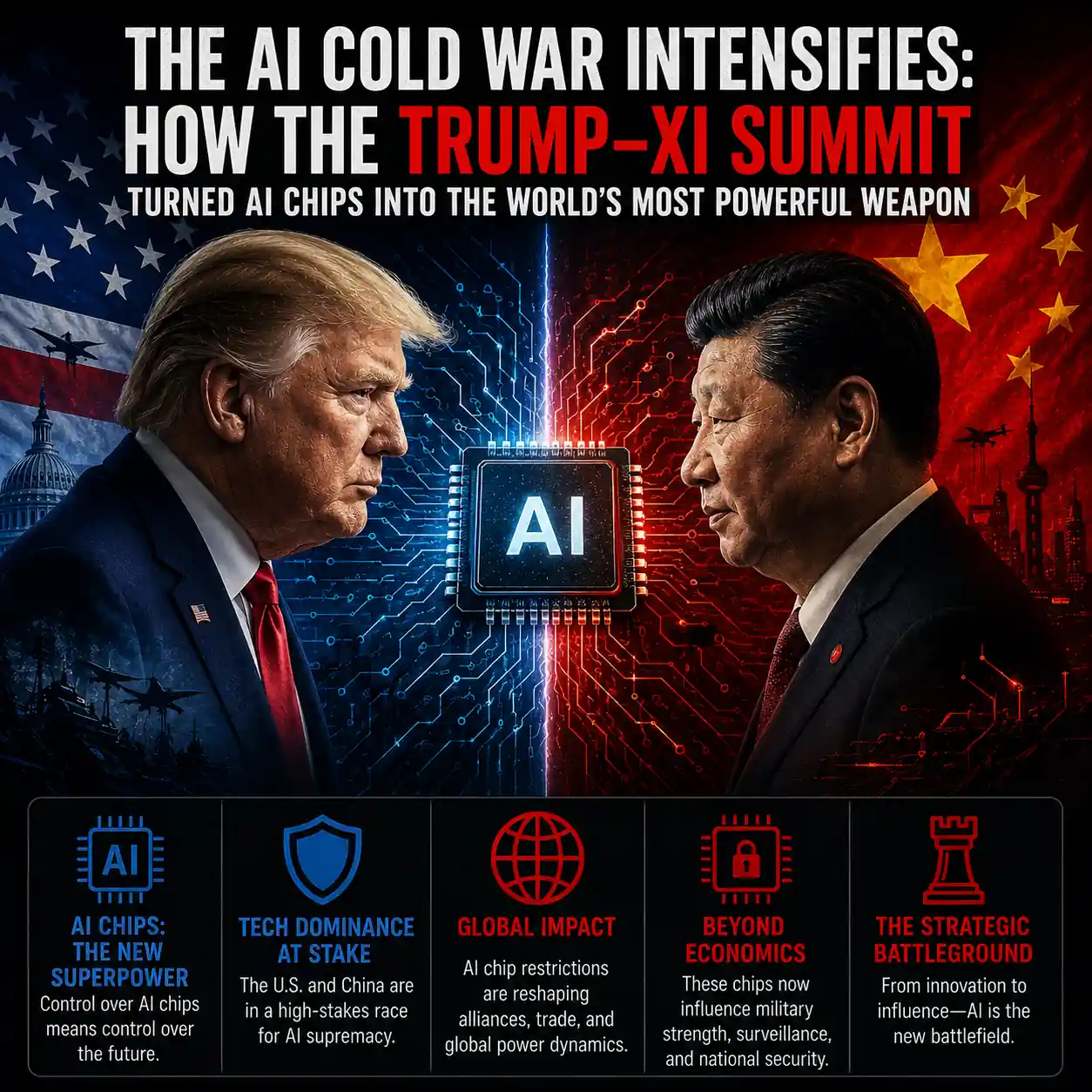
The AI Cold War Intensifies: How the Trump–Xi Summit Turned AI Chips Into the World’s Most Powerful Weapon
The AI Cold War Intensifies
The global artificial intelligence race entered a new and more dangerous phase on May 13, 2026, as the summit between U.S. President Donald Trump and Chinese President Xi Jinping placed AI chips, semiconductor restrictions, cybersecurity, and technological dominance at the center of international politics.
Artificial intelligence is no longer just a technology industry trend. Governments increasingly see advanced AI systems as strategic assets comparable to nuclear technology, oil reserves, and military infrastructure. The world’s leading economies are now competing to secure semiconductor supply chains, restrict rival access to advanced GPUs, strengthen cybersecurity capabilities, and establish international AI rules before their competitors do.
At the center of this technological power struggle are AI chips. These highly specialized processors are the engines behind modern artificial intelligence systems. Whether training frontier AI models, running generative AI applications, processing large-scale analytics, or supporting military simulations, advanced chips have become the foundation of national AI capability.
Without access to cutting-edge semiconductors, even the most talented AI researchers face enormous limitations. That reality explains why chip restrictions have become one of the most powerful geopolitical tools of the modern era.
Why AI Chips Matter
Artificial intelligence systems depend heavily on computational power. Modern frontier AI models require enormous quantities of GPUs and AI accelerators capable of processing massive datasets at incredible speeds. Companies such as Nvidia, AMD, Intel, and Qualcomm now sit at the center of a global race for technological dominance.
Training state-of-the-art AI systems requires enormous data centers filled with high-performance chips. These systems consume huge amounts of electricity, cooling infrastructure, networking bandwidth, and semiconductor resources.
As AI capabilities continue to improve, governments increasingly believe that controlling access to advanced chips could determine which countries dominate future industries such as robotics, autonomous systems, defense technologies, biotech research, cyber warfare, and financial infrastructure.
This explains why semiconductor export controls have become one of the most aggressive policy tools in the ongoing U.S.–China technology conflict.
The United States has gradually expanded restrictions on advanced chip exports to China, particularly targeting AI accelerators that could be used for military or strategic purposes. These controls have impacted shipments of high-end GPUs and semiconductor manufacturing equipment while also limiting China’s access to advanced lithography systems.
China has responded by heavily investing in domestic chip production, AI infrastructure, and alternative supply chain partnerships. Chinese firms are attempting to reduce dependence on U.S.-designed semiconductors while building local AI ecosystems capable of competing globally.
The Trump–Xi Summit
The May 2026 summit highlighted how deeply AI competition now influences diplomatic relations between the world’s two largest economies.
Reports surrounding the summit indicated that artificial intelligence, export controls, cybersecurity, and semiconductor access were among the most sensitive discussion topics. Analysts described the negotiations as part economic diplomacy and part strategic containment effort.
The summit also revealed growing concerns among policymakers about the risks associated with increasingly powerful AI systems. Governments are not only racing to dominate AI development but also attempting to prevent catastrophic misuse.
The United States views AI leadership as essential for maintaining technological and military superiority. Washington argues that unrestricted Chinese access to advanced chips could accelerate military modernization programs and strengthen offensive cyber operations.
China, meanwhile, sees U.S. export controls as an attempt to suppress Chinese technological growth and maintain Western dominance over critical digital infrastructure.
This mutual distrust has transformed the AI race into something resembling a technological Cold War.
Cybersecurity and AI
Recent developments in powerful AI models have intensified fears that highly capable systems could identify software vulnerabilities, automate cyberattacks, manipulate information ecosystems, or accelerate digital espionage campaigns.
Security researchers increasingly warn that future AI systems may dramatically lower the barrier for sophisticated cyber operations. Tasks that once required highly specialized human expertise could eventually become partially automated.
Modern cybersecurity already struggles to keep pace with evolving threats. AI-powered systems capable of autonomously identifying vulnerabilities, writing exploit code, conducting phishing campaigns, or coordinating attacks across infrastructure networks could fundamentally reshape cyber warfare.
While AI also offers enormous defensive benefits for cybersecurity teams, the dual-use nature of these technologies creates major geopolitical tensions. Every breakthrough in AI capability potentially strengthens both defensive and offensive digital operations.
Semiconductors: The New Oil
For decades, oil shaped global geopolitics. In the AI era, semiconductors are rapidly becoming the equivalent strategic resource.
Advanced chips now power nearly every major digital system, including smartphones, cloud infrastructure, defense technologies, industrial robotics, autonomous vehicles, healthcare systems, and financial networks.
The country controlling the most advanced semiconductor supply chains gains influence over the future of AI development itself.
This explains why nations are investing billions into domestic chip manufacturing initiatives. Governments increasingly want local production capacity for advanced semiconductors to reduce dependence on foreign suppliers.
The semiconductor ecosystem is extraordinarily complex. Chip design, fabrication, packaging, software tooling, rare-earth minerals, and manufacturing equipment all depend on interconnected global supply chains.
Any disruption involving Taiwan, export controls, cyberattacks, or supply chain bottlenecks could impact global AI development.
Nvidia and the AI Boom
No company better represents the AI chip revolution than Nvidia.
Originally known for gaming graphics cards, Nvidia transformed into one of the world’s most strategically important technology companies as AI demand exploded. Its GPUs became essential for training and deploying advanced AI systems.
The company’s influence now extends far beyond Silicon Valley. Governments, hyperscalers, defense contractors, and research institutions all depend heavily on high-performance Nvidia chips for AI workloads.
This strategic importance has placed Nvidia directly in the middle of U.S.–China tensions.
Export restrictions targeting advanced AI chips have significantly affected Nvidia’s China business. The company has repeatedly faced pressure to comply with evolving export regulations while also maintaining relationships with international customers.
Meanwhile, investors continue pouring money into AI infrastructure companies. Semiconductor stocks experienced renewed momentum during the summit period as markets reacted to growing expectations for long-term AI spending.
The Future of AI Geopolitics
The May 2026 summit may ultimately be remembered as a defining moment in the global AI power struggle.
Artificial intelligence is no longer simply a commercial technology trend. It has become a foundational element of national power, economic competitiveness, cybersecurity strategy, and military capability.
The race for AI dominance increasingly revolves around infrastructure rather than applications alone. Chips, energy systems, cloud computing, cybersecurity, and semiconductor manufacturing now shape the balance of technological power.
The United States and China are deeply interconnected economically, yet increasingly divided strategically. Both nations rely on global technology ecosystems while also attempting to secure national advantages.
This creates a fragile environment where technology policy, trade restrictions, cybersecurity incidents, and AI breakthroughs can quickly influence global markets and diplomatic relations.
The semiconductor battle is likely only beginning. Future conflicts may involve AI compute access, cloud infrastructure restrictions, quantum computing development, autonomous defense systems, and AI-driven cyber operations.
Technology firms want access to global markets, but governments increasingly expect alignment with national strategic priorities. This tension will continue shaping the technology industry for years to come.
Conclusion
The Trump–Xi summit demonstrated that artificial intelligence has officially become one of the central geopolitical battlegrounds of the 21st century.
Semiconductors are now strategic assets. AI chips are becoming instruments of global influence. Cybersecurity is evolving into a machine-speed battlefield. And governments increasingly view technological leadership as essential for national survival.
The competition between the United States and China is no longer limited to trade disputes or manufacturing output. It is now fundamentally about who controls the computational infrastructure powering the future world economy.
As AI systems grow more powerful, the stakes will only increase.
One thing is already clear: the AI Cold War is no longer a theory. It is happening in real time.
shareShare this post
recommendYou may also like
BUSINESSTECHNOLOGYMicrosoft Ignite 2026: Satya Nadella Puts AI Agents, Copilot and Enterprise Cloud at the Centre of Microsoft's Next Technology RevolutionFlipFileZone · Read Fullopen_in_new BUSINESSTECHNOLOGYChina Uses American AI Models to Train Domestic Rivals as US Chip Restrictions Intensify the Global Artificial Intelligence RaceFlipFileZone · Read Fullopen_in_new
 BUSINESSTECHNOLOGYNvidia Leadership Turmoil Raises Concerns Over AI Industry Financing as Investors Rethink the Future of the AI BoomFlipFileZone · Read Fullopen_in_new
 TECHNOLOGYGovernor Gulab Chand Kataria launches Shaheed Bhagat Singh Youth Facilitation Centre in LudhianaFlipFileZone · Read Fullopen_in_new
 TECHNOLOGYInstinct AI Assistant Secures $350M Funding, Hits $2.5B Valuation in Record TimeFlipFileZone · Read Fullopen_in_new
 TECHNOLOGYXiaomi Unveils Xring Chip with TSMC Partnership, Redefining Its Global Hardware StrategyFlipFileZone · Read Fullopen_in_new
 TECHNOLOGYApple’s AI‑Powered Camera AirPods Could Launch in 2026, Not 2027FlipFileZone · Read Fullopen_in_new
chatPost a comment
Comments
0