 TECH GUIDESConvert XLS to XLSX Online Free — Upgrade Old Excel Files in SecondsFlipFileZone · Read Fullopen_in_new
The Never-Ending Debates Among Computer Programmers
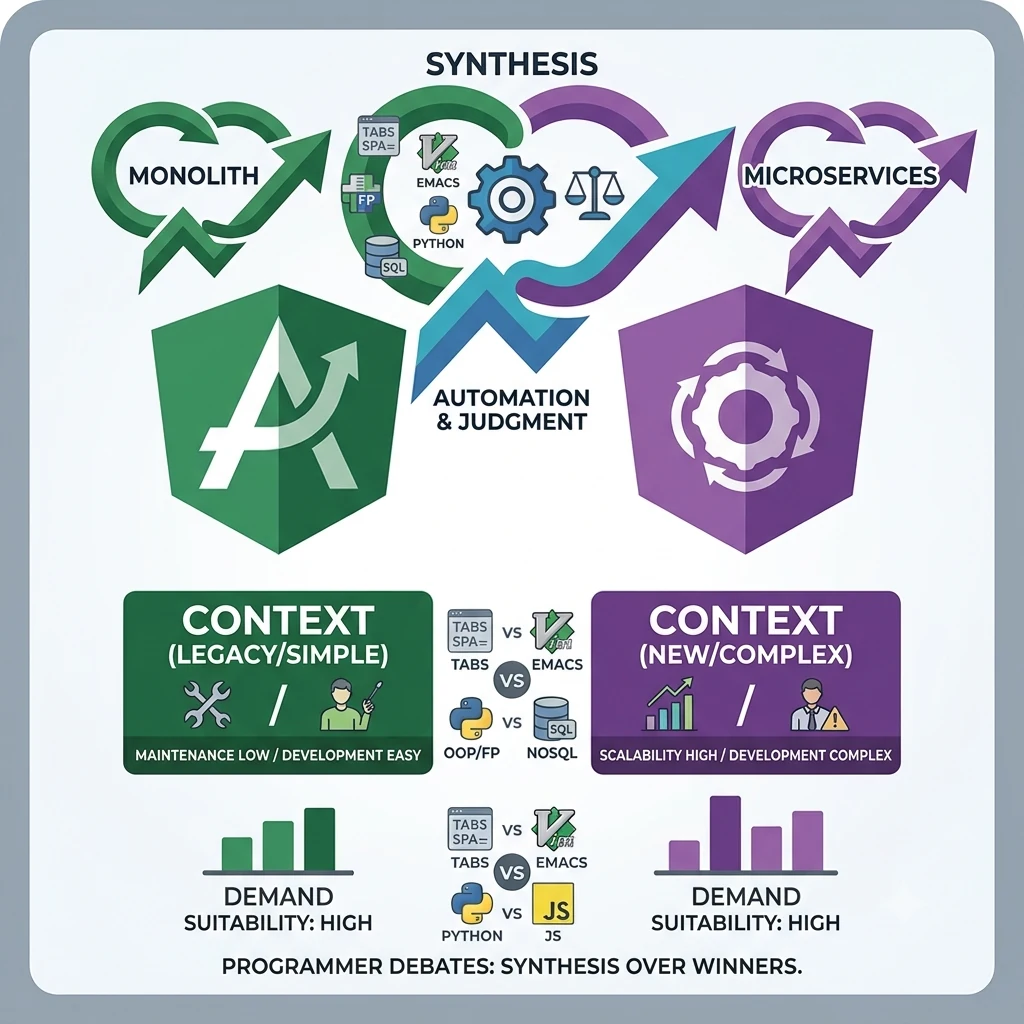
Programmer debates — tabs vs spaces, Vim vs Emacs, OOP vs FP, SQL vs NoSQL, monoliths vs microservices — rarely resolve through winners; most settle via synthesis, automation, or context-dependent judgment.
FlipFileZone · TECH GUIDES
shareShare this post


The Never-Ending Debates Among Computer Programmers
Every professional field has its sacred controversies — arguments that resurface reliably, generate disproportionate heat relative to their importance, and never seem to reach a definitive resolution no matter how many times they are relitigated. Medicine has debates over treatment protocols. Economics has debates over fiscal policy. Computer programming has all of those, plus a remarkable number of arguments about where to put curly braces. What distinguishes programming debates from those in most other fields is a combination of factors that makes them particularly durable: the problems are often genuinely hard with no objectively correct answer, the participants have strong personal investment in the tools they've spent years mastering, and the internet has given every opinion an infinite, permanent, searchable audience. This article surveys the most persistent, most passionately argued, and — in many cases — most genuinely interesting debates in the programming world, examines what each side actually argues, and explains why these debates remain unresolved decades after they began.
1. Tabs vs. Spaces
There is no more reliably mocked debate in programming than the question of whether source code should be indented with tab characters or with sequences of space characters. The fact that this debate appears on this list alongside genuinely deep technical arguments about language design and software architecture says something real about programming culture: when a debate is old enough and heated enough, it achieves a kind of cultural permanence regardless of its actual significance.
The core arguments are straightforward. Tab advocates argue that a tab character is semantically correct — it represents "one level of indentation," and developers can configure their editor to render it at any visual width they prefer (2 columns, 4 columns, 8 columns), making tabs more flexible and accessible in a meaningful sense: developers with visual impairments or specific reading preferences can adjust their display without touching the source file itself. Space advocates argue that spaces guarantee visual consistency across every editor, every tool, and every context — what you commit to version control is exactly what every reviewer sees, with no ambiguity about rendering.
The debate acquired a famous cultural moment in the HBO series Silicon Valley, where a character's preference for spaces over tabs was played as a relationship dealbreaker, but it has real engineering implications. Python resolves it by requiring consistent indentation (and forbidding mixed tabs and spaces within a file since Python 3) without mandating which you use. Google's style guides mandate spaces for most languages. The Go programming language, designed by Ken Thompson and Rob Pike among others and documented at go.dev, sidesteps the debate entirely by enforcing the gofmt formatter, which automatically reformats all Go code to a single canonical style — tabs, as it happens — removing the choice from individual developers altogether. This "auto-formatter as arbiter" approach, which has since been adopted by Rust (rustfmt), JavaScript (Prettier), and Python (Black), represents the most intellectually honest resolution to this class of debate: acknowledge that consistency matters more than which convention is chosen, and enforce consistency automatically rather than arguing about it forever.
2. Vim vs. Emacs
The "editor war" between Vim and Emacs is possibly the oldest ongoing debate in all of computing still actively prosecuted in 2026. Vim traces its lineage to vi, written by Bill Joy in 1976 for Unix systems. Emacs, written by Richard Stallman, dates to 1976 as well, with GNU Emacs arriving in 1984. Both are free, open-source, highly configurable, terminal-capable text editors with enormous, devoted user bases who have spent years building muscle memory, custom configurations, and plugin ecosystems around their preferred tool.
The philosophical difference is real and interesting. Vim is a modal editor: it has distinct modes for inserting text, navigating, selecting, and issuing commands, allowing experienced users to perform complex text manipulations without their hands leaving the keyboard's home row, using a composable grammar of commands (operators, motions, and text objects) that can be combined in powerful ways. Emacs is a modeless editor (in Vim's sense) that is more accurately described as a Lisp runtime with a text editor built on top of it — extensible to a degree that has led to jokes about Emacs being an operating system that happens to include a text editor. Emacs users have built email clients, web browsers, IRC clients, calendar applications, and even games inside Emacs, all configured in Emacs Lisp.
The debate has evolved over time. Both Vim and Emacs now have younger spiritual successors — Neovim (neovim.io) has modernized Vim's codebase with Lua scripting and LSP (Language Server Protocol) support, while Emacs has gained Tree-sitter integration and improved performance. Meanwhile, VS Code — which is neither Vim nor Emacs — has captured the majority of the developer market (55.6% of developers used VS Code according to the 2024 Stack Overflow Developer Survey), while simultaneously validating both sides of the debate by shipping first-class Vim keybinding emulation via the VSCodeVim extension and Emacs keybinding support via the "Awesome Emacs Keymap" extension. The modal editing model in particular has proven so compelling that virtually every major editor and IDE now ships Vim keybinding support, a quiet acknowledgment that Vim won at least one dimension of the debate.
3. Static vs. Dynamic Typing
This is arguably the most substantive recurring debate in programming language design, with real engineering consequences that vary significantly depending on the type of software being built. The question is whether a programming language should require that every variable's type (integer, string, list of floats, and so on) be known and checked at compile time (static typing), or whether types should be determined at runtime without requiring explicit declarations (dynamic typing).
The static typing camp, represented by languages like Java, C++, Rust, Go, TypeScript, and Kotlin, argues that catching type errors at compile time eliminates an entire class of production bugs before code ever runs, enables better IDE tooling (accurate autocomplete, immediate error highlighting, confident refactoring), and produces code that is easier to maintain at scale because the types themselves serve as machine-checked documentation of a function's contract with its callers. Bjarne Stroustrup's extensive writing on C++ design philosophy, available at stroustrup.com, articulates the case for strong static typing in systems software particularly well.
The dynamic typing camp, represented by Python, JavaScript, Ruby, and Lisp, argues that static types add verbosity and ceremony that slows development speed, that many real-world programs don't need the guarantees static typing provides because their logic is inherently data-driven and flexible, and that well-written tests catch type-related bugs just as effectively as a type checker while also catching logical errors that no type system can detect. Paul Graham, a Lisp advocate and essayist whose writings are collected at paulgraham.com, argues forcefully that expressive dynamic languages allow faster prototyping and more concise programs, which matters when competitive speed is the primary constraint.
The most revealing development in this debate over the past decade has been TypeScript's adoption: a statically-typed superset of JavaScript that has achieved near-universal adoption in professional JavaScript development, including being the default in frameworks like Angular and increasingly React, despite — or perhaps because of — JavaScript being the most widely deployed dynamic language in existence. This market outcome suggests that, at scale and under team development conditions, the practical advantages of static typing are sufficiently large that developers who initially chose a dynamic language often retrofit type checking onto it. Python's adoption of type hints (gradually, since Python 3.5) tells the same story. The debate isn't fully resolved — Python and JavaScript without types remain entirely valid and widely used — but the industry's drift toward static checking in large codebases is fairly clear.
4. Object-Oriented Programming vs. Functional Programming
Arguably the deepest philosophical divide in programming paradigms, the tension between object-oriented programming (OOP) and functional programming (FP) has produced more books, conference talks, and blog posts than almost any other topic in software engineering. OOP, popularized by Smalltalk, Java, and C++, organizes programs around objects that bundle data and behavior together, model real-world entities, and communicate through method calls. FP, with roots in the lambda calculus and languages like Lisp, Haskell, and ML, organizes programs around pure functions (functions without side effects, where the same input always produces the same output), immutable data, and function composition.
The OOP critique of FP argues that the real world is fundamentally stateful — bank accounts have balances that change, users log in and out, devices send and receive events — and that modeling this reality through immutable data transformations requires contorted workarounds (monads, for instance, which are both a brilliantly elegant mathematical structure and a famously confusing concept for programmers encountering them for the first time). The FP critique of OOP is equally pointed: object-oriented code, by bundling mutable state inside objects and passing it around through method calls, makes programs extraordinarily difficult to reason about, test, and parallelize safely, because the behavior of any method call may depend on the entire history of mutations to the object's internal state. Famous computer scientist Joe Armstrong, the creator of Erlang, once quipped that the problem with object-oriented languages is that they take all the data and smear it around everywhere.
What makes this debate particularly interesting in 2026 is that the most popular languages in industry have converged on taking both paradigms seriously rather than picking one. Python has first-class functions, list comprehensions, and functools tools borrowed from FP, alongside class-based OOP. JavaScript has closures, higher-order functions (.map, .filter, .reduce), and immutable patterns popularized by React's state model, alongside prototype-based OOP. Scala, Kotlin, and Swift all explicitly embrace both paradigms and let the programmer choose which is appropriate for each problem. Rust's type system is influenced heavily by ML-family functional languages while its ownership model comes from systems programming. Even Java, the quintessential OOP language, has added lambdas, streams, records, and pattern matching in recent versions. The practical resolution, visible in how modern codebases actually look, is not a victory for either side but a synthesis: use objects to model entities with identity and lifecycle, use functions and immutability to model transformations and business logic, and use whichever style makes the code clearest in context.
5. SQL vs. NoSQL
Few technology debates have more directly cost companies millions of dollars in engineering time and infrastructure migration costs than the SQL versus NoSQL controversy of the 2010s, and the argument has still not fully settled. The debate was ignited by the internet-scale data problems of companies like Google, Amazon, and Facebook, which found that traditional relational databases struggled to handle their read/write volumes and sharding requirements, and published influential papers (Google's Bigtable in 2006, Amazon's Dynamo in 2007) describing alternative, non-relational storage systems that traded some of relational databases' guarantees (particularly ACID transactions and complex join queries) for dramatically better horizontal scalability.
A wave of NoSQL databases followed — MongoDB for document storage, Cassandra for wide-column storage, Redis for key-value caching, Neo4j for graph data — and there was a period in the early 2010s when the conventional wisdom in many startup circles was that SQL databases were the past and NoSQL was the future. This turned out to be substantially overstated. Many companies that migrated to NoSQL databases during this period found that the strong consistency guarantees and mature query expressiveness of relational databases were things they badly missed — especially as their applications grew in complexity and the cost of application-level join operations and consistency enforcement became apparent. The influential database researcher Martin Kleppmann documents this cycle with unusual clarity in Designing Data-Intensive Applications, noting that many organizations eventually migrate back toward relational databases or toward hybrid solutions, once the pain of enforcing data integrity at the application layer exceeds the pain of database scalability challenges that proper indexing and read replicas can often address.
The contemporary resolution is less a debate victory and more a specialization: relational databases (PostgreSQL in particular has become the dominant choice for new projects) handle the majority of structured data needs, while NoSQL solutions serve specific use cases where their design genuinely fits the access patterns — Redis for caching and session storage, Elasticsearch for full-text search, Cassandra for extremely high write throughput at the cost of consistency, MongoDB for document storage where schema flexibility genuinely matters. The PostgreSQL documentation is an extraordinary resource that also illustrates how much modern relational databases have absorbed from the NoSQL movement — PostgreSQL supports JSON document storage, full-text search, and horizontal scaling patterns that were historically only available in dedicated NoSQL systems.
6. Monolith vs. Microservices
The debate over whether a backend application should be built as a single, unified codebase (a monolith) or as a collection of small, independently deployable services (microservices) has consumed enormous amounts of engineering energy in the past decade and shows no sign of resolution, primarily because the right answer genuinely depends on the scale, team size, and maturity of each specific organization — which the debate's loudest advocates tend to elide.
The microservices case, articulated most influentially by Martin Fowler (whose writing on software architecture at martinfowler.com remains essential reading) is that decomposing a large application into small, independently deployable services allows different teams to develop, deploy, and scale their services independently, reduces the blast radius of a bug or deployment failure, allows different services to use the technology best suited to each problem, and prevents the codebase from growing into an unmanageable "big ball of mud" monolith where every change has unpredictable ripple effects. Netflix, Amazon, and Uber are often cited as examples of companies that built large-scale microservices architectures successfully.
The monolith case is argued with equal force by engineers who have experienced the operational complexity of microservices at inappropriate scale. A distributed system — which is what microservices create — introduces network latency between service calls that were previously in-process function calls, requires sophisticated service discovery, load balancing, distributed tracing, and circuit-breaking infrastructure, makes debugging much harder (a bug that causes one service to return incorrect data to another may produce an error that surfaces in a third service with no obvious connection), and creates a distributed transactions problem that is genuinely, mathematically hard: maintaining consistency across multiple independently deployed services with no shared transaction coordinator. The term "distributed monolith" has emerged to describe the worst of both worlds: a system decomposed into nominally independent services that are nonetheless tightly coupled through shared databases or synchronous HTTP chains, with all of a monolith's coordination costs and none of its simplicity.
The most honest guidance, from engineers who have navigated both, is: start with a well-structured monolith, extract services only when a specific team ownership or scaling problem makes it clearly worthwhile, and resist the architectural fashion cycle that makes microservices feel mandatory for serious engineering regardless of actual organizational context. This is advice that both Martin Fowler and DHH (creator of Ruby on Rails, writing at dhh.dk) have articulated, from different stylistic angles but arriving at the same practical conclusion.
7. TDD (Test-Driven Development) vs. Writing Tests After
Test-Driven Development — the practice of writing a failing test before writing the implementation code that makes it pass — has been a subject of fierce debate since Kent Beck systematized it in his 2002 book Test Driven Development: By Example. Advocates argue that writing the test first forces the developer to specify precisely what the code should do before thinking about how to implement it (a discipline that tends to produce better-designed, more modular interfaces), creates a safety net that catches regressions immediately, and produces a suite of tests that genuinely specify behavior rather than simply verifying implementation details. The TDD discipline is central to Extreme Programming (XP) and is described in detail at agilealliance.org.
Critics of strict TDD argue that writing tests before code only works smoothly when you already know what the API should look like, which is frequently not the case when exploring a genuinely novel problem or when working at the boundaries of a poorly understood domain; that the discipline of TDD-first produces tests that are tightly coupled to implementation details (because both the test and the implementation emerge from the same design session), making them brittle in the face of refactoring; and that well-written tests written after a working implementation can be more useful, because the implementation's actual shape informs what tests are meaningful versus what tests are merely checking internal wiring.
The most prominent critic of TDD in its strict form is DHH, who published a widely read 2014 essay titled "TDD is Dead. Long Live Testing" arguing that zealous TDD practice had led Rails developers to build artificially indirect, test-optimized architectures that obscured rather than clarified intent. Kent Beck responded at length, and David Hansson, Martin Fowler, and Beck held a series of public Google Hangouts titled "Is TDD Dead?" that remain instructive listening. The debate generated more heat than resolution, and in practice most professional developers have landed on a pragmatic middle ground: test-first when the design is clear and the behavior is precisely specified, test-after when exploring, and always maintain a comprehensive test suite regardless of when individual tests were written.
8. REST vs. GraphQL vs. gRPC
How services should communicate with each other — specifically, what style of API they should expose — has become a defining architectural debate of the cloud services era. REST (Representational State Transfer), which structures APIs around resources represented by URLs and HTTP verbs (GET, POST, PUT, DELETE), became the dominant API style in the 2000s and early 2010s and remains by far the most widely used approach. GraphQL, developed internally at Facebook and open-sourced in 2015 (documented at graphql.org), allows API clients to specify exactly what data fields they need in a single query, eliminating the "over-fetching" (receiving more data than needed) and "under-fetching" (needing multiple requests to get related data) problems endemic to naive REST API designs. gRPC, developed at Google and documented at grpc.io, uses Protocol Buffers as a schema definition language, generates client and server code automatically, and is optimized for high-performance, strongly-typed service-to-service communication.
REST advocates argue that its simplicity, universality, and alignment with HTTP semantics make it the right default for nearly all public-facing APIs, that caching and CDN infrastructure is built around HTTP's model, and that GraphQL's flexibility comes with real costs: complex query parsing on the server, the N+1 query problem when resolving nested objects naively, and security concerns around clients issuing arbitrarily expensive queries. GraphQL advocates argue that its client-specified queries are transformative for frontend development — a mobile app can request exactly the fields it needs for a given screen without coordinating with a backend team to create a specialized endpoint — and that the strong schema provides automatic API documentation and type safety. gRPC advocates note that its binary serialization is dramatically more efficient than JSON over REST for internal service-to-service communication, and that its code generation eliminates the class of bugs that arise from manually keeping client and server in sync.
In practice, many organizations use all three: REST for public APIs consumed by third parties, GraphQL for APIs consumed by their own frontends, and gRPC for internal service-to-service communication. The debate rarely produces a winner in context — it tends to produce a more precise question: what is this specific API for, who will consume it, and what are the primary constraints?
9. Spaces Around Equals Signs, One True Brace Style, and the Galaxy of Formatting Debates
It would be incomplete to discuss programmer debates without acknowledging the enormous subgroup of controversies that are fundamentally trivial but generate intense partisanship: whether opening curly braces belong on the same line as the control structure (if (condition) {) or on their own line (if (condition)\n{); whether there should be a space before a function call's parenthesis; whether lines should be limited to 80 characters (the historical default of a terminal screen) or 120 characters (more comfortable on modern wide monitors) or unlimited. These debates are collectively known under the umbrella of "code style" and have generated entire style guides, linting tools, and more than a few broken working relationships.
The interesting observation here is that the technical content of these debates is almost entirely irrelevant to their actual source of intensity, which is that style choices made early in a project become load-bearing conventions that every developer on the team must adopt or fight against, and that human beings are remarkably resistant to changing muscle memory once it's established. An experienced programmer who has spent five years pressing { at the end of a line will feel genuine visceral discomfort when forced to put it on the next line, not because the latter is wrong but because the former has become automatic. This is why the "just pick one and enforce it automatically with a formatter" solution adopted by Go, Rust, and increasingly JavaScript (via Prettier) and Python (via Black) is so practically valuable: it removes style from the domain of human preference by making it a technical decision with a single enforced answer.
10. The "Real Programmer" Gatekeeping Debate
Finally, and perhaps most corrosively in terms of its effect on the programming community, there is the recurring debate about what constitutes a "real" programmer: whether web developers are "real" programmers, whether people who use frameworks rather than building from scratch are "real" engineers, whether someone who primarily codes in Python without understanding pointers can meaningfully call themselves a programmer, whether someone who came to programming through a coding bootcamp rather than a four-year computer science degree deserves the same professional respect as a university graduate.
This debate is distinct from all the others on this list because it has no technical content whatsoever — it is purely about identity, belonging, and the human tendency to use expertise as a social hierarchy marker. The history of the field offers a useful corrective: COBOL programmers once looked down on BASIC programmers, C programmers once looked down on Java programmers as not understanding memory, Java programmers once looked down on Python developers, and Python developers look down on no-code tools. Every generation of programmers is the "real" generation, and every subsequent wave of tools that makes programming more accessible is derided by the previous wave as insufficiently rigorous, until those tools become normalized. This pattern is documented with particular clarity in Paul Graham's essays on the subject of programming languages and accessibility.
The practical issue is that this gatekeeping actively harms the field by discouraging people who could contribute meaningfully from pursuing programming, creating hostile community environments that drive away exactly the diverse perspectives that produce more robust software, and consuming energy that could be directed at the genuinely hard technical problems outlined throughout this article.
What Endures and What It Means
Looking across these ten debates, a pattern emerges: the ones with the most technical substance (OOP vs. FP, static vs. dynamic typing, SQL vs. NoSQL) have tended to resolve not through one side winning but through modern languages and systems absorbing the best insights from both and allowing practitioners to choose contextually. The ones with the least technical substance (tabs vs. spaces, formatting style) have tended to resolve through automation — formatters that eliminate the choice entirely. And the ones rooted in human social dynamics (the "real programmer" gatekeeping) remain as unresolved and as harmful as ever, because they were never technical debates in the first place.
The most useful posture toward programming debates, for a working engineer or a student, is neither to ignore them nor to be captured by them. Understanding what each side actually argues — not a caricature of it — and developing the judgment to see when those arguments apply to your specific context and when they don't, is exactly the kind of engineering wisdom that no tutorial or documentation page teaches directly but that accumulates from years of encountering real tradeoffs in real systems.
Further Reading
- Martin Fowler's software architecture essays — martinfowler.com
- Paul Graham's essays on programming and languages — paulgraham.com
- The Go programming language and gofmt — go.dev
- Prettier — the opinionated code formatter for JavaScript
- GraphQL official documentation — graphql.org
- gRPC documentation — grpc.io
- PostgreSQL documentation — postgresql.org
- Neovim — the modern Vim successor — neovim.io
- Agile Alliance on TDD — agilealliance.org
- Designing Data-Intensive Applications — Martin Kleppmann
shareShare this post
recommendYou may also like
TECH GUIDESConvert XLS to XLSX Online Free — Upgrade Old Excel Files in SecondsFlipFileZone · Read Fullopen_in_new TECH GUIDESConvert PNG to ICO Online Free — Create Favicons and Windows Icons in SecondsFlipFileZone · Read Fullopen_in_new
 TECH GUIDESConvert Markdown to PDF Online Free — Turn .md Files Into PDF in SecondsFlipFileZone · Read Fullopen_in_new
 TECH GUIDESConvert SVG to PNG Online Free — Export Vector Graphics as Images in SecondsFlipFileZone · Read Fullopen_in_new
 TECH GUIDESConvert GIF to MP4 Online Free — Turn Animated GIFs Into Video in SecondsFlipFileZone · Read Fullopen_in_new
 TECH GUIDESConvert WAV to MP3 Online Free — Compress Audio Files in SecondsFlipFileZone · Read Fullopen_in_new
 TECH GUIDESConvert MOV to MP4 Online Free — Convert iPhone Videos in SecondsFlipFileZone · Read Fullopen_in_new
chatPost a comment
Comments
0