 TECH GUIDESConvert XLS to XLSX Online Free — Upgrade Old Excel Files in SecondsFlipFileZone · Read Fullopen_in_new
What Makes Python So Popular in Data Science Compared to Java's Verbose Nature?
Python dominates data science through readable syntax, NumPy/pandas/PyTorch ecosystem, Jupyter notebooks, and academic adoption. Java's verbosity and fragmented libraries create friction incompatible with iterative, exploratory scientific workflows.
FlipFileZone · TECH GUIDES
shareShare this post


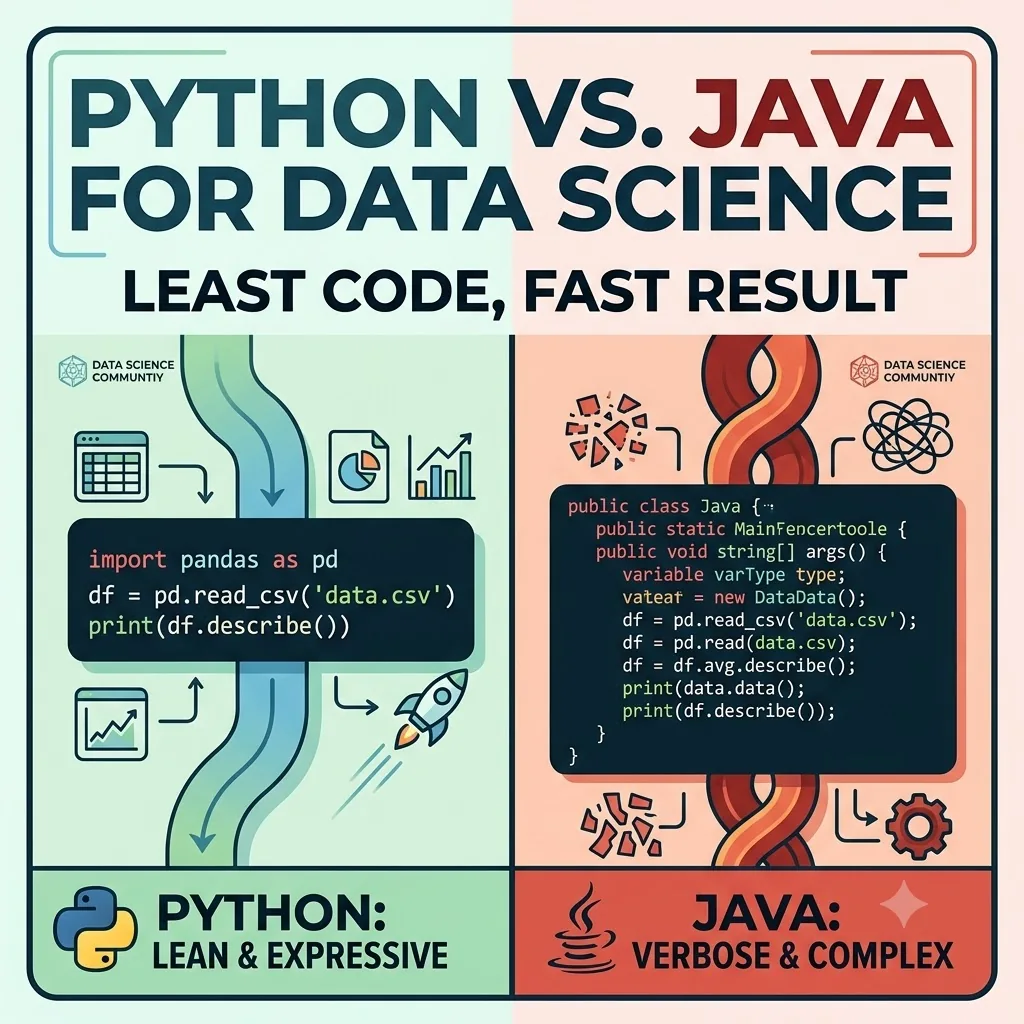
Python vs Java
What Makes Python So Popular in Data Science Compared to Java's Verbose Nature?
If you ask a data scientist what language they work in, the answer is almost certainly Python. Stack Overflow's 2024 Developer Survey found Python to be the most used programming language overall for the third consecutive year, and in data science specifically the dominance is even more pronounced — surveys of Kaggle users, a platform hosting over five million data scientists worldwide, have shown Python usage consistently above 80 percent since 2017. Java, by comparison, barely registers in data science contexts despite being one of the most widely deployed programming languages in enterprise software, with decades of maturity, excellent performance characteristics, and enormous ecosystem depth.
This disparity isn't accidental, and it isn't simply explained by saying Python is "easier" or Java is "too verbose" — though verbosity is a genuine and quantifiable factor. The gap between the two languages in data science adoption reflects a confluence of forces: historical timing, community network effects, library ecosystem maturity, the cognitive fit between Python's syntax and mathematical thinking, and the specific workflow requirements of exploratory data analysis that favor Python's design philosophy in ways that go well beyond surface-level syntax preferences. This article unpacks all of these factors carefully, with concrete examples that make the comparison tangible.
The Verbosity Problem Is Real, and Quantifiable
The most immediately obvious difference between Python and Java in a data science context is the difference in how much code must be written to accomplish the same thing. This matters more in data science than in most other programming domains because data science involves enormous amounts of exploratory, iterative work — loading a dataset, inspecting its shape, computing a summary statistic, plotting a distribution, trying a transformation, inspecting the result — and any friction in that iteration loop directly slows the pace of discovery.
Consider loading a CSV file and computing the mean of one of its columns, one of the most routine operations in data analysis:
Python (with pandas):
python
import pandas as pd

df = pd.read_csv("data.csv")
print(df["age"].mean())
Three lines. No class definitions, no type declarations, no main method, no import of a logging framework to see the output. The intent of the code is the code itself.
Java (with OpenCSV and manual computation):
python
import com.opencsv.CSVReader;
import java.io.FileReader;
import java.util.List;

public class DataAnalysis {
    public static void main(String[] args) throws Exception {
        CSVReader reader = new CSVReader(new FileReader("data.csv"));
        List<String[]> rows = reader.readAll();
        reader.close();

        String[] header = rows.get(0);
        int ageIndex = -1;
        for (int i = 0; i < header.length; i++) {
            if (header[i].equals("age")) {
                ageIndex = i;
                break;
            }
        }

        double sum = 0;
        int count = 0;
        for (int i = 1; i < rows.size(); i++) {
            sum += Double.parseDouble(rows.get(i)[ageIndex]);
            count++;
        }
        System.out.println("Mean age: " + (sum / count));
    }
}
Twenty-plus lines, a class wrapper, exception handling boilerplate, explicit type declarations throughout, manual column-index lookup, and manual arithmetic — all to do something that a working data scientist does dozens of times before breakfast. Even with a more capable Java data library (Apache Commons Math, Tablesaw, or Weka), the ceremony required by Java's static type system and object-oriented structure creates overhead that, multiplied across hundreds of exploratory operations in a typical analysis session, represents a genuine productivity tax.
This verbosity gap exists because Java and Python were designed with different goals and different primary users in mind. Java was designed in the mid-1990s for enterprise application development by professional software engineers working in teams, where static type safety, long-term maintainability, and explicit architectural structure are primary concerns. Python was designed by Guido van Rossum in the late 1980s with the explicit goal of being readable and approachable for people who are primarily experts in some domain other than programming — scientists, engineers, mathematicians, researchers — who need to write code as a tool for doing their actual work rather than as the work itself. Van Rossum's articulation of this design philosophy, formalized in "The Zen of Python" (accessible by running import this in any Python interpreter), explicitly values "readability counts" and "there should be one obvious way to do it" — principles that align naturally with scientific computing, where the goal is to express a mathematical or analytical idea clearly, not to demonstrate software engineering rigor.
The Library Ecosystem: Why This Is the Real Story
The most important single reason Python dominates data science has nothing to do with Python's syntax at all. It is the library ecosystem that grew up around Python starting in the early 2000s, which created a self-reinforcing cycle of adoption that is now so mature it would be nearly impossible to displace even if a better-designed language appeared tomorrow.
The foundational stack — NumPy, pandas, matplotlib, and SciPy — represents decades of accumulated effort by thousands of contributors, and each library solves a core data science problem so well that alternatives in other languages have struggled to match them.
NumPy (numpy.org), published in its modern form in 2006, provides an n-dimensional array data structure backed by contiguous blocks of memory and implemented in C, with broadcasting rules and vectorized operations that allow mathematical operations on entire arrays without explicit Python loops. This is the key performance insight that makes Python's reputation for being "slow" mostly irrelevant in numerical computing: Python code that calls NumPy operations is slow only at the Python layer; the actual computation happens in optimized C or Fortran code that runs at speeds comparable to hand-optimized native code.
python
import numpy as np

# Compute the dot product of two million-element vectors
a = np.random.randn(1_000_000)
b = np.random.randn(1_000_000)
result = np.dot(a, b)  # Executes in milliseconds, in C
The equivalent operation written as a pure Python loop would be roughly 100x slower. Java's primitive arrays can match NumPy's raw computation speed, but Java lacks the broadcasting syntax and the decades of scientific algorithm implementations that NumPy has accumulated, including linear algebra (wrapping LAPACK and BLAS), Fourier transforms (wrapping FFTW), random number generation, and statistical distributions.
pandas (pandas.pydata.org), built on top of NumPy and first released publicly in 2009 by Wes McKinney (who was working at a hedge fund and needed better tools for financial data analysis), provides the DataFrame — a two-dimensional, labeled data structure that allows heterogeneous column types, intuitive label-based indexing, and a rich API for filtering, grouping, aggregating, merging, pivoting, and reshaping tabular data. The DataFrame concept is borrowed from R (which itself borrowed it from S), but pandas' implementation in Python made it available within the same language used for machine learning, web APIs, and scripting, eliminating the need to context-switch between languages during an analysis workflow.
Scikit-learn (scikit-learn.org), released in 2010, provided a consistent, well-documented API for the most commonly used machine learning algorithms — linear and logistic regression, support vector machines, random forests, gradient boosting, k-means clustering, principal component analysis — all following the same fit(X, y) / predict(X) interface, documented to a standard that made it genuinely learnable from documentation alone. The consistency of scikit-learn's API design is worth emphasizing: a developer who learns to use a logistic regression model can transfer that knowledge to a random forest or a gradient boosting model with almost no additional learning, because they all implement the same interface. This is a software design achievement, not just a library achievement, and it dramatically lowered the barrier to experimenting with different modeling approaches.
PyTorch (pytorch.org) and TensorFlow (tensorflow.org), the two dominant deep learning frameworks, are both primarily Python interfaces to highly optimized C++ and CUDA (GPU) backends. The reason both were built with Python front-ends rather than Java front-ends is that by the time deep learning became practically important (roughly 2012 onward, following AlexNet's dramatic ImageNet result), the Python data science ecosystem was already the dominant environment for numerical research, so building for Python was the obvious choice to reach the community of researchers who would actually use these tools. This is the network effect in action: libraries attract users, users attract more libraries, more libraries attract more users, until the ecosystem becomes self-sustaining and switching costs become prohibitive.
The Jupyter Notebook: Changing What "Programming" Means for Scientists
No single tool has done more to accelerate Python's adoption in scientific and data communities than Jupyter Notebooks (jupyter.org), originally called IPython Notebooks, first released in 2011. Jupyter provides a browser-based interactive environment where code, output (including plots, tables, and computed values), mathematics (rendered via LaTeX), and prose (in Markdown) coexist in a single document that executes cell by cell. The result is a programming environment that feels less like "writing software" and more like "writing a mathematical argument with executable steps."
python
# A Jupyter cell - run independently, output displayed immediately below

import matplotlib.pyplot as plt
import numpy as np

x = np.linspace(0, 2 * np.pi, 1000)
plt.plot(x, np.sin(x), label="sin(x)")
plt.plot(x, np.cos(x), label="cos(x)")
plt.legend()
plt.title("Trigonometric Functions")
plt.show()
Running this cell in a Jupyter notebook renders the plot inline, immediately below the code, without leaving the browser or opening a separate graphics window. For a scientist or analyst whose primary goal is to understand data visually, this immediacy is transformative — it closes the feedback loop between writing code and seeing results to near-instantaneous, which encourages the kind of rapid, iterative exploration that characterizes real data analysis work.
Java has no equivalent to Jupyter for general data science work. JShell, introduced in Java 9, provides a REPL (Read-Eval-Print Loop) for interactive Java execution, but it lacks the notebook model, the inline visualization, and the prose integration that make Jupyter qualitatively different from a conventional development environment. Attempts to create Java-based notebook environments exist (such as the Jupyter kernel for Java, IJava) but they remain niche, used primarily by developers who specifically need to demonstrate Java code interactively rather than by working data scientists.
The "Battery-Included" Philosophy vs. Java's "Build Your Own Stack"
Python's standard library philosophy — "batteries included," meaning the standard library should cover a wide range of common tasks without requiring third-party dependencies — means that Python installations come with tools for file I/O, JSON and CSV parsing, HTTP requests, regular expressions, math functions, and many other utilities out of the box. For data science work, this baseline is extended by a de facto standard stack (NumPy, pandas, matplotlib, scikit-learn, Jupyter) that any working data scientist expects to be present and that is installed by default in Anaconda (anaconda.com), the most widely used Python distribution in scientific computing.
Java, by contrast, was designed around the principle that the JVM platform provides core language and runtime facilities, and that specific functionality should be provided by third-party libraries selected and managed by the developer. This is an entirely sensible approach for enterprise application development, where different applications have radically different requirements and a "one size fits all" standard library would be either too large or too limited. But for a domain like data science, where almost every practitioner needs the same core set of tools, it means that a Java-based data scientist faces a library selection problem — choosing among Apache Commons Math, Weka, Deeplearning4j, Tablesaw, and others — where there is no obvious default choice, no community consensus, and no guarantee that the libraries they select will interoperate cleanly. This fragmentation, absent from the Python ecosystem which has clear, dominant libraries for each core task, imposes a recurring cognitive overhead on Java-based data science that Python users never experience.
The Academic and Research Pipeline
A decisive structural advantage for Python in data science is its dominance in the academic research environment where new methods are developed and published. When a research team at a university publishes a new machine learning method, optimization algorithm, or statistical technique, they almost invariably publish the accompanying code in Python. The Papers With Code database, which tracks machine learning research with associated code repositories, shows Python as the implementation language in the overwhelming majority of papers across computer vision, natural language processing, reinforcement learning, and general machine learning research.
This creates a direct, fast pipeline from research publication to practical use: a data scientist who reads a new paper can often clone the accompanying GitHub repository, install its dependencies with pip install -r requirements.txt, and run the published experiments within minutes. If the same method were published in Java, the effort to adapt it for use in a Python-based data pipeline — even if the Java code were excellent — would be substantially larger, and many practitioners would simply wait for a Python reimplementation rather than attempting the integration themselves. This dynamic reinforces Python's dominance self-referentially: because practitioners use Python, researchers publish in Python; because researchers publish in Python, practitioners use Python.
Python's Dynamic Nature as a Feature, Not a Bug, for Exploration
Python's dynamic type system, which is often cited as a liability (and is, for large-scale software engineering in teams, where TypeScript's adoption pattern in JavaScript suggests strong demand for optional static typing), turns out to be a genuine asset for exploratory data analysis. In a Jupyter session, a data scientist can define a variable, inspect its type and shape, overwrite it with a different type, call methods on it interactively, and get immediate feedback — all without satisfying a compiler's type system at each step. This flexibility is exactly what's needed when the shape of the data and the appropriate analysis approach are both unknown at the start of a session.
bash
# In a Jupyter notebook, this incremental exploration is natural:
df = pd.read_csv("mystery_dataset.csv")
df.shape           # (10000, 47) — how many rows and columns?
df.dtypes          # what types are the columns?
df.describe()      # summary statistics for numeric columns
df.isnull().sum()  # how many missing values in each column?
df["target"].value_counts()  # distribution of the target variable
Each of these lines can be run in a separate cell, inspected, and used to decide what to do next. In Java, even with a hypothetical equivalent library, each of these operations would require declaring appropriate types for intermediate results, which is manageable in production code but adds significant friction to the exploratory phase where the developer is still learning what the data looks like.
Where Java Does Have Genuine Advantages — and Why They Don't Outweigh the Above
It would be incomplete to present this as a story of Java's pure inferiority for data science, because that mischaracterizes the actual technical tradeoffs. Java genuinely outperforms Python in several areas relevant to data-related work: Java's JVM is extremely well optimized for long-running server processes and handles multithreading natively with a mature concurrency model, while Python's Global Interpreter Lock (GIL) has historically prevented true multi-threaded parallelism in CPU-bound Python code (though PEP 703, which proposes making the GIL optional, was accepted for CPython 3.13 as an experimental feature — a significant development). Java's static type system makes large codebases easier to refactor and maintain over time. Apache Spark, one of the most widely used platforms for distributed large-scale data processing, is written in Scala (which runs on the JVM) and has Java as a first-class API, making Java a reasonable choice for production data engineering pipelines processing petabyte-scale datasets.
The reason these advantages don't translate into Java's adoption in data science is not that they're unimportant, but that they matter most in production engineering contexts — deploying a model at scale, processing enormous datasets in a distributed cluster, maintaining a data pipeline that runs in production for years — rather than in the exploratory analysis and model development contexts that constitute most of what data scientists call "data science work." The community has, largely sensibly, settled on a division of labor: Python for exploration, model development, and research; Scala/Java/Spark for production data engineering and large-scale processing; Python again for model serving (often through FastAPI or similar frameworks), since the overhead of deploying a Python model is manageable and maintaining a single language throughout the ML lifecycle simplifies tooling. Java's strengths are real, but they're concentrated in the engineering-at-scale phase of a project that typically follows the Python-based exploration and model development phase, not replaces it.
What This Means for Aspiring Data Scientists
For someone entering the field in 2026, the practical guidance from the above is clear: Python is not just the popular choice but the right choice for learning data science, because the ecosystem — libraries, notebooks, research code, online courses, community resources — is so comprehensively built around Python that starting anywhere else imposes an unnecessary disadvantage. Resources like Andrew Ng's Deep Learning Specialization on Coursera, fast.ai's Practical Deep Learning course at fast.ai, Kaggle's free Python and pandas courses at kaggle.com/learn, and the entire library of scikit-learn documentation tutorials all assume Python. Attempting to learn data science through Java would mean constantly translating concepts from Python-based resources — adding a second, unnecessary difficulty on top of the primary one.
For software engineers with strong Java backgrounds who want to move into data science or ML engineering, the practical advice is not to abandon Java expertise but to add Python fluency on top of it. Understanding the JVM, concurrency, and large-scale systems engineering is genuinely valuable in ML engineering and data engineering roles; the Python data science stack can be learned in weeks to a productive level, though mastery takes longer. The combination of strong systems engineering instincts (often developed through Java experience) with Python data science fluency is in practice one of the more valuable skill combinations in the industry right now — it spans both the exploratory model development phase and the production deployment phase in a way that pure Python data scientists and pure Java engineers rarely can on their own.
Conclusion
Python's dominance in data science over Java is the result of at least five mutually reinforcing factors: a design philosophy that prioritizes readability and approachability for domain experts rather than professional software engineers; the early development of a world-class numerical and data science library ecosystem (NumPy, pandas, scikit-learn, PyTorch) that established Python as the default research environment; the Jupyter notebook's transformation of the development workflow into something that suits exploratory, iterative analysis; the academic research community's adoption of Python as the standard publication language for new methods; and the self-reinforcing network effect that follows from all of the above. Java's verbosity is a real and quantifiable contributor to the gap — the code comparison earlier in this article makes the friction tangible — but it's less a primary cause than a symptom of a deeper mismatch between Java's design goals and the specific workflow and user profile of data science work. Understanding this distinction is what allows a technically precise prediction: Python's dominance in data science will persist not because Python is better at everything, but because it is specifically and deeply suited to the exploratory, iterative, community-driven work that data science actually is.
Further Reading
- NumPy official documentation — numpy.org
- pandas official documentation — pandas.pydata.org
- Scikit-learn documentation and tutorials — scikit-learn.org
- PyTorch official documentation — pytorch.org
- Project Jupyter — jupyter.org
- Kaggle — free Python and data science courses
- fast.ai — Practical Deep Learning for Coders
- Papers With Code — ml research with code
- Anaconda Python distribution for data science — anaconda.com
shareShare this post
recommendYou may also like
TECH GUIDESConvert XLS to XLSX Online Free — Upgrade Old Excel Files in SecondsFlipFileZone · Read Fullopen_in_new TECH GUIDESConvert PNG to ICO Online Free — Create Favicons and Windows Icons in SecondsFlipFileZone · Read Fullopen_in_new
 TECH GUIDESConvert Markdown to PDF Online Free — Turn .md Files Into PDF in SecondsFlipFileZone · Read Fullopen_in_new
 TECH GUIDESConvert SVG to PNG Online Free — Export Vector Graphics as Images in SecondsFlipFileZone · Read Fullopen_in_new
 TECH GUIDESConvert GIF to MP4 Online Free — Turn Animated GIFs Into Video in SecondsFlipFileZone · Read Fullopen_in_new
 TECH GUIDESConvert WAV to MP3 Online Free — Compress Audio Files in SecondsFlipFileZone · Read Fullopen_in_new
 TECH GUIDESConvert MOV to MP4 Online Free — Convert iPhone Videos in SecondsFlipFileZone · Read Fullopen_in_new
chatPost a comment
Comments
0