 TECH GUIDESConvert XLS to XLSX Online Free — Upgrade Old Excel Files in SecondsFlipFileZone · Read Fullopen_in_new
What Makes Software Developers Valuable When Languages Like Python Are Easy to Learn?
Easy syntax doesn't equal engineering skill. Real developer value lies in problem decomposition, debugging intuition, system design, algorithmic reasoning, security awareness, and judgment built from experience—skills no tutorial teaches.
FlipFileZone · TECH GUIDES
shareShare this post






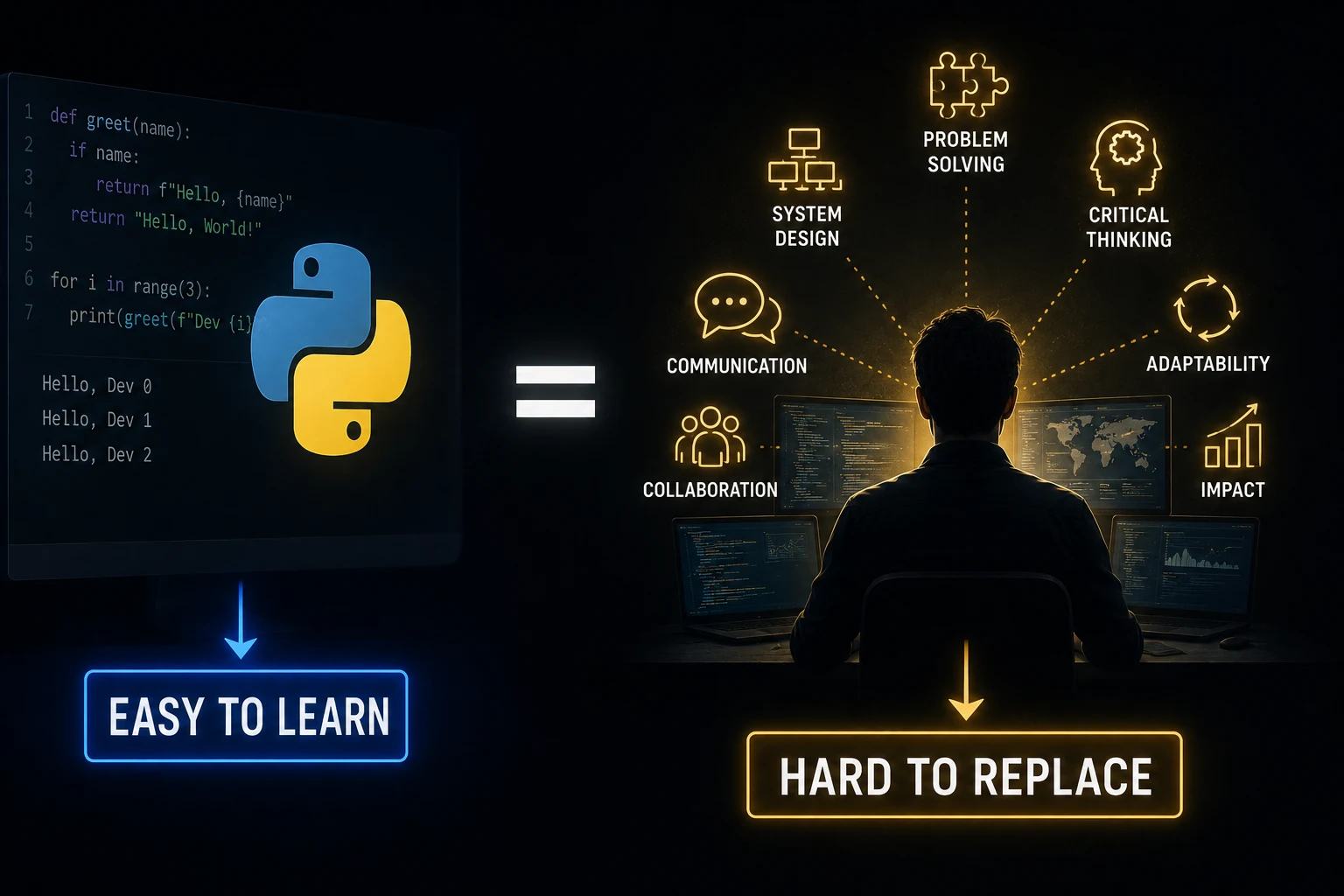
A common observation, especially from people outside the software industry, goes something like this: "Python is so easy to learn — a beginner can write a working script in a weekend. So why are software developers still paid so well, and why does the profession still seem to matter?" The question is reasonable on its surface, but it rests on a conflation that turns out to be the entire answer: learning the syntax of a programming language and being a competent software engineer are almost entirely different skills. This article unpacks that distinction in detail, using concrete examples from real software practice, and explains why the ease of learning a language's grammar has done remarkably little to commoditize the value of the people who use it well.
Syntax Is the Alphabet, Not the Literature
Learning Python's syntax means learning that loops use for and while, that indentation defines blocks, that lists use square brackets, and that functions are defined with def. This is genuinely something a motivated beginner can learn in a weekend, and free resources like Python's official tutorial make it even faster. But knowing the alphabet of a language is not the same as being able to write a novel in it. Plenty of people can technically write grammatically correct English sentences without being able to produce a coherent essay, a persuasive argument, or a publishable short story. Software is similar: syntax is necessary but nowhere close to sufficient.
The skills that actually separate a junior hobbyist from a senior engineer — problem decomposition, system design, debugging intuition, performance reasoning, security awareness, and the judgment to make sound tradeoffs under ambiguity — are not taught by a language tutorial at all. They are built over years of writing code that breaks, fixing it, watching other people's code break, and absorbing the patterns of failure that recur across different projects and even different languages entirely.
Problem Decomposition: Translating Ambiguity Into Structure
Real-world software requirements rarely arrive as clean, fully specified problems. A product manager might say "let users export their data as a spreadsheet," and a junior developer might immediately start writing a function that loops over rows and writes them to a CSV file. An experienced developer, before writing a line of code, starts asking questions that the requirement didn't answer: What happens if a user has millions of rows — should this be a background job instead of a synchronous request? What if the export fails halfway through — does the user get a partial file, or should the operation be atomic? What if two requests for the same export happen simultaneously? What format do downstream tools expect — should numeric formatting follow the user's locale?
This translation from a vague human request into a precise technical specification, complete with edge cases, is a skill independent of any particular programming language. It's also one of the hardest skills to automate, because it requires understanding both the business context and the technical constraints simultaneously — something that currently still benefits enormously from human judgment, even as AI tools get better at generating code from a spec once that spec exists.
Debugging Intuition: The Mental Model of Failure
Consider a production incident: an API endpoint that has worked fine for months suddenly starts timing out under moderate load. A beginner, faced with this, often resorts to trial-and-error — adding print statements, randomly tweaking code, or restarting the server and hoping the problem goes away. An experienced developer instead reasons from a mental model: they ask whether the database query plan changed (perhaps a missing index, or a table that grew past a size where a full table scan became unacceptably slow), whether a recent deploy introduced an N+1 query pattern, whether a downstream service started responding more slowly and the timeout cascaded upstream, or whether a connection pool is exhausted because connections aren't being released properly.
This kind of debugging intuition comes from having encountered — and fixed — dozens of similar failures before. It's pattern matching built on real experience, not something a tutorial on Python's try/except syntax can convey. Tools like Brendan Gregg's USE Method (Utilization, Saturation, Errors) for systems performance analysis exist precisely because experienced engineers have systematized this kind of diagnostic reasoning, but applying the method well still requires judgment about which signals matter in a given context.
System Design: Decisions That Outlive Any Single Function
Writing a single function that sorts a list or parses a string is a small, self-contained problem. Designing a system that handles millions of users, stays available during partial outages, and can be modified six months later by a different team entirely is a different category of problem. This is where concepts like load balancing, caching strategy, database indexing and normalization, message queues, eventual consistency, and service boundaries come into play.
A concrete example: imagine building a notification system that emails users when something happens in an app. A naive implementation sends the email synchronously, inside the same request that triggers the event. This works fine in a demo with ten users. At scale, it becomes a serious liability — a slow or down email provider now makes the entire user-facing request slow or fail, even though the user didn't ask to wait on an email. An experienced developer would instead push the email-sending work onto an asynchronous queue (using something like RabbitMQ or Celery in Python's ecosystem), decoupling the user's request from the side effect, and the queue handles retries if the email provider is temporarily unavailable.
This design decision has nothing to do with whether the underlying code is written in Python, Go, or Java. It comes from understanding distributed systems principles, which take far longer to internalize than the syntax of any one language. The book Designing Data-Intensive Applications by Martin Kleppmann is widely regarded as one of the best resources for building this kind of systems intuition, and it deliberately avoids language-specific syntax in favor of durable principles.
Algorithms, Complexity, and the Cost of "It Works"
A script that works on a hundred rows of test data and a system that works on a hundred million rows of production data can look identical in source code while behaving completely differently in practice. This is the domain of algorithmic complexity — understanding that a nested loop over a list is O(n²) and will become unbearably slow as the list grows, while a hash-map lookup is O(1) on average and scales gracefully.
A junior developer might write code that checks whether an item exists in a list using if item in my_list, which is intuitive and works correctly. An experienced developer recognizes that if my_list has a million elements and this check happens inside a loop, the program will silently become extremely slow, and switches to a set instead, where membership testing is essentially constant time. The functional behavior is identical; the performance characteristics are wildly different. This isn't a Python-specific insight — the same reasoning about data structures and Big-O complexity applies in every language, which is exactly why computer science fundamentals remain valuable independent of which language is fashionable in a given year.
Code Quality, Maintainability, and the Reality of Technical Debt
Code is rarely written once and never touched again. Most professional software is read and modified far more often than it is initially written, sometimes by people who weren't involved in the original design. This is why experienced developers care deeply about things that don't affect whether code runs at all: naming variables clearly, structuring functions so each one does one understandable thing, writing tests that catch regressions, and documenting the why behind non-obvious decisions, not just the what.
A function that works perfectly but is 400 lines long, has no comments, and relies on global mutable state might pass every test today, but it becomes a serious liability the moment someone needs to extend it under deadline pressure six months later. This is the concept of technical debt: shortcuts that speed up delivery today but cost more in the future. Recognizing when a shortcut is acceptable (a quick prototype that will be thrown away) versus when it's dangerous (core infrastructure that will be built upon for years) is a judgment call, and making that call well is part of what senior engineers are actually paid for.
Testing and Reliability: Confidence at Scale
Writing a script and confirming it works by running it once and eyeballing the output is fine for a one-off task. Building software that other people and other systems depend on requires a fundamentally different relationship with correctness. Experienced developers write automated tests — unit tests for individual functions, integration tests for how components interact, and sometimes end-to-end tests that simulate real user behavior — not because it's required by a syntax rule, but because they've personally experienced the cost of a regression slipping into production undetected.
Frameworks like pytest make the mechanics of writing a test in Python trivial. Knowing what to test, how to structure tests so they're fast and reliable rather than flaky, and how much test coverage is the right amount for a given piece of code (testing everything exhaustively is often a waste of time; testing nothing is a recipe for disaster) is, again, a matter of judgment built from experience rather than something a syntax tutorial teaches.
Security: The Cost of Naive Assumptions
A beginner writing a login form might directly interpolate user input into a SQL query string, unaware that this opens the application to SQL injection — a vulnerability that has caused real, well-documented data breaches at major companies. An experienced developer automatically reaches for parameterized queries or an ORM that handles escaping correctly, not because the syntax is harder, but because they understand the threat model: any input from outside the system's trust boundary must be treated as potentially adversarial.
This kind of security awareness extends well beyond SQL injection — cross-site scripting, insecure deserialization, broken authentication, and improperly stored secrets are all categories of vulnerability cataloged extensively by resources like the OWASP Top Ten. None of these are syntax problems. They're judgment problems, born from understanding how systems get attacked in practice, and that understanding is exactly the kind of thing that takes years to develop and is genuinely difficult to shortcut.
Communication, Collaboration, and Reading the Room
Professional software is almost never built by a single person in isolation. It involves code review, where a developer needs to explain why they made a particular design choice to a skeptical colleague; cross-functional communication, where a developer needs to translate a technical constraint into language a product manager or executive can act on; and mentorship, where a senior developer needs to explain not just what's wrong with a junior developer's code but why, in a way that builds their judgment rather than just fixing the immediate bug.
A developer who can write correct code but can't explain a tradeoff, push back constructively on an unrealistic deadline, or communicate risk to a non-technical stakeholder is significantly less valuable in a team setting than one who can do both. This soft-skill dimension of the job is invisible in a syntax tutorial but shows up constantly in performance reviews and promotion decisions at real companies.
Domain Knowledge: Code in Context
A developer working on a payments system needs to understand concepts like idempotency (ensuring a duplicate request doesn't charge a customer twice), currency rounding rules, and regulatory requirements around financial data. A developer working on a healthcare application needs to understand data privacy regulations like HIPAA in the United States. A developer working on a recommendation system needs at least a working understanding of the statistics behind A/B testing to avoid drawing false conclusions from noisy data.
None of this domain knowledge comes from learning Python. It comes from working in an industry long enough to understand its specific failure modes, regulations, and unwritten rules. This is also why experienced developers are often more valuable within a specific domain than their general programming skill alone would suggest — institutional and domain knowledge compounds over time in a way that's hard to shortcut.
The Shifting Landscape: AI Coding Assistants
It would be incomplete to discuss this topic without addressing the elephant in the room directly: AI coding tools like GitHub Copilot, Claude, and ChatGPT have made it dramatically easier to generate working code from a natural-language description, which has compressed some of the value that used to come purely from knowing syntax and recalling API details. This is a real and significant shift, and it's reasonable to expect that the value of pure syntax recall will continue to decline.
But this trend, if anything, reinforces rather than undermines the argument above. As AI tools handle more of the mechanical translation from intent to code, the bottleneck increasingly shifts toward the things that were always the hard part: knowing what to build, recognizing when generated code is subtly wrong, understanding the system-level implications of a change, and exercising the judgment to know when a quick AI-generated answer is good enough versus when it needs serious scrutiny. Developers who only ever knew syntax — without the deeper judgment described throughout this article — are the ones most exposed by this shift. Developers with strong systems thinking, debugging skill, and architectural judgment are, if anything, becoming more valuable, because they're the ones who can effectively direct, verify, and integrate AI-generated code into systems that actually work reliably at scale.
Conclusion: The Value Was Never in the Syntax
The premise that programming languages like Python are "easy to learn" is true and has been true for a long time — Python was explicitly designed for readability and a gentle learning curve. But this was never where a software developer's professional value primarily came from. The value comes from problem decomposition, debugging intuition built over years of failure, system design judgment, algorithmic reasoning, an instinct for maintainable code, security awareness, the ability to communicate tradeoffs to non-technical stakeholders, and accumulated domain knowledge specific to the industry being worked in.
Languages are tools, and tools with simpler interfaces have always been more accessible — that's a feature, not a threat to the profession. What remains scarce, and what continues to command real compensation in the labor market, is the judgment built from experience that determines whether code is merely functional or genuinely good: reliable, maintainable, secure, and fit for the actual problem it was meant to solve. That judgment was never something a syntax tutorial could teach, and it remains, even in an era of increasingly capable AI coding tools, the core of what makes a software developer valuable.
Further Reading
- Designing Data-Intensive Applications by Martin Kleppmann — the definitive resource on systems design principles that transcend any single language.
- OWASP Top Ten — the standard reference for understanding the most common and dangerous security vulnerabilities in real applications.
- The USE Method by Brendan Gregg — a systematic approach to performance debugging used widely in production systems engineering.
- Python's Official Tutorial — useful as a reference point for just how quickly the syntax layer of a modern language can be learned, in contrast to everything else discussed in this article.
shareShare this post
recommendYou may also like
TECH GUIDESConvert XLS to XLSX Online Free — Upgrade Old Excel Files in SecondsFlipFileZone · Read Fullopen_in_new TECH GUIDESConvert PNG to ICO Online Free — Create Favicons and Windows Icons in SecondsFlipFileZone · Read Fullopen_in_new
 TECH GUIDESConvert Markdown to PDF Online Free — Turn .md Files Into PDF in SecondsFlipFileZone · Read Fullopen_in_new
 TECH GUIDESConvert SVG to PNG Online Free — Export Vector Graphics as Images in SecondsFlipFileZone · Read Fullopen_in_new
 TECH GUIDESConvert GIF to MP4 Online Free — Turn Animated GIFs Into Video in SecondsFlipFileZone · Read Fullopen_in_new
 TECH GUIDESConvert WAV to MP3 Online Free — Compress Audio Files in SecondsFlipFileZone · Read Fullopen_in_new
 TECH GUIDESConvert MOV to MP4 Online Free — Convert iPhone Videos in SecondsFlipFileZone · Read Fullopen_in_new
chatPost a comment
Comments
0