 TECH GUIDESConvert XLS to XLSX Online Free — Upgrade Old Excel Files in SecondsFlipFileZone · Read Fullopen_in_new
Who Are Some of the Best Programmers in the World?
Exceptional programmers like Torvalds, Knuth, Ritchie, Carmack, and Hamilton share deep mastery, assumption-questioning, long time horizons, and clear communication—their contributions define computing's foundations, not just individual codebases.
FlipFileZone · TECH GUIDES
shareShare this post


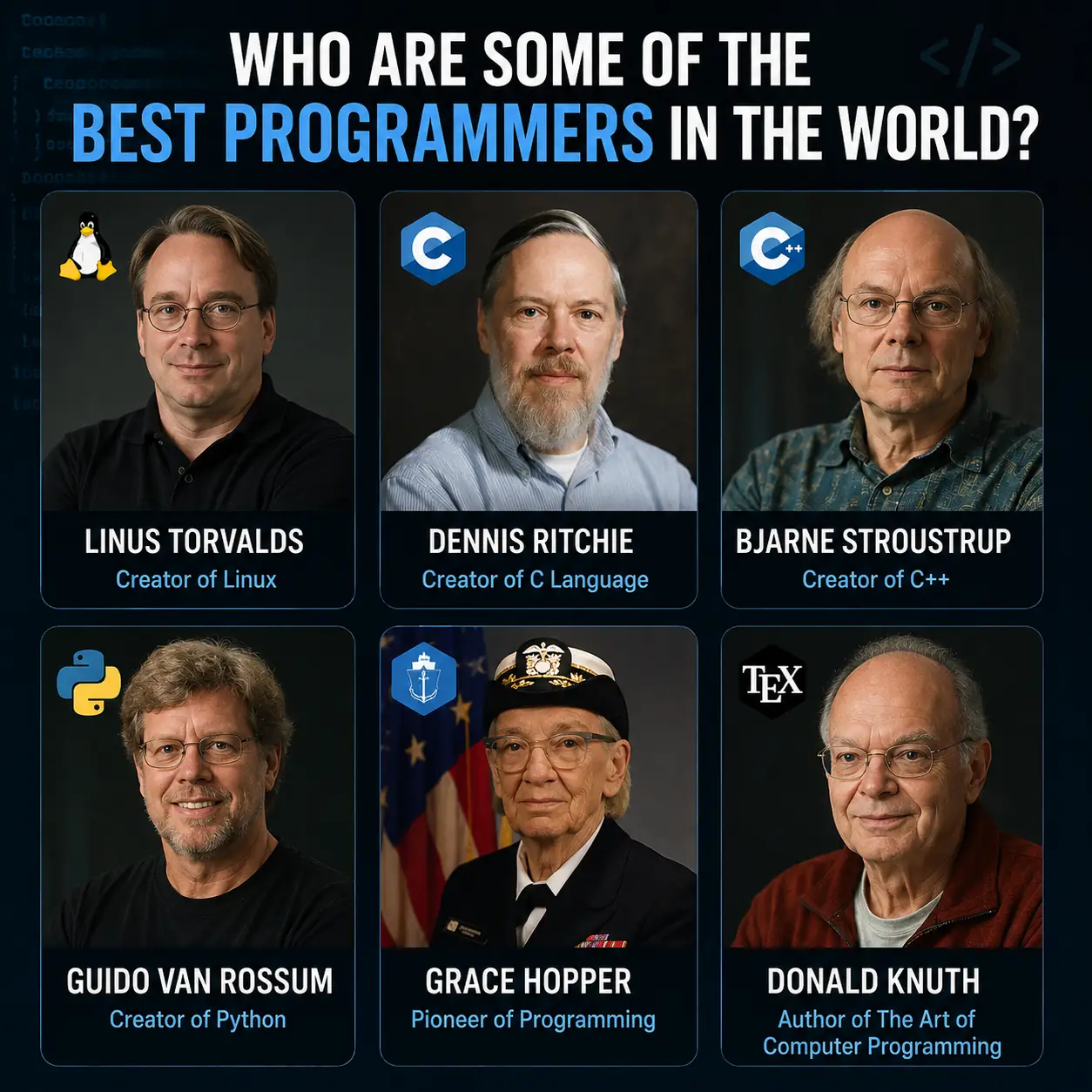
Who Are Some of the Best Programmers in the World?
Programming, like mathematics or chess, has produced a small number of individuals whose contributions so far exceed the ordinary that they become reference points for an entire field. These are people who didn't just write good code — they invented new ways of thinking about computation, built systems that billions of people use daily, and produced work that practicing engineers still study and cite decades later. This article profiles a selection of the most widely recognized exceptional programmers in computing history and the present, organized not as a strict ranking (which would be as meaningless as ranking novelists) but as a survey of the specific kinds of excellence that define the upper end of this craft, with links to their most important work for readers who want to go deeper.
Linus Torvalds — The Pragmatic Systems Builder
No list of exceptional programmers can begin anywhere other than Linus Torvalds, the Finnish-American software engineer who, as a 21-year-old computer science student in Helsinki in 1991, wrote the first version of the Linux kernel as a personal project and posted it to a newsgroup with the now-famous message: "I'm doing a (free) operating system (just a hobby, won't be big and professional like gnu) for 386(486) AT clones." What followed was one of the most consequential pieces of software engineering in history: Linux now powers over 96 percent of the world's top one million web servers, virtually every Android device, most supercomputers, and the majority of cloud infrastructure on the planet.
Torvalds' genius is specifically pragmatic and architectural rather than theoretical. He has never published a landmark academic paper in the style of the theorists profiled later in this article. What he built, and continues to actively maintain through the Linux kernel mailing list, is a working system of extraordinary scale and reliability. Torvalds also created Git in 2005, initially to manage the Linux kernel's source code after a dispute with the proprietary version control system the project had been using. Git, documented at git-scm.com, is now the dominant version control system in professional software development worldwide — used by virtually every software project on earth, hosted on platforms like GitHub and GitLab — a second contribution, from the same person, of comparable global impact to the first. The combination of Linux and Git represents a scale of practical impact on working software engineers that is genuinely without parallel in the history of the field.
Donald Knuth — The Mathematician of Algorithms
If Torvalds represents engineering genius, Donald Knuth represents mathematical genius applied to programming with a rigor that remains unmatched. Knuth, a professor emeritus at Stanford University, began writing The Art of Computer Programming in 1962 when he was a 24-year-old graduate student, intending it as a single book summarizing all existing knowledge about compiler design. It became a multi-volume series — four volumes published so far, with a fifth in progress — that is widely regarded as the most thorough and authoritative treatment of fundamental algorithms and data structures ever written.
Knuth's specific contributions go well beyond the books. He invented TeX, a typesetting system so precise in its mathematical notation rendering that it remains the standard tool for publishing academic papers in mathematics, physics, and computer science, described in detail at tug.org. He invented the concept of literate programming — the idea that programs should be written as documents that humans read, with formal code embedded within them rather than the reverse — documented in his book of the same name. He formalized the asymptotic analysis of algorithm complexity using Big-O notation in its modern, precise form, giving the field a language for comparing algorithms that is used in every computer science textbook and every technical job interview in the world today. Bill Gates has been quoted saying that if he had a chance to hire Knuth, he would be sure to offer him a job. Knuth himself has famously refused email since 1990 on the grounds that it interrupts the deep concentration his work requires, a stance documented on his Stanford faculty page, which has itself become a mild legend in the programming community.
Ken Thompson and Dennis Ritchie — The Architects of Computing's Foundation
Ken Thompson and Dennis Ritchie share a place at the very foundation of modern computing that is difficult to overstate. Working together at Bell Labs in the late 1960s and early 1970s, they created two things that most working software engineers interact with, in some form, every single day: the C programming language (Ritchie) and the Unix operating system (Thompson, with Ritchie), originally developed and documented in Ritchie's famous 1978 book The C Programming Language, co-authored with Brian Kernighan, which is still in print and still read today.
C became the implementation language for essentially all operating systems written after it, including the Linux kernel, macOS's foundation, and Windows' lowest-level components. Unix's design philosophy — small, composable programs that do one thing well, communicating through text streams — became the conceptual model underlying Linux, macOS, and every Unix-like system running today. Thompson additionally invented the regular expression syntax that remains the standard used in grep, sed, and virtually every programming language's string-matching library, and he was a principal designer of the Go programming language during his time at Google. Both Ritchie and Thompson received the Turing Award in 1983, computing's highest honor, for their work on Unix and C. Ritchie, who passed away in 2011, is memorialized at bell-labs.com, while Thompson continues to work in the industry.
John Carmack — The Performance Optimization Virtuoso
John Carmack, the co-founder of id Software and creator of the game engines behind Doom and Quake, occupies a unique place in this list: he represents a kind of genius defined by pushing hardware to its absolute limits through inventive, sometimes mathematically brilliant programming. In the early 1990s, when the IBM PC was widely believed to be incapable of rendering smooth, full-screen, first-person 3D graphics in real time, Carmack proved the assumption wrong — by inventing new rendering algorithms, writing hand-optimized assembly code, and finding ways to approximate the mathematics of 3D rendering that were "good enough" visually while running fast enough on hardware that wasn't supposed to be capable of the task.
His most famous single piece of code, the "fast inverse square root" algorithm from the Quake III Arena source code — a bit-manipulation hack that approximates 1/√x at roughly four times the speed of a conventional floating-point division, with the mysterious hex constant 0x5F3759DF embedded in it — became a minor legend in the programming world and is discussed in detail in any number of computer science resources and blog posts analyzing what is, at bottom, a creative insight about the structure of IEEE 754 floating-point representation. Carmack's approach to both game engine architecture and his current work on virtual reality at Meta exemplifies a form of programming genius that is specifically about performance engineering: deep knowledge of hardware, mastery of the entire stack from high-level algorithm choice down to machine code, and the creativity to find unconventional solutions when conventional ones are insufficient.
Alan Kay — The Inventor of Object-Oriented Programming
Alan Kay is, in a meaningful sense, the intellectual originator of the object-oriented programming paradigm — the conceptual framework that underlies Java, C++, Python, Ruby, Kotlin, Swift, and most of the mainstream programming languages used in industry today. Kay coined the term "object-oriented" while working at Xerox PARC in the early 1970s and designed the Smalltalk programming language, the first fully object-oriented programming environment, with his colleagues there. The graphical user interface concept, the window/icon/mouse/pointer desktop metaphor, and the idea of a personal computer as an expressive, personal creative tool rather than an institutional data-processing machine all emerged from the research environment at Xerox PARC during this period, much of it influenced by Kay's ideas.
Kay is notably critical, in many public talks and writings, of the way object-oriented programming has been implemented in mainstream languages since Smalltalk — arguing that the focus on classes and inheritance missed the deeper point of his original vision, which was about autonomous objects communicating through message passing, an architecture more similar to how distributed systems and microservices work today than how a typical Java class hierarchy works. His writings and recorded talks, many available through the Viewpoints Research Institute, remain required reading for anyone interested in the history and philosophy of programming language design.
Guido van Rossum — The Language Designer for Human Beings
Guido van Rossum, the Dutch programmer who created Python while working at Centrum Wiskunde & Informatica in the Netherlands in the late 1980s, occupies a different kind of place on this list: his genius was specifically about language design for human cognitive experience rather than for computational performance. Python's design philosophy — summarized in the document "The Zen of Python" accessible by running import this in any Python interpreter — prioritized readability, simplicity, and "one obvious way to do things" in a way that was deliberately and explicitly at odds with the "anything goes" flexibility of Perl, which was Python's main competitor for scripting tasks at the time.
This design philosophy, it turned out, aligned almost perfectly with what scientists, researchers, statisticians, and domain-expert non-programmers needed from a programming language — a tool expressive enough to do real computational work but approachable enough that a biologist or economist could learn it without a computer science degree. Python is now the dominant language for machine learning research, data science, and scientific computing, powering frameworks like TensorFlow, PyTorch, NumPy, and pandas, and is consistently one of the most widely used programming languages in the world by any metric. Van Rossum served as Python's "Benevolent Dictator For Life" (the official informal title the community gave him) until 2018, when he stepped back from active language governance. He subsequently worked at Dropbox and then Microsoft, while Python itself continues to be governed through the Python Software Foundation at python.org.
Bjarne Stroustrup — The Engineer of Controlled Complexity
Bjarne Stroustrup, a Danish computer scientist who designed C++ while working at Bell Labs in the early 1980s, made a design decision that has been debated ever since: he took the C language — powerful, fast, and close to the hardware — and added object-oriented programming features on top of it, without sacrificing C's performance characteristics, its compatibility with existing C code, or its ability to work in resource-constrained, bare-metal environments. The result is a language of extraordinary power and extraordinary complexity, one that is simultaneously responsible for the majority of high-performance, systems-level software in existence (operating system components, game engines, browsers, embedded firmware, high-frequency trading systems) and for a substantial portion of the most serious security vulnerabilities in software history, due to its manual memory management model.
Stroustrup's specific genius was the design of zero-overhead abstractions — the principle, built into C++ from the beginning, that a language feature should compile down to code no less efficient than what a competent programmer would have written by hand if the feature didn't exist, or the feature shouldn't be in the language. This principle, described in detail in Stroustrup's own writing and in his standard reference The C++ Programming Language, has been enormously influential on the design of subsequent systems languages, including Rust's design goal of zero-cost abstractions. Stroustrup currently holds the College of Engineering Chair in Computer Science at Texas A&M University, and maintains a personal website at stroustrup.com where he writes extensively on C++ philosophy and pushes back actively on common misconceptions about the language's design history.
Jeff Dean — Engineering at Google Scale
Jeff Dean, a Google Fellow who led the creation of many of Google's most foundational infrastructure systems over two decades, represents a form of programming genius that is specifically about scale — designing and building systems that work correctly, efficiently, and reliably when they're handling billions of requests from billions of users across tens of thousands of machines. Dean was the principal designer and implementer of systems including MapReduce (the framework for distributed data processing across large clusters of machines that inspired Apache Hadoop and the entire "big data" ecosystem), Bigtable (Google's distributed key-value store, which inspired Apache HBase and influenced the design of most subsequent NoSQL databases), TensorFlow (one of the most widely used machine learning frameworks in research and industry), and Spanner (Google's globally distributed, externally consistent relational database, a distributed systems engineering feat widely described as one of the most impressive large-scale database systems ever built). Several of these systems were described in foundational research papers that the broader industry used as blueprints — the MapReduce paper from 2004 and the Bigtable paper from 2006, both available through research.google, are among the most cited papers in the distributed systems field.
Dean has become something of a folk legend in the programming community, partly through a long-running series of humorous "facts" modeled on the "Chuck Norris facts" joke format — "Jeff Dean's keyboard has two keys: 0 and 1. He types 200 words per minute" — which, while obviously satirical, reflect a genuine community consensus about the scale and breadth of his engineering contributions. Dean currently leads Google DeepMind's AI research efforts, having shifted from infrastructure to machine learning research.
Margaret Hamilton — The Inventor of Software Engineering
Margaret Hamilton is, by many accounts, the person who both coined the term "software engineering" and first made the argument — at a time when "software" was widely regarded as secondary to hardware engineering — that the systematic, rigorous development of software needed to be treated as a serious engineering discipline in its own right, with the same standards of correctness, documentation, and verification applied to building bridges or aircraft. Hamilton led the development of the on-board flight software for the Apollo missions at MIT's Instrumentation Laboratory in the 1960s, responsible for the code running on the guidance computer aboard the Apollo 11 lunar module that landed humans on the moon in 1969.
A photograph of Hamilton standing next to a stack of printed software listings as tall as she is became one of the most reproduced images in the history of computing, both as a document of the sheer volume of the work and as an early piece of evidence for the idea that software could be a substantial, serious engineering achievement. Critically, the Apollo flight software was designed with priority-display interrupts that allowed the guidance computer to discard lower-priority tasks when critical tasks needed immediate attention — a design that famously saved the Apollo 11 landing when an unexpected computer overload alarm (1202 program alarm) could have aborted the mission; the priority-based scheduling allowed the system to keep running, and the landing proceeded. Hamilton received the Presidential Medal of Freedom in 2016, the highest civilian honor in the United States, and founded Hamilton Technologies, where she continues to develop the Universal Systems Language, a formal method for software design described at htius.com.
Fabrice Bellard — The One-Person Standards Setter
Fabrice Bellard occupies a unique category on this list: he is a French programmer who, largely working independently, has produced an extraordinary breadth of high-quality, influential open-source software across completely different technical domains, to a standard that would be impressive for a well-funded team of specialists. He created FFmpeg — the multimedia processing framework used by virtually every software product that converts, encodes, or processes video and audio, embedded inside YouTube, VLC, Chrome, and hundreds of other applications — when he was in his twenties, as a personal project. He created QEMU, a widely used hardware emulator and virtualizer that forms the foundation for much of modern virtualization infrastructure. He wrote TCC (Tiny C Compiler), a minimal but standards-compliant C compiler that compiles itself in a fraction of a second. He set a world record for computing digits of pi using a personal computer, a feat requiring both algorithmic innovation and highly optimized low-level programming. He created JSLinux, a complete Linux system running inside a web browser written in JavaScript, for which he also wrote a custom JavaScript engine from scratch.
The cumulative breadth of Bellard's solo output is what makes him a reference case for individual programming genius: not a single transformative contribution in one domain, but an almost implausible range of high-quality systems across compilers, emulators, multimedia, cryptography, and numerical computing, each one a significant piece of software in its own right. His work is documented at bellard.org, one of the most understated personal pages in software engineering given the scale of what it documents.
What These Programmers Have in Common
Looking across these profiles, a few patterns emerge that distinguish exceptional programmers from merely competent ones, patterns that are worth naming explicitly.
Deep, not just wide, knowledge. Every person on this list has, in addition to breadth, an area of sufficiently deep mastery that they are able to see solutions invisible to other practitioners. Carmack's knowledge of hardware made rendering tricks obvious to him that were invisible to everyone else. Knuth's mathematical rigor allowed him to prove properties about algorithms that others could only observe empirically. Deep knowledge generates genuine insight; broad-but-shallow knowledge generates familiarity.
The ability to question assumptions. Thompson and Ritchie's creation of Unix required rejecting the assumption that operating systems had to be large, complex, and hardware-specific. Torvalds questioned the assumption that a reliable, production-quality operating system kernel required a large, organized team. Hamilton questioned the assumption that "software" was a secondary concern compared to hardware. In each case, the insight came from being willing to ask whether an assumption that everyone else took for granted was actually true.
Long time horizons. Knuth has been working on The Art of Computer Programming for over sixty years. The Linux kernel has been actively maintained for over thirty. C++ has been developed and refined for forty years. The most consequential programming contributions have almost all been the result of sustained, decades-long commitment to a single problem or system, not a brilliant burst of activity followed by moving on.
Communicating clearly. Nearly every person on this list is also a notable writer or communicator: Knuth's books, Stroustrup's books and papers, Torvalds' famously blunt mailing list messages (which, whatever one thinks of their tone, are models of precise technical argumentation), Hamilton's articulation of software engineering as a discipline, Kay's philosophical writings on programming and computing. The ability to precisely express ideas — both in code and in prose — appears to be a common trait among those who influence how others think about programming.
Further Reading
- The Art of Computer Programming — Donald Knuth (official page)
- Linux Kernel Archives
- Git documentation
- Bjarne Stroustrup's personal page
- Fabrice Bellard's projects
- The Python Story — python.org
- Google Research — original MapReduce and Bigtable papers
- Hamilton Technologies — Universal Systems Language
- Alan Kay collected works — Viewpoints Research Institute
shareShare this post
recommendYou may also like
TECH GUIDESConvert XLS to XLSX Online Free — Upgrade Old Excel Files in SecondsFlipFileZone · Read Fullopen_in_new TECH GUIDESConvert PNG to ICO Online Free — Create Favicons and Windows Icons in SecondsFlipFileZone · Read Fullopen_in_new
 TECH GUIDESConvert Markdown to PDF Online Free — Turn .md Files Into PDF in SecondsFlipFileZone · Read Fullopen_in_new
 TECH GUIDESConvert SVG to PNG Online Free — Export Vector Graphics as Images in SecondsFlipFileZone · Read Fullopen_in_new
 TECH GUIDESConvert GIF to MP4 Online Free — Turn Animated GIFs Into Video in SecondsFlipFileZone · Read Fullopen_in_new
 TECH GUIDESConvert WAV to MP3 Online Free — Compress Audio Files in SecondsFlipFileZone · Read Fullopen_in_new
 TECH GUIDESConvert MOV to MP4 Online Free — Convert iPhone Videos in SecondsFlipFileZone · Read Fullopen_in_new
chatPost a comment
Comments
0