 TECH GUIDESConvert XLS to XLSX Online Free — Upgrade Old Excel Files in SecondsFlipFileZone · Read Fullopen_in_new
Why Can't There Be a Coding Language That's Just Like Natural Language?
Natural language is inherently ambiguous and context-dependent, while computers require deterministic, unambiguous instructions. Programming languages stay formal despite English-like attempts (COBOL, AppleScript) and modern AI translation layers.
FlipFileZone · TECH GUIDES
shareShare this post






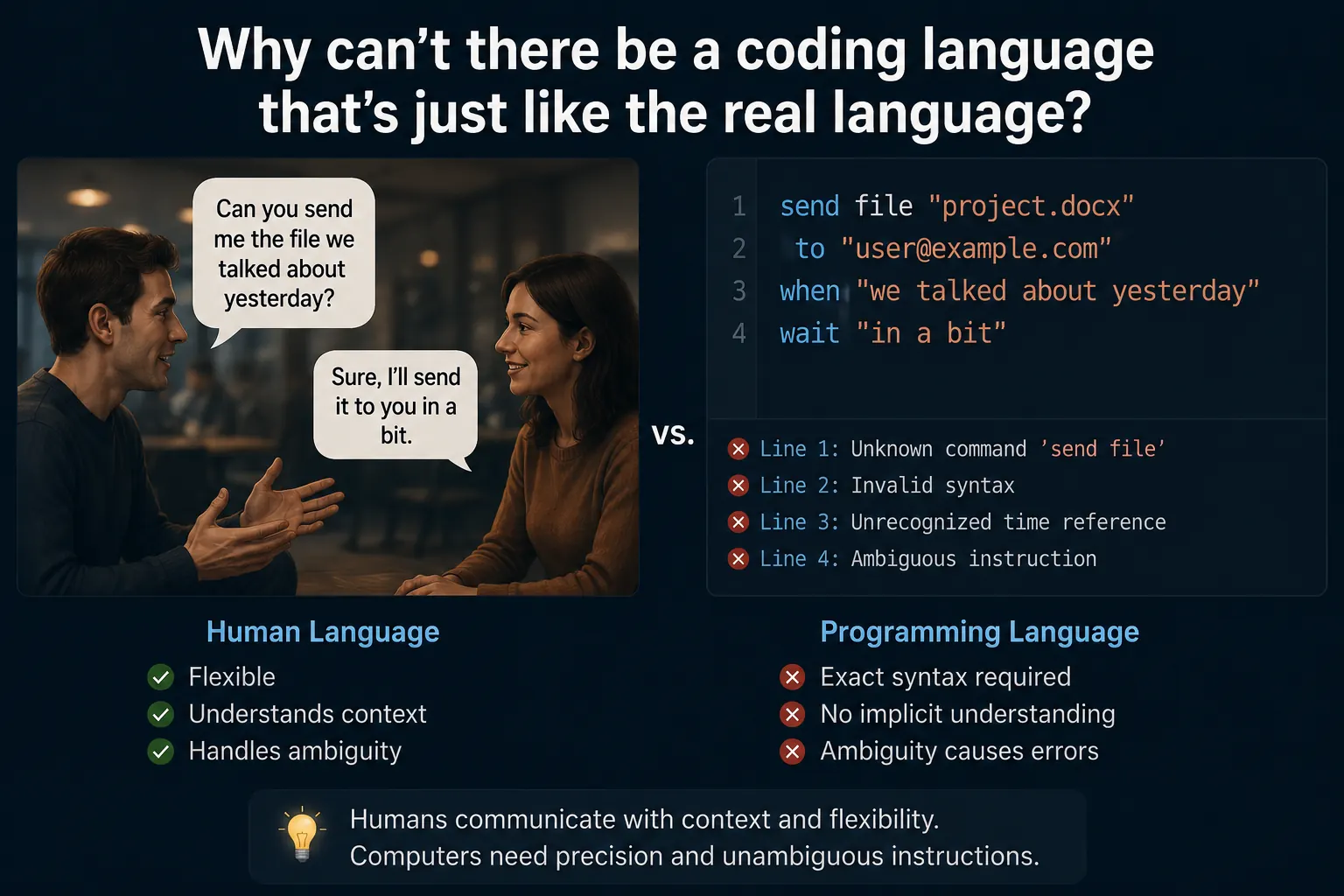
It's a question almost every beginning programmer asks at some point, usually while staring at a syntax error caused by a missing semicolon or a misplaced bracket: why do we have to write for (int i = 0; i < n; i++) when we could just tell the computer "repeat this ten times"? Why can't we program in plain English, or any other human language, the way we talk to another person? The question turns out to be far deeper than it first appears, touching on linguistics, formal logic, the theory of computation, and the practical history of software engineering. This article works through why "a coding language that's just like natural language" is not simply an engineering feature nobody has gotten around to building, but runs into fundamental tensions between how human language works and what computers require to execute instructions reliably.
The Allure Is Real, and People Have Tried This Before
Before getting into why this is hard, it's worth acknowledging that the idea is not naive — serious computer scientists have pursued versions of it for decades, and the results are genuinely instructive.
COBOL (Common Business-Oriented Language), designed in 1959, was explicitly built to read like English so that business managers, not just specialist programmers, could understand and even write it. A line of COBOL looks like this:
docker
ADD AMOUNT-DUE TO TOTAL-BALANCE GIVING NEW-BALANCE.
This reads almost like a sentence a person might say. COBOL remains in active use today — astonishingly, large portions of global banking and government infrastructure still run on COBOL systems written decades ago, a fact regularly covered by outlets reporting on the COBOL programmer shortage in legacy financial systems. But COBOL's English-like syntax was always a thin layer over a strictly formal grammar; "ADD X TO Y GIVING Z" is not actually flexible English, it's a rigid template that happens to use English words.
AppleScript, designed in the early 1990s for automating tasks on Apple's operating systems, pushed this even further:
javascript
tell application "Finder"
    if there is a file named "report.txt" on the desktop then
        move file "report.txt" to folder "Archive"
    end if
end tell
This is remarkably readable, even to a non-programmer. Apple's own AppleScript documentation describes the explicit design goal of making scripts "easy to read and write." But AppleScript only accepts a narrow, predefined subset of English phrasing. Write move "report.txt" over to the Archive folder instead of the exact accepted syntax, and the interpreter fails, because it isn't actually understanding English — it's pattern-matching against a fixed, formally defined grammar that happens to overlap with some English vocabulary.
Inform 7, a language designed for writing interactive fiction (text adventure games), is perhaps the most ambitious attempt at natural-language-style programming ever shipped as a real, working tool:
javascript
The Kitchen is a room. "A small kitchen with a wooden table."
A knife is on the table.
Instead of taking the knife, say "It's too sharp to pick up safely."
This genuinely looks like prose, and game logic of real complexity has been written this way, documented extensively in the freely available Inform 7 documentation. And yet, just as with AppleScript, the parser behind Inform 7 implements a precisely specified, formal grammar; the creators have written extensively about how much engineering effort went into constraining what counts as valid "natural" input so that the system always produces one unambiguous interpretation.
The pattern across all three examples is the same: each system achieves English-like readability by carefully restricting the language to a narrow, formally defined subset, not by genuinely understanding open-ended natural language. This pattern is the first clue to why a truly general "natural language is the programming language" system runs into trouble.
The Core Problem: Natural Language Is Ambiguous by Design
Human languages evolved for communication between minds that already share an enormous amount of unstated context — shared experiences, cultural assumptions, body language, tone of voice, and the ability to ask clarifying questions in real time. This shared context allows natural language to be extraordinarily efficient and expressive, but it also means natural language is, by its very structure, riddled with ambiguity that humans resolve unconsciously and that machines cannot resolve without extensive additional reasoning.
Lexical Ambiguity
Many words have multiple distinct meanings, and the correct one depends entirely on context. Consider the word "bank" in "I went to the bank" — a financial institution, or the edge of a river? A human reader effortlessly disambiguates this from surrounding context (if the next sentence mentions fishing, it's probably a riverbank). A literal instruction-following system has no inherent way to know which meaning was intended unless that disambiguation logic is itself built in, which is exactly the kind of work that formal programming languages avoid entirely by simply not having ambiguous keywords in the first place — if always means if, never "a conditional clause or possibly a financial term."
Syntactic (Structural) Ambiguity
This is the more dangerous category for a programming context, because it can produce a sentence that is perfectly grammatical but structurally maps to two completely different meanings. The classic linguistics example is:
"I saw the man on the hill with a telescope."
Did the speaker use a telescope to see the man? Or did the man on the hill have a telescope? Both readings are grammatically valid, and English provides no built-in mechanism to force one interpretation over the other without rephrasing the sentence. Now imagine this kind of ambiguity inside a piece of software logic: "delete the files in the folder with the password" — does "with the password" modify "folder" (a password-protected folder) or "delete" (use a password to authorize the deletion)? A human reading this in a casual conversation might ask a follow-up question. A computer executing it as an instruction has to do something, deterministically, every single time, and a wrong guess in a deletion command is exactly the kind of mistake that destroys real data.
Pragmatic Ambiguity and Vagueness
Even setting aside structural parsing, natural language is full of vague quantifiers and context-dependent terms that humans interpret flexibly but that programs cannot. "Wait a little while before retrying" — how long, exactly, is "a little while"? Fifty milliseconds? Five seconds? A human reading this in a casual instruction manual would use judgment based on context. A program needs an exact number, because computation is, at the lowest level, a sequence of precise operations on precise values — there is no "use your judgment" instruction a CPU can execute.
Reference Resolution
Pronouns like "it," "that," and "this" are resolved by tracking context across a conversation, something linguists call anaphora resolution. "Open the file, read its first line, and print it" — does the final "it" refer to the file or to the first line that was just read? Humans resolve this instantly using working memory and conversational context. Formal programming languages sidestep the problem entirely by requiring every reference to be an explicit, named variable, with rules (called scoping rules) that define exactly which variable a name refers to in any given location in the code, with zero ambiguity by construction.
Why This Matters So Much More for Computers Than for Humans
In ordinary human conversation, ambiguity is rarely catastrophic, because listeners can ask "wait, do you mean X or Y?" and conversations are inherently interactive and self-correcting. Software, by contrast, typically needs to run unattended, deterministically, the same way every single time it executes, often millions of times a day, without a human in the loop to clarify intent on each run. This requirement — determinism and reproducibility — is at the heart of why programming languages are deliberately designed to be unambiguous formal systems rather than natural languages.
This connects to a foundational idea in computer science called the Chomsky hierarchy, named after linguist Noam Chomsky, which classifies formal grammars by their structural complexity. Most programming languages are designed to be "context-free" or close to it, meaning a parser can determine the structure of a piece of code by examining it locally, without needing to track unlimited amounts of surrounding context or world knowledge. Natural language, by contrast, is widely understood by computational linguists to require far richer, context-sensitive (and arguably context-dependent on real-world knowledge, not just textual context) processing to disambiguate correctly — which is precisely why natural language parsing remained an unsolved, actively researched problem for decades, long after programming language parsing was considered a solved, almost routine compiler-engineering task. The ACL Anthology, the primary archive for computational linguistics research, contains decades of papers wrestling with exactly this gap.
The Specification Problem: Even Humans Struggle to Communicate Software Requirements Precisely
A revealing piece of evidence comes from software engineering itself, independent of any natural-language programming experiment: even when one human is writing a specification for another human to implement, ambiguity causes serious, well-documented problems. Studies in software engineering literature consistently identify unclear or ambiguous requirements as one of the leading causes of project failure and budget overruns, a finding echoed in classic references like the Standish Group's CHAOS Report on software project outcomes over multiple decades. If two professional humans, communicating in natural language with the ability to ask follow-up questions, routinely produce ambiguous specifications that lead to bugs and miscommunication, it becomes much clearer why removing the human-to-human clarification loop entirely — and asking a machine to execute natural language directly, deterministically, without any back-and-forth — multiplies the problem rather than solving it.
What Formal Programming Languages Actually Buy You
It's worth being explicit about what programming languages deliberately sacrifice and gain by abandoning natural-language flexibility:
A formal grammar guarantees that any syntactically valid program has exactly one parse — exactly one structural interpretation — which a compiler or interpreter can determine mechanically and predictably. This is what allows two different compilers, built by entirely different teams, to compile the same source code into functionally equivalent programs; it's what allows a programmer to reason confidently about exactly what a piece of code will do before running it; and it's what allows automated tools to analyze code for bugs, optimize it for performance, or prove mathematical properties about its behavior, none of which would be tractable if the underlying language were as ambiguous as natural English.
This is closely related to why programming languages restrict their vocabulary to a small set of reserved keywords (if, while, return, and so on) rather than allowing the full richness of a human vocabulary. A small, fixed vocabulary with strict, unambiguous rules for how those words can combine is precisely what makes a language "context-free" enough to parse deterministically. The cost is that programming languages feel rigid and unforgiving to beginners, who have spent their entire lives using a flexible, ambiguity-tolerant natural language and now have to adapt to a system that rejects a perfectly understandable instruction merely because a comma is in the wrong place. The benefit is that the resulting programs are reliable, predictable, and analyzable in ways that natural-language instructions fundamentally cannot be, at least not without an enormous amount of additional machinery to resolve ambiguity on every single execution.
Literate Programming: A Middle Path, Not a Replacement
Donald Knuth, one of the most influential figures in computer science, proposed an interesting middle ground in the 1980s called literate programming, documented in his book Literate Programming and implemented in his WEB system. The idea was not to make code itself read like natural language, but to interleave formal code with extensive natural-language prose explaining the reasoning behind it, structured as a single document meant to be read by humans first and extracted into compilable code second.
javascript
@* Introduction. This section computes the greatest common
divisor of two positive integers using Euclid's algorithm,
chosen here for its simplicity and historical significance.

@<Compute gcd@>=
while (b != 0) {
    int t = b;
    b = a % b;
    a = t;
}
This approach has been influential — modern documentation tools like Jupyter notebooks, which interleave prose, code, and output, carry forward a similar philosophy, as described in the Jupyter Project documentation. But notice that literate programming doesn't actually eliminate formal code; it keeps the formal, unambiguous code as the thing that actually executes, and adds natural language purely as human-facing explanation alongside it. This turns out to be a recurring pattern throughout the history of this idea: natural language is wonderful for communicating intent and reasoning between humans, but the artifact that a machine actually executes keeps needing to be formal and unambiguous.
The Modern Twist: Large Language Models as Translators, Not Replacements
The most significant recent development relevant to this question is the rise of large language models (LLMs) like GitHub Copilot, Claude, and ChatGPT, which can take a natural-language description ("write a function that sorts a list of dictionaries by the 'age' key") and generate working code in a real programming language. This might look, at first glance, like the natural-language-programming dream finally realized. It's worth being precise about what's actually happening, though: the LLM is acting as a sophisticated, statistically trained translator between ambiguous natural language and unambiguous formal code. The code that actually executes on the computer is still fully formal Python, JavaScript, or whatever target language was generated — the ambiguity-resolution step has been moved to translation time, performed by a probabilistic model trained on enormous amounts of data, rather than eliminated.
This distinction matters because it explains why LLM-generated code can be subtly wrong in ways that purely formal-language bugs typically aren't: an LLM might resolve an ambiguous instruction the "wrong" way — choosing one of several grammatically valid interpretations of an underspecified request — and produce code that runs perfectly without errors but does something different from what the user actually intended. This is a direct, very modern illustration of exactly the ambiguity problem discussed throughout this article: the natural-language request was genuinely ambiguous, the translator had to guess, and the guess wasn't checked by a formal grammar because, again, the request itself was never formal to begin with — only the generated output was. Industry discussion of this phenomenon, often under labels like "vibe coding," increasingly emphasizes that careful prompt specification, code review, and testing remain essential precisely because natural-language-to-code translation does not eliminate the fundamental ambiguity problem, it only moves where that ambiguity gets resolved and by whom (or what).
Could Future Systems Close This Gap Entirely?
It's reasonable to ask whether sufficiently advanced AI systems might eventually close this gap so thoroughly that the distinction stops mattering in practice — where a natural-language instruction reliably and consistently produces exactly the intended behavior, with ambiguity resolved correctly essentially all the time through enormous amounts of contextual reasoning. This is an active and genuinely open area of both research and product development, and reasonable people disagree about how far it can go. What seems unlikely to change, based on the structural arguments above, is the need for an underlying deterministic, formally specified layer that actually executes on hardware — even a hypothetical future AI system that perfectly understood natural-language intent would still need to translate that intent into something precise and reproducible before a computer could reliably execute it the same way every time. The translation layer might become extraordinarily good, perhaps good enough that most users never need to think about the formal code underneath at all, but the formal layer itself is unlikely to disappear, for the same reason that even Inform 7 and AppleScript, despite reading like English, are formal grammars underneath their friendly surface syntax.
Conclusion
A programming language identical to natural human language runs into a problem that isn't really about engineering effort or clever design — it's about a fundamental mismatch between what natural language is for and what computation requires. Natural language evolved to be flexible, context-dependent, and tolerant of ambiguity precisely because it's used between minds that share enormous unstated context and can interactively clarify misunderstandings in real time. Computation requires the opposite: precise, unambiguous, reproducible instructions that execute identically every single time, with no shared context and no opportunity to ask a clarifying question mid-execution. Every serious attempt to bridge this gap — from COBOL's English-flavored syntax, to AppleScript and Inform 7's carefully restricted natural-language subsets, to Knuth's literate programming, to today's LLM-powered code generation tools — has succeeded by either constraining natural language down into something effectively formal, or by inserting a translation step that converts ambiguous human intent into unambiguous formal code before anything actually executes. The destination of "a coding language exactly like natural language" turns out to be less a single achievable feature and more a boundary defined by what language and computation each fundamentally are — which is why the most promising modern systems aim not to dissolve that boundary, but to build an increasingly capable translator that sits on top of it.
Further Reading
- The Rust Programming Language Book — Chapter on Ownership (for an example of how rigorously formal language design enables compile-time guarantees, contrasted with natural language flexibility)
- Inform 7 Documentation — a detailed look at one of the most ambitious natural-language-style programming systems ever built.
- AppleScript Language Guide (Apple Developer Documentation) — Apple's own explanation of the design tradeoffs behind English-like scripting.
- ACL Anthology — the central archive of computational linguistics and natural language processing research, documenting decades of work on the ambiguity-resolution problem.
- Donald Knuth, Literate Programming — the foundational text proposing a structured blend of prose and formal code.
shareShare this post
recommendYou may also like
TECH GUIDESConvert XLS to XLSX Online Free — Upgrade Old Excel Files in SecondsFlipFileZone · Read Fullopen_in_new TECH GUIDESConvert PNG to ICO Online Free — Create Favicons and Windows Icons in SecondsFlipFileZone · Read Fullopen_in_new
 TECH GUIDESConvert Markdown to PDF Online Free — Turn .md Files Into PDF in SecondsFlipFileZone · Read Fullopen_in_new
 TECH GUIDESConvert SVG to PNG Online Free — Export Vector Graphics as Images in SecondsFlipFileZone · Read Fullopen_in_new
 TECH GUIDESConvert GIF to MP4 Online Free — Turn Animated GIFs Into Video in SecondsFlipFileZone · Read Fullopen_in_new
 TECH GUIDESConvert WAV to MP3 Online Free — Compress Audio Files in SecondsFlipFileZone · Read Fullopen_in_new
 TECH GUIDESConvert MOV to MP4 Online Free — Convert iPhone Videos in SecondsFlipFileZone · Read Fullopen_in_new
chatPost a comment
Comments
0