 BUSINESSTECHNOLOGYMicrosoft Ignite 2026: Satya Nadella Puts AI Agents, Copilot and Enterprise Cloud at the Centre of Microsoft's Next Technology RevolutionFlipFileZone · Read Fullopen_in_new
Why Developers Choose MongoDB Instead of PostgreSQL for Modern Applications
MongoDB has become a popular choice for modern applications because of its flexible schema, scalability, developer-friendly architecture, and faster iteration compared to traditional relational databases like PostgreSQL.
FlipFileZone · TECHNOLOGY
shareShare this post






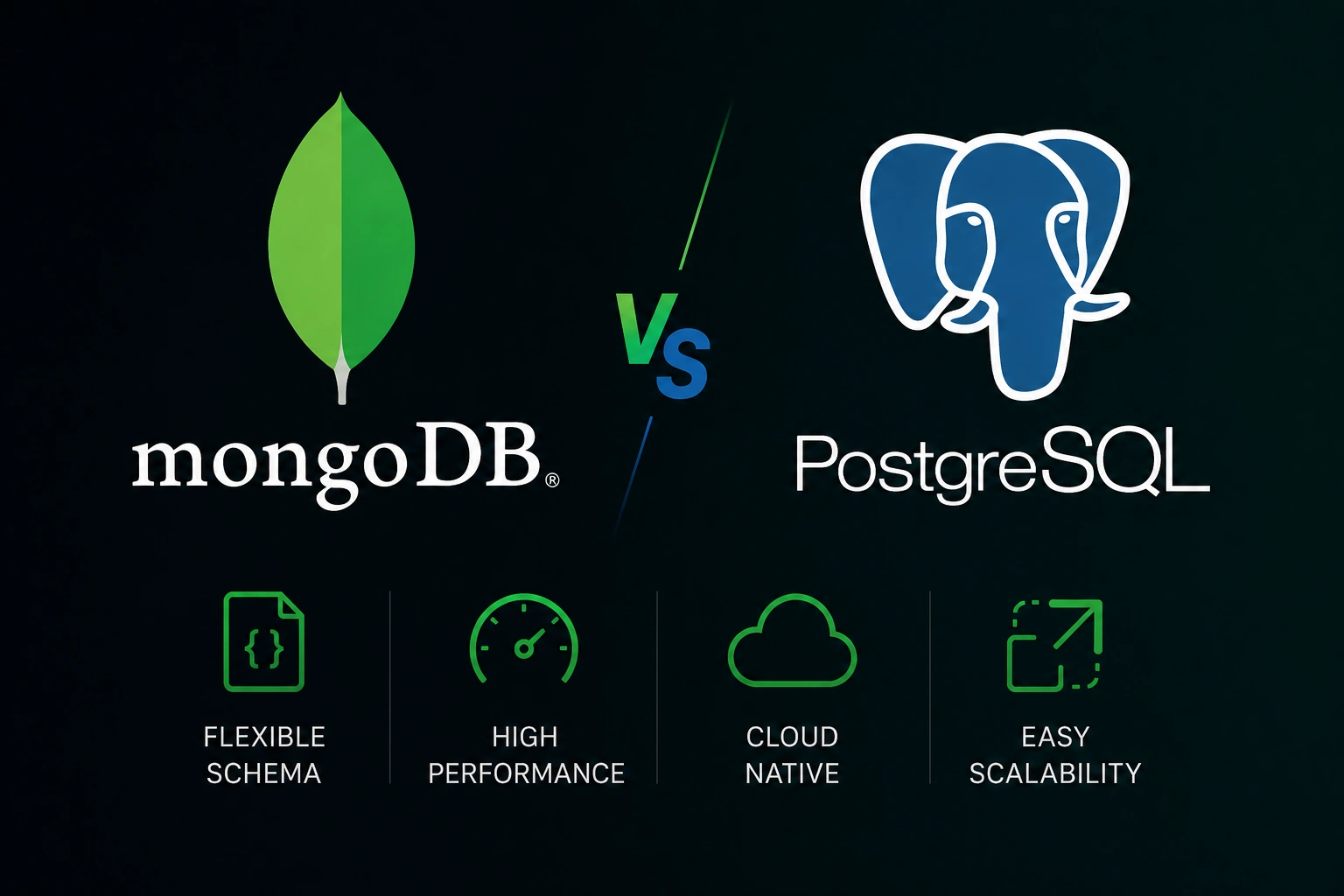
Why Developers Choose MongoDB Instead of PostgreSQL for Modern Applications
Why Developers Choose MongoDB Instead of PostgreSQL for Modern Applications
Choosing the right database is one of the most important decisions in modern software development. Two of the most popular databases today are MongoDB and PostgreSQL. Both are powerful, production-ready, and widely used across startups, enterprises, SaaS platforms, and modern web applications.
However, many developers increasingly choose MongoDB instead of PostgreSQL for certain types of applications because of its flexibility, scalability, and developer-friendly architecture.
MongoDB is a NoSQL document database designed for speed, flexibility, and rapid development. PostgreSQL, on the other hand, is a relational SQL database known for strong consistency, structured data management, and complex query capabilities.
The debate between MongoDB and PostgreSQL is not about which database is universally better. Instead, it depends heavily on the project requirements, scaling strategy, development speed, and data structure complexity.
Still, MongoDB continues gaining popularity among modern developers, especially in startups and rapidly evolving applications.
Flexible Schema Makes Development Faster
One of the biggest reasons developers prefer MongoDB is schema flexibility.
In PostgreSQL, developers must define strict schemas before storing data. Tables require predefined columns, relationships, and structures.
MongoDB works differently.
It stores data in JSON-like BSON documents, allowing developers to save flexible and dynamic data structures without predefined rigid schemas.
This flexibility becomes extremely useful in fast-moving projects where application requirements change frequently.
For example, in a startup environment, features evolve rapidly. New fields, objects, or nested structures may need to be added continuously.
With MongoDB, developers can modify data structures without performing complex database migrations.
This significantly speeds up development and iteration.
Perfect for Modern JavaScript Applications
MongoDB integrates naturally with JavaScript-based applications.
Modern full-stack development heavily relies on technologies such as Node.js, React, Next.js, and Express.
Since MongoDB stores data in JSON-like documents, developers can work with similar object structures across both frontend and backend systems.
This reduces transformation complexity between application code and database storage.
For JavaScript developers, MongoDB often feels more natural compared to relational SQL databases.
This is one reason the MERN stack became extremely popular:
MongoDB, Express.js, React, and Node.js.
The ecosystem allows developers to build full-stack applications efficiently using JavaScript across the entire stack.
Better for Rapidly Scaling Applications
MongoDB was designed with horizontal scalability in mind.
As applications grow, databases must handle increasing traffic, larger datasets, and more concurrent users.
MongoDB supports sharding, allowing data to be distributed across multiple servers easily.
This makes it highly suitable for applications expecting rapid growth.
Large-scale platforms often require distributed architectures capable of scaling efficiently across cloud infrastructure.
MongoDB’s distributed database model helps developers scale applications without heavily redesigning infrastructure.
PostgreSQL can scale extremely well too, but horizontal scaling in relational databases often becomes more complex compared to document-based systems.
Faster Development for Startups
Startups prioritize speed.
Early-stage companies frequently change product direction, features, business logic, and data models.
Rigid database schemas can slow down iteration.
MongoDB’s flexible architecture allows startups to ship features faster without worrying constantly about database migrations and schema updates.
This agility makes MongoDB highly attractive for MVP development, SaaS platforms, social applications, content systems, and rapidly evolving products.
Developers can focus more on building features instead of managing relational database complexity.
Document Storage Feels More Natural
Modern applications often deal with nested and unstructured data.
User profiles, chats, product catalogs, analytics events, notifications, comments, activity feeds, and API responses naturally fit document-based storage models.
MongoDB allows developers to store deeply nested objects directly inside documents.
In PostgreSQL, representing such relationships often requires multiple tables, joins, and relational mapping.
For many developers, MongoDB’s structure feels closer to how applications actually work internally.
This reduces complexity and improves readability.
Reduced Join Complexity
Relational databases rely heavily on joins.
PostgreSQL handles joins extremely well, but complex relational queries can become difficult to maintain as applications grow.
MongoDB reduces the need for joins by storing related data together inside documents.
For example, a user document can contain addresses, preferences, settings, and activity history inside a single structure.
This simplifies many application queries.
Developers can retrieve complete objects using fewer database operations.
This often improves performance for read-heavy applications.
Excellent Cloud and DevOps Support
MongoDB works extremely well in modern cloud-native environments.
Platforms like MongoDB Atlas provide fully managed cloud infrastructure with automatic scaling, backups, monitoring, and global distribution.
Developers can deploy scalable production databases quickly without complex server management.
MongoDB also integrates well with containerized environments, Kubernetes infrastructure, serverless applications, and modern DevOps workflows.
This makes it attractive for cloud-first engineering teams.
Why Many Startups Prefer MongoDB
Many successful startups initially choose MongoDB because of development speed and flexibility.
In early-stage products, speed often matters more than perfect relational architecture.
Founders want to validate ideas quickly, iterate fast, and adapt products based on user feedback.
MongoDB allows teams to move quickly without rigid schema restrictions.
This is especially useful for:
Social media platforms, AI products, SaaS dashboards, chat systems, analytics tools, content management systems, marketplaces, and real-time applications.
As long as developers design schemas properly, MongoDB can scale extremely effectively.
Real-Time Applications Work Well
MongoDB performs well for many real-time and dynamic applications.
Applications involving live chats, notifications, feeds, IoT data, streaming analytics, gaming systems, and user-generated content often benefit from document-based storage.
Frequent writes and rapidly changing structures are easier to manage in MongoDB.
The database is optimized for modern application workloads involving high-speed interactions and flexible datasets.
Strong Ecosystem and Community
MongoDB built a massive developer ecosystem.
It has strong community support, extensive documentation, official drivers for multiple languages, and integrations across cloud platforms and backend frameworks.
The learning curve is also relatively beginner-friendly for JavaScript developers.
Modern frameworks, APIs, authentication systems, and backend services commonly support MongoDB out of the box.
This contributes heavily to its adoption.
When PostgreSQL Is Still Better
Despite MongoDB’s advantages, PostgreSQL remains one of the most powerful databases in the world.
PostgreSQL is often better for applications requiring:
Complex joins, strict ACID compliance, financial systems, transactional integrity, relational consistency, advanced analytics, and highly structured enterprise data.
Industries such as banking, healthcare, ERP systems, and enterprise reporting often prefer PostgreSQL because of its strong relational guarantees.
PostgreSQL also supports advanced SQL querying, indexing, stored procedures, extensions, and mature transactional systems.
In many cases, PostgreSQL provides stronger long-term data consistency and relational modeling.
MongoDB Is Not Always Faster
A common misconception is that MongoDB is always faster than PostgreSQL.
The truth is more nuanced.
MongoDB can outperform relational databases in certain workloads involving flexible documents, distributed scaling, and simple object retrieval.
However, PostgreSQL may outperform MongoDB in complex relational queries, transactional operations, and analytical workloads.
Performance depends heavily on schema design, indexing, query optimization, infrastructure, and application architecture.
The Rise of Hybrid Architectures
Many modern companies now use both MongoDB and PostgreSQL together.
Different databases solve different problems.
For example:
MongoDB may handle user activity feeds, analytics, and flexible application data.
PostgreSQL may handle payments, transactions, reporting, and financial operations.
This hybrid approach allows companies to leverage the strengths of both systems.
Modern architecture increasingly focuses on choosing the best tool for each workload rather than forcing everything into one database.
Conclusion
MongoDB became popular because it aligns extremely well with modern application development.
Its flexible schema, JSON-like document structure, scalability, cloud-native design, and developer-friendly experience make it highly attractive for startups, SaaS platforms, real-time systems, and rapidly evolving products.
For developers building modern JavaScript applications, MongoDB often feels faster, simpler, and more natural compared to traditional relational databases.
However, PostgreSQL remains one of the best choices for structured data, transactional systems, financial platforms, and complex relational workloads.
The decision between MongoDB and PostgreSQL ultimately depends on project requirements.
Neither database is universally superior.
But for speed, flexibility, rapid iteration, and scalable modern applications, many developers increasingly choose MongoDB as their primary database solution.
shareShare this post
recommendYou may also like
BUSINESSTECHNOLOGYMicrosoft Ignite 2026: Satya Nadella Puts AI Agents, Copilot and Enterprise Cloud at the Centre of Microsoft's Next Technology RevolutionFlipFileZone · Read Fullopen_in_new BUSINESSTECHNOLOGYChina Uses American AI Models to Train Domestic Rivals as US Chip Restrictions Intensify the Global Artificial Intelligence RaceFlipFileZone · Read Fullopen_in_new
 BUSINESSTECHNOLOGYNvidia Leadership Turmoil Raises Concerns Over AI Industry Financing as Investors Rethink the Future of the AI BoomFlipFileZone · Read Fullopen_in_new
 TECHNOLOGYGovernor Gulab Chand Kataria launches Shaheed Bhagat Singh Youth Facilitation Centre in LudhianaFlipFileZone · Read Fullopen_in_new
 TECHNOLOGYInstinct AI Assistant Secures $350M Funding, Hits $2.5B Valuation in Record TimeFlipFileZone · Read Fullopen_in_new
 TECHNOLOGYXiaomi Unveils Xring Chip with TSMC Partnership, Redefining Its Global Hardware StrategyFlipFileZone · Read Fullopen_in_new
 TECHNOLOGYApple’s AI‑Powered Camera AirPods Could Launch in 2026, Not 2027FlipFileZone · Read Fullopen_in_new
chatPost a comment
Comments
0