 TECH GUIDESConvert XLS to XLSX Online Free — Upgrade Old Excel Files in SecondsFlipFileZone · Read Fullopen_in_new
Will Rust Replace C++?
Rust offers compile-time memory safety matching C++'s performance, driving real adoption in OS kernels and browsers. Yet C++'s legacy codebases and mature ecosystem suggest coexistence, not full replacement, ahead.You said: 3 comma separated tags and keywords
FlipFileZone · TECH GUIDES
shareShare this post






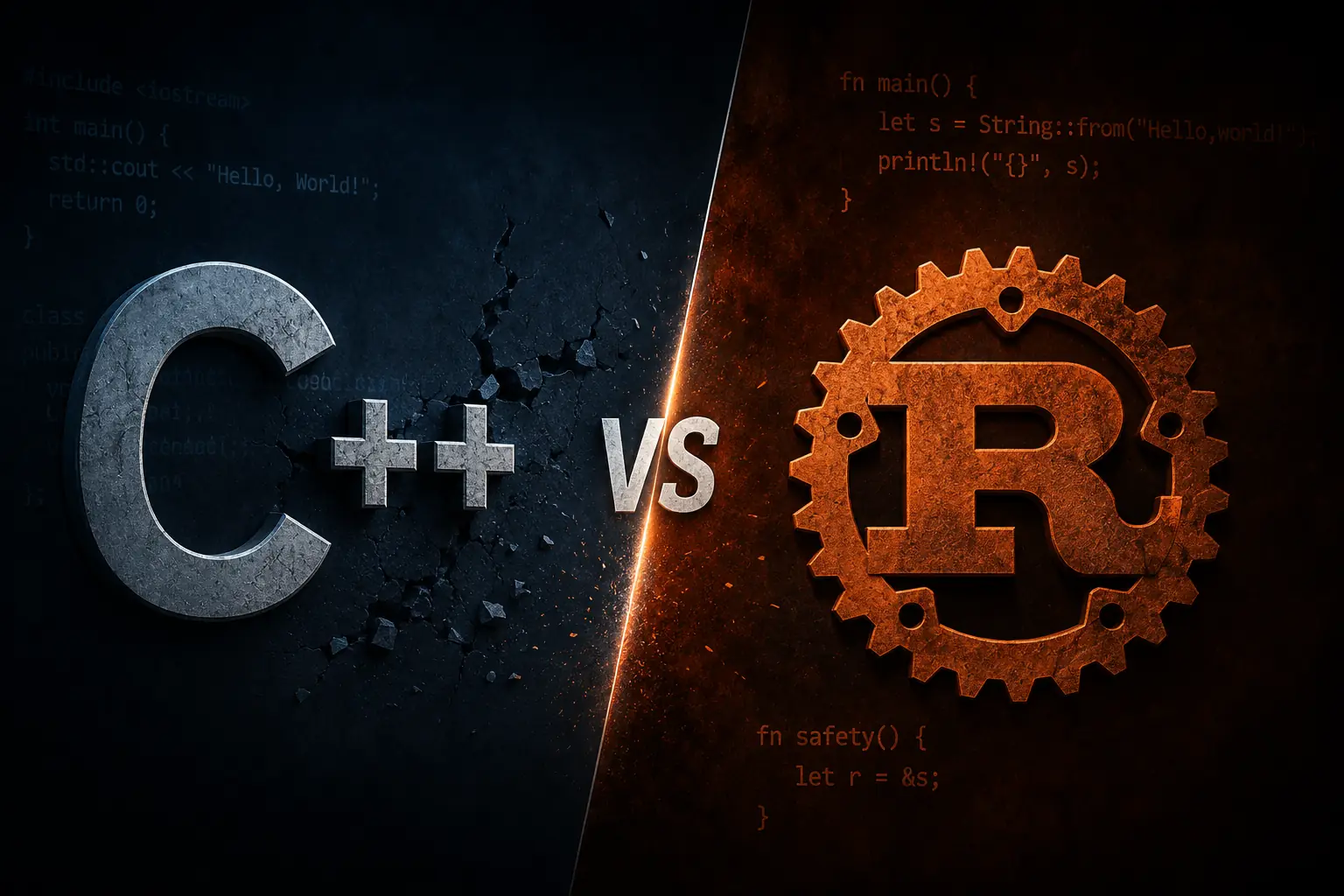
Few questions provoke as much passionate debate in systems programming communities as this one. Rust, a language first released in stable form in 2015, has grown from a niche project at Mozilla into one of the most discussed languages in software engineering, repeatedly topping Stack Overflow's "most loved language" survey. C++, by contrast, has been the dominant language for performance-critical software since the late 1980s and still powers the overwhelming majority of operating systems, game engines, browsers, and embedded systems running today. The question of whether Rust will replace C++ is really a question about memory safety, legacy code, ecosystem maturity, and how quickly massive, decades-old codebases can realistically change. This article examines the evidence on both sides in detail, rather than assuming the answer in advance.
Why the Question Exists in the First Place
To understand why this debate is taken seriously rather than dismissed outright, it helps to understand the core problem Rust was designed to solve. C++ gives programmers direct, manual control over memory: you allocate it, you decide when to free it, and the language trusts you to do this correctly. This trust is also the source of an enormous and well-documented class of bugs — use-after-free errors, buffer overflows, double-frees, and dangling pointers — collectively known as memory-safety vulnerabilities.
These aren't theoretical concerns. Multiple independent studies from major software organizations have found that the vast majority of severe security vulnerabilities in large C and C++ codebases trace back to memory-safety issues. Microsoft's security engineers have stated that around 70 percent of the vulnerabilities they assign CVEs to each year continue to be memory-safety issues, a number that has remained roughly consistent for the past decade. A 2022 study from Google similarly found that the percentage of memory-safety vulnerabilities in Android dropped sharply as the proportion of new code written in memory-safe languages increased, falling from 76 percent in 2019 to 24 percent in 2022. These figures are central to why Rust exists at all: it was explicitly designed to eliminate this entire category of bug at compile time, without sacrificing the performance characteristics that make C++ attractive in the first place.
How Rust Solves the Memory Safety Problem
Rust's central innovation is its ownership and borrowing system, enforced entirely at compile time by a component of the compiler informally called the "borrow checker." Every value in Rust has a single owner, and when that owner goes out of scope, the value is automatically deallocated — similar in spirit to C++'s RAII (Resource Acquisition Is Initialization) idiom, but enforced by the compiler rather than left to programmer discipline.
rust
fn main() {
    let s1 = String::from("hello");
    let s2 = s1; // ownership of the string moves to s2
    // println!("{}", s1); // COMPILE ERROR: s1 no longer owns the value
    println!("{}", s2); // valid
}
In C++, the equivalent mistake — using a std::string after it has been moved from, or worse, after the underlying buffer has been freed by a raw delete — compiles without error and may only manifest as a crash, or worse, a silent security vulnerability, much later at runtime. Rust converts this entire class of error into a compile-time failure, which is precisely the property that makes it attractive for security-critical software. The Rust compiler documentation explains these rules in detail in the freely available Rust Programming Language book, often referred to as "the Rust book."
Beyond ownership, Rust's type system also enforces strict rules around concurrent access to data — you cannot have a mutable reference to a value while another reference to it exists, a rule checked entirely at compile time. This eliminates a large class of data races by construction, something C++ has no equivalent compile-time guarantee for; data races in concurrent C++ code are typically only caught at runtime, if at all, using tools like ThreadSanitizer.
How C++ Has Responded: Smart Pointers, RAII, and Safety Profiles
It's a mistake to think of C++ as a static target frozen in the 1990s. Modern C++ (C++11 through C++23) has steadily added features that reduce, though do not eliminate, the memory-safety risks of older C-style code. Smart pointers like std::unique_ptr and std::shared_ptr, introduced in C++11, automate deallocation in a way conceptually similar to Rust's ownership model:
javascript
#include <memory>

void example() {
    std::unique_ptr<int> p = std::make_unique<int>(42);
    // p is automatically deleted when it goes out of scope
} // no manual delete needed
The crucial difference is enforcement. C++'s smart pointers are a library convention that a disciplined programmer can opt into; nothing stops a developer on the same team from mixing in a raw new/delete pair, or from accidentally retaining a raw pointer to memory owned by a unique_ptr after it has been freed. Rust's ownership rules, by contrast, are enforced by the compiler for every single value in the program, with no opt-out short of explicitly marking code unsafe.
In response to mounting pressure — both from Rust's rise and from government security advisories discussed below — the C++ standards committee has begun exploring more aggressive safety mechanisms. Herb Sutter, a long-time chair of the ISO C++ standards committee, published a widely discussed proposal in 2023 called "C++ Safety Profiles", aiming to add compiler-enforced safety guarantees to C++ without breaking existing code or abandoning the language's core philosophy of zero-overhead abstraction. As of this writing, these profiles remain a work in progress rather than a shipped, widely adopted standard feature, which illustrates one of the central tensions in this debate: C++ can technically add Rust-like safety guarantees, but doing so without breaking forty years of existing code is a much harder engineering and political problem than designing such guarantees into a brand-new language from scratch.
Performance: A Largely Settled Question
One claim that used to be more contentious is now broadly accepted: Rust's performance is comparable to C++'s in the vast majority of real-world workloads. Both languages compile to native machine code via LLVM-based or similarly optimizing backends, both give programmers control over memory layout and avoid garbage collection, and both support zero-cost abstractions, where high-level constructs compile down to code as efficient as hand-written low-level equivalents. Benchmark suites like the Computer Language Benchmarks Game consistently show Rust and C++ trading places at the top, with differences typically attributable to specific algorithm implementations rather than any fundamental limitation of either language.
This matters enormously for the "will Rust replace C++" question, because it removes what would otherwise be the single biggest practical objection. If Rust were meaningfully slower, the safety benefits would be a much harder sell for performance-critical domains like game engines, high-frequency trading, or embedded firmware. Because the performance gap is negligible in practice, the debate has shifted almost entirely to ecosystem maturity, legacy code, and developer experience — not raw execution speed.
Where Rust Is Already Winning: Real Adoption Evidence
Rather than treating this as a purely theoretical debate, it's worth looking at concrete adoption decisions made by major engineering organizations, since these decisions reflect real cost-benefit analysis under production constraints rather than abstract preference.
The Linux kernel began accepting Rust code as an experimental option starting with Linux 6.1 in late 2022, a genuinely landmark decision given the kernel's status as one of the largest and most conservative C codebases in existence. As of recent kernel releases, Rust support continues to expand, with maintainers explicitly framing it as a way to reduce a class of memory-safety bugs that have historically plagued driver code written in C. This does not mean the kernel is being rewritten in Rust — the core remains overwhelmingly C — but it signals that even the most safety-skeptical corners of systems programming now consider Rust viable for new code.
Google's Android team has been one of the most vocal adopters, citing concrete vulnerability reduction data. Google has stated publicly that no memory-safety vulnerabilities have been discovered in Android's Rust code, despite Rust now accounting for a significant and growing share of new native code written for the platform. Google has applied similar reasoning to parts of Chrome and ChromeOS, gradually introducing Rust into security-sensitive parsing code (such as image and font parsing) where memory-safety bugs have historically been a major source of exploitable vulnerabilities.
Microsoft's security engineering team has also been outspoken on this topic, with senior engineers stating in public talks and blog posts that, given the consistent ~70 percent memory-safety vulnerability rate cited earlier, Microsoft has begun using Rust for new components in Windows, particularly in the kernel and core OS layers, where memory-safety bugs carry the highest security risk.
Amazon Web Services built Firecracker, the lightweight virtual machine technology underlying AWS Lambda, in Rust from the ground up, explicitly citing memory safety and performance as joint motivations, and has published open-source code and engineering blog posts explaining this choice in detail.
Discord famously rewrote a core piece of backend infrastructure (responsible for tracking "read states") from Go to Rust, publishing a widely circulated engineering blog post explaining that Rust's lack of garbage collection eliminated latency spikes ("garbage collection pauses") that had been causing performance problems — though notably, this case compares Rust to Go rather than to C++, illustrating that Rust's appeal extends beyond just displacing C++.
These examples share a common pattern: organizations are not rewriting existing, working C++ systems wholesale. Instead, they are choosing Rust for new code, particularly in security-sensitive or greenfield components, while leaving large existing C++ codebases largely untouched. This distinction — new code versus legacy code — turns out to be central to answering the original question.
Government and Industry Pressure Toward Memory-Safe Languages
This debate has moved beyond engineering teams into the realm of national policy. In February 2024, the White House Office of the National Cyber Director released a report explicitly urging software manufacturers to adopt memory-safe programming languages, citing decades of preventable vulnerabilities rooted in memory-unsafe languages like C and C++. The U.S. National Security Agency has issued similar guidance, recommending that organizations developing new software consider memory-safe languages including Rust, Go, C#, Java, and Swift, and that organizations maintaining legacy C and C++ codebases adopt strict compiler warnings, static analysis tools, and sanitizers to mitigate risk where rewriting isn't feasible.
This kind of policy pressure adds a dimension to the debate that pure technical comparison doesn't capture: even organizations that are technically satisfied with C++'s performance and tooling may face external pressure — from regulators, from customers demanding security guarantees, or from cyber-insurance requirements — to adopt memory-safe alternatives for new development, independent of whether engineers personally prefer one language over another.
Why C++ Isn't Going Anywhere Soon: The Case for Coexistence
Despite all of the above, there are substantial reasons to doubt that Rust will fully "replace" C++ in any near-term or even medium-term sense, and these reasons deserve equal weight.
The sheer scale of existing C++ code is staggering. Major game engines (Unreal Engine, large portions of Unity's runtime), most operating system kernels outside of Linux's experimental Rust modules, the core of most major web browsers, large swaths of financial trading infrastructure, and enormous amounts of embedded and automotive software are written in C++, often spanning millions of lines accumulated over decades. Rewriting working, battle-tested software carries substantial risk — every rewrite introduces the possibility of reintroducing bugs that were fixed in the original code years ago, and the business case for rewriting code that already works, purely for safety guarantees, is often hard to justify against feature development that generates revenue.
The learning curve is a genuine practical barrier. Rust's borrow checker, while powerful, has a well-documented reputation for being difficult for newcomers, particularly those coming from garbage-collected languages without prior exposure to manual memory management concepts. Experienced C++ developers transitioning to Rust often describe an initial period of frustration sometimes called "fighting the borrow checker," where code that seems logically correct is rejected by the compiler until the programmer restructures it to satisfy Rust's stricter ownership rules. This learning curve has real organizational costs in training time and reduced initial productivity, even if it pays off in reduced bug rates later.
C++'s ecosystem and tooling maturity remains, in many domains, more developed. Decades of accumulated libraries, mature IDE integrations, established debugging and profiling tools, and a vast pool of experienced engineers give C++ practical advantages that a newer language, however technically elegant, takes years to fully replicate. Domains like game development, scientific computing (with libraries like Eigen for linear algebra), and certain embedded toolchains have C++ libraries and compiler support refined over twenty-plus years that Rust's ecosystem, while growing quickly, has not yet fully matched.
Interoperability concerns cut both ways. Calling C++ code from Rust, or vice versa, is possible but adds friction — Rust's safety guarantees don't extend across an FFI (foreign function interface) boundary into C++ code, meaning a hybrid codebase only gets the safety benefits in the portions actually written in Rust. This creates an incentive for organizations to either commit fully to a rewrite (high cost, high risk) or to use Rust only at the margins for new, isolated components (lower cost, but limited safety benefit for the codebase as a whole) — the strategy most of the adoption examples above actually follow.
A More Precise Framing: Augmentation, Not Replacement
Given the evidence on both sides, the framing of "will Rust replace C++" may itself be slightly misleading. A more accurate description of the current trajectory, based on the adoption patterns of organizations like Google, Microsoft, AWS, and the Linux kernel project, is that Rust is increasingly becoming the default choice for new, security-sensitive systems-level software, while C++ continues to dominate existing large-scale codebases and certain domains — particularly game development, high-performance computing, and areas with deep, mature C++-specific tooling — where the cost of switching outweighs the safety benefits, at least for now.
This pattern mirrors how previous language transitions have actually unfolded historically, rather than the more dramatic "language X is dead" narratives that often circulate online. C itself was never fully replaced by C++; it remains dominant in operating system kernels, embedded firmware, and anywhere minimal runtime overhead and a small language surface matter most. It seems plausible, based on current evidence, that C++ will follow a similar long-tail trajectory: not disappearing, but gradually ceding share in new development to memory-safe alternatives like Rust, particularly in domains where security is a primary concern, while retaining a long-term presence in legacy systems, performance-critical niches, and domains with entrenched tooling.
Counterpoints Worth Taking Seriously
It would be incomplete to present only the pro-Rust adoption narrative without noting credible pushback from experienced C++ practitioners. Some argue that the C++ committee's ongoing safety-profile work, alongside widespread use of static analyzers (like Clang-Tidy and PVS-Studio) and sanitizers (AddressSanitizer, UndefinedBehaviorSanitizer), can close much of the practical safety gap without requiring a full language switch, and that well-disciplined teams using modern C++ idioms (smart pointers, RAII, the C++ Core Guidelines) already avoid the vast majority of memory-safety bugs that plague older, undisciplined C-style code. Others point out that Rust itself permits unsafe blocks for low-level operations that the borrow checker cannot verify, and that real-world Rust codebases — particularly those interfacing with hardware or legacy C libraries — do still contain unsafe code, meaning Rust's safety guarantees, while statistically strong, are not an absolute guarantee of bug-free software either.
There is also a cultural and organizational dimension that's easy to overlook in a purely technical comparison: large engineering organizations often have decades of institutional knowledge, internal tooling, and trained personnel built specifically around C++. The cost of switching isn't just rewriting code — it's retraining engineers, rebuilding internal tooling, and accepting short-term productivity loss during the transition, costs that are real and substantial even when the long-term safety case for Rust is compelling.
Conclusion
The evidence suggests that "replace" is too strong and too binary a word for what's actually happening. Rust has demonstrated, through adoption by organizations like Google, Microsoft, Amazon, and the Linux kernel project, that it can match C++'s performance while eliminating an entire, well-documented class of memory-safety vulnerabilities that has plagued the software industry for decades — a case strong enough that even government cybersecurity agencies are now actively recommending the shift for new development. At the same time, the sheer volume of existing, working C++ code, combined with C++'s deep ecosystem maturity in domains like game development and embedded systems, and the C++ committee's own ongoing efforts to add compiler-enforced safety guarantees, make a full displacement of C++ unlikely within any near-term horizon.
The more defensible prediction, based on current evidence rather than speculation, is coexistence with a gradually shifting balance: Rust capturing an increasing share of new, security-critical systems programming, particularly in operating systems, browsers, and cloud infrastructure, while C++ continues to dominate legacy codebases and specific high-performance niches for years, likely decades, to come. Anyone choosing between the two languages today is better served by evaluating the specific tradeoffs for their project — team experience, existing codebase, security requirements, and ecosystem needs — than by assuming either language is on an inevitable path to obsolescence.
Further Reading
- The Rust Programming Language (the official book) — the definitive, freely available introduction to Rust's ownership and borrowing model.
- Herb Sutter's "Safety in Context" — the C++ standards committee chair's detailed proposal for adding compiler-enforced safety profiles to C++.
- Google Security Blog: Memory Safety in Android — Google's published data on memory-safety vulnerability trends as Rust adoption increased in Android.
- Rust for Linux — the official project page tracking Rust's integration into the Linux kernel.
- ONCD Technical Report on Memory Safety (2024) — the White House Office of the National Cyber Director's report urging adoption of memory-safe languages.
shareShare this post
recommendYou may also like
TECH GUIDESConvert XLS to XLSX Online Free — Upgrade Old Excel Files in SecondsFlipFileZone · Read Fullopen_in_new TECH GUIDESConvert PNG to ICO Online Free — Create Favicons and Windows Icons in SecondsFlipFileZone · Read Fullopen_in_new
 TECH GUIDESConvert Markdown to PDF Online Free — Turn .md Files Into PDF in SecondsFlipFileZone · Read Fullopen_in_new
 TECH GUIDESConvert SVG to PNG Online Free — Export Vector Graphics as Images in SecondsFlipFileZone · Read Fullopen_in_new
 TECH GUIDESConvert GIF to MP4 Online Free — Turn Animated GIFs Into Video in SecondsFlipFileZone · Read Fullopen_in_new
 TECH GUIDESConvert WAV to MP3 Online Free — Compress Audio Files in SecondsFlipFileZone · Read Fullopen_in_new
 TECH GUIDESConvert MOV to MP4 Online Free — Convert iPhone Videos in SecondsFlipFileZone · Read Fullopen_in_new
chatPost a comment
Comments
0