 BUSINESSTECHNOLOGYMicrosoft Ignite 2026: Satya Nadella Puts AI Agents, Copilot and Enterprise Cloud at the Centre of Microsoft's Next Technology RevolutionFlipFileZone · Read Fullopen_in_new
Windows 'MiniPlasma' Zero-Day Exploit: A New Threat
A new Windows zero-day exploit, 'MiniPlasma', has been released, giving attackers SYSTEM access on fully patched Windows systems, posing a significant threat to user security and data integrity
FlipFileZone · TECHNOLOGY
shareShare this post






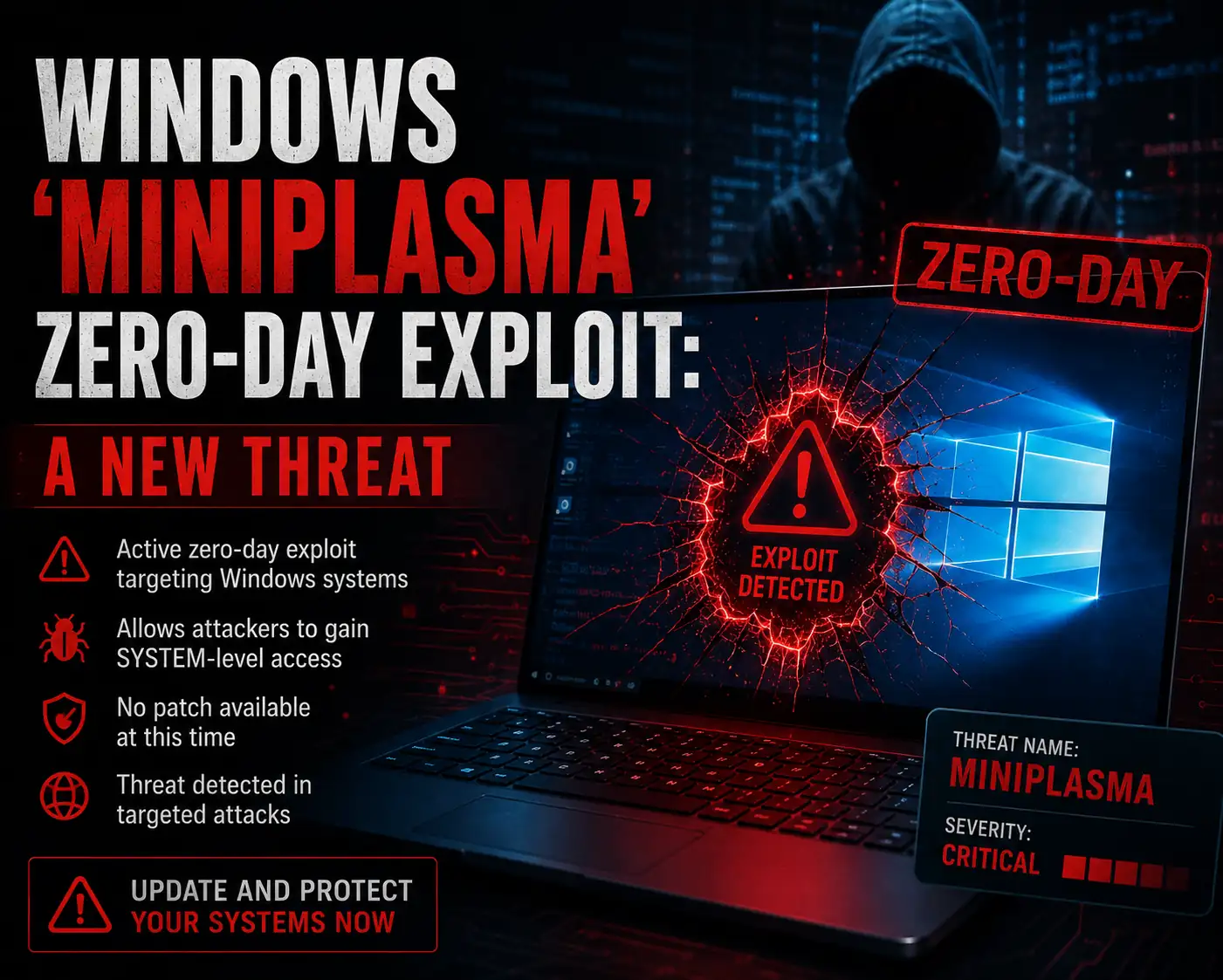
Windows 'MiniPlasma' Zero-Day Exploit: A New Threat
Introduction to MiniPlasma
A cybersecurity researcher, known as Chaotic Eclipse, has released a proof-of-concept exploit for a Windows privilege escalation zero-day dubbed 'MiniPlasma'. This exploit allows attackers to gain SYSTEM privileges on fully patched Windows systems, highlighting a significant vulnerability in the operating system's security. The researcher claims that Microsoft failed to properly patch a previously reported 2020 vulnerability, which was originally assigned the CVE-2020-17103 identifier and reportedly fixed in December 2020.
The 'MiniPlasma' exploit targets the cldflt.sys Cloud Filter driver and its HsmOsBlockPlaceholderAccess routine. According to Chaotic Eclipse, the exact same issue reported to Microsoft by Google Project Zero researcher James Forshaw in September 2020 is still present and unpatched. This raises concerns about the effectiveness of Microsoft's patching process and the potential for similar vulnerabilities to exist in the system.
✦✦✦
Technical Details and Implications
The 'MiniPlasma' exploit appears to abuse how the Windows Cloud Filter driver handles registry key creation through an undocumented CfAbortHydration API. This allows attackers to create arbitrary registry keys in the .DEFAULT user hive without proper access checks, potentially enabling privilege escalation. The exploit has been tested on a fully patched Windows 11 Pro system, and it successfully opened a command prompt with SYSTEM privileges.
Principal vulnerability analyst at Tharros, Will Dormann, also confirmed that the exploit works on the latest public version of Windows 11. However, he noted that the flaw does not work in the latest Windows 11 Insider Preview Canary build, suggesting that Microsoft may have already addressed the issue in their latest internal builds.
The release of the 'MiniPlasma' exploit is part of a recent string of Windows zero-day disclosures by the researcher. This highlights the ongoing cat-and-mouse game between security researchers and Microsoft, as well as the need for continuous vigilance and improvement in the operating system's security posture.
✦✦✦
Mitigation and Response
To detect exploitation of the 'MiniPlasma' vulnerability, organizations can monitor specific registry keys for modifications using their Endpoint Detection and Response (EDR) platforms. The ZeroTrust platform ThreatLocker recommends monitoring the \Registry\User\Software\Policies\Microsoft\CloudFiles\BlockedApps* and \Registry\User\.DEFAULT\Volatile Environment* keys for any suspicious activity.
The release of the 'MiniPlasma' exploit serves as a reminder of the importance of keeping systems up to date and being proactive in addressing potential security vulnerabilities. As the cybersecurity landscape continues to evolve, it is essential for organizations and individuals to remain vigilant and adapt to new threats and exploits.
shareShare this post
recommendYou may also like
BUSINESSTECHNOLOGYMicrosoft Ignite 2026: Satya Nadella Puts AI Agents, Copilot and Enterprise Cloud at the Centre of Microsoft's Next Technology RevolutionFlipFileZone · Read Fullopen_in_new BUSINESSTECHNOLOGYChina Uses American AI Models to Train Domestic Rivals as US Chip Restrictions Intensify the Global Artificial Intelligence RaceFlipFileZone · Read Fullopen_in_new
 BUSINESSTECHNOLOGYNvidia Leadership Turmoil Raises Concerns Over AI Industry Financing as Investors Rethink the Future of the AI BoomFlipFileZone · Read Fullopen_in_new
 TECHNOLOGYGovernor Gulab Chand Kataria launches Shaheed Bhagat Singh Youth Facilitation Centre in LudhianaFlipFileZone · Read Fullopen_in_new
 TECHNOLOGYInstinct AI Assistant Secures $350M Funding, Hits $2.5B Valuation in Record TimeFlipFileZone · Read Fullopen_in_new
 TECHNOLOGYXiaomi Unveils Xring Chip with TSMC Partnership, Redefining Its Global Hardware StrategyFlipFileZone · Read Fullopen_in_new
 TECHNOLOGYApple’s AI‑Powered Camera AirPods Could Launch in 2026, Not 2027FlipFileZone · Read Fullopen_in_new
chatPost a comment
Comments
0