 TECH GUIDESConvert XLS to XLSX Online Free — Upgrade Old Excel Files in SecondsFlipFileZone · Read Fullopen_in_new
With AI Writing Most of the Code Now, What Should CSE Students Actually Focus on Learning in 2026?
AI handles routine code generation, so CSE students must prioritize algorithms, system design, mathematical foundations, security, ML literacy, and communication—skills that judge, direct, and take responsibility for AI output.
FlipFileZone · TECH GUIDES
shareShare this post






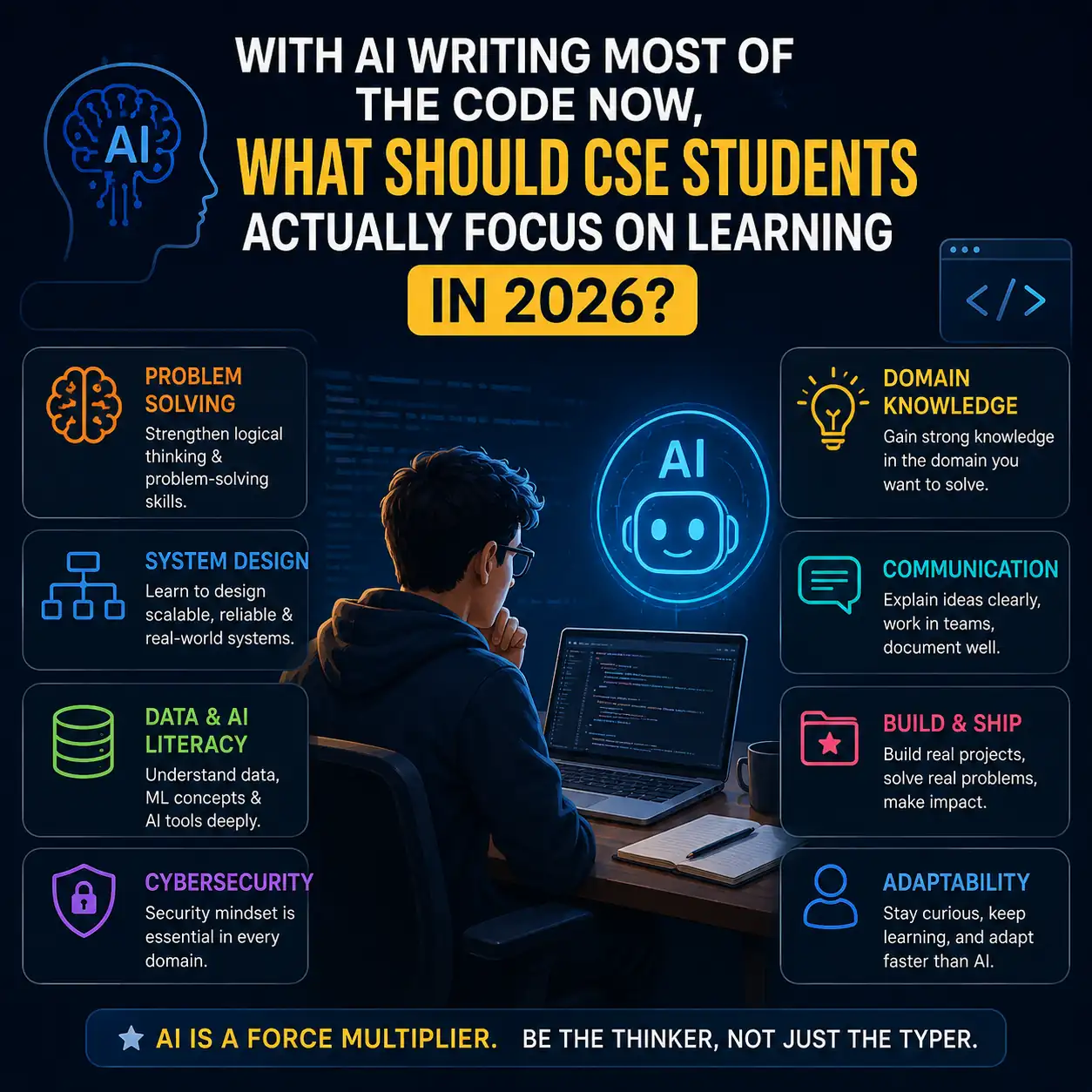
There is a version of this question that is pure anxiety, and there is a version that is genuinely worth thinking about carefully. The anxious version goes: "AI writes code better than I do, so why bother learning computer science at all?" The version worth thinking about goes: "Given that AI coding tools have dramatically changed what a software engineer spends their time on, what should a CSE student invest in learning so that they are genuinely valuable when they graduate?" This article is about the second question.
The honest starting point is that AI tools have made certain things dramatically easier: generating a working CRUD endpoint, scaffolding a project from a description, writing boilerplate test cases, explaining an unfamiliar codebase, and suggesting implementations for well-defined, narrow problems. These are real capabilities, and they are already reflected in the job market — junior roles that primarily consisted of writing routine, specification-following code have become more competitive, and some have been compressed in headcount altogether. But they have not made the underlying computer science obsolete. They have, if anything, shifted the bottleneck from "can you write the code" to "can you judge whether the code is right, design the system it lives in, and solve the problems AI tools can't decompose by themselves." This article unpacks what that shift means concretely for a student in 2026 who wants to be employable, growing, and genuinely valuable in this field five to ten years from now.
1. Foundations First: Data Structures and Algorithms Are Not Negotiable
The first and most important thing to say, before anything else, is that the fundamentals of computer science — data structures, algorithms, and complexity analysis — have not been made less relevant by AI code generation. They have, if anything, become a more critical differentiator, for a specific reason: AI-generated code is frequently functionally correct on small inputs and subtly, catastrophically wrong on large ones, and catching the difference requires exactly the algorithmic and complexity intuition that strong CS fundamentals build.
When a language model generates a nested-loop solution to a problem that has a well-known linear-time algorithm, it produces code that passes all the test cases a junior developer is likely to write (small, clean inputs) and fails only at scale, which is precisely when failure is most expensive. A developer without algorithmic training can't catch this. A developer who understands why an O(n²) algorithm is categorically different from an O(n log n) one catches it in code review in thirty seconds.
The same logic applies to data structure selection. AI tools tend to default to common, familiar structures (lists, dictionaries) regardless of whether a set, a heap, a trie, or a balanced BST would be more appropriate for the actual problem. A developer who has genuinely internalized when to use each structure, and why, catches these mismatches. One who hasn't treats whatever the model generated as a black box to be trusted, which is exactly the wrong relationship to have with AI-generated code in a production system.
Resources: Knuth's The Art of Computer Programming remains the deepest reference, though it's dense. For practical algorithmic preparation, Leetcode and CSES Problem Set remain the most widely used platforms for deliberate practice; for conceptual depth, MIT OpenCourseWare's 6.006 Introduction to Algorithms is freely available and rigorous.
2. Systems Programming: Understanding What Actually Runs Under the Hood
One of the most reliable predictions about the AI era of software development is that "high-level" work — building features, writing application-layer logic, wiring together APIs — is the layer that AI tools are best at, and therefore the layer most vulnerable to compression. The layer that remains stubbornly resistant to full AI automation is the one closest to the hardware: operating systems, compilers, memory allocators, networking stacks, database engines, and the other foundational systems that everything else runs on top of. This is partly because these systems require intimate knowledge of hardware behavior that doesn't translate into natural-language descriptions well, and partly because the correctness requirements are so strict and the failure modes so subtle that AI-generated systems code currently cannot be trusted without deep expert verification.
More importantly for a student: understanding how these systems work is what allows a developer to correctly diagnose why a high-level application misbehaves. A Python web service that has a mysterious memory leak can only be debugged by someone who understands how memory allocation and garbage collection work at a level below Python's abstraction layer. A database query that inexplicably takes forty seconds instead of four hundred milliseconds can only be understood by someone who knows how database engines build and use indexes, how disk I/O and buffer pools work, and what a query plan actually represents.
The foundational text for this layer of understanding remains Bryant and O'Hallaron's Computer Systems: A Programmer's Perspective (commonly abbreviated CS:APP), which walks through the entire path from C source code to hardware execution with unusual rigor and clarity. Carnegie Mellon's course based on this book is freely available with lectures and assignments. Students who complete it genuinely think differently about what code is doing when it runs.
3. System Design: The Skill That Separates Engineers from Code Typists
If data structures and algorithms are the sharpest differentiator in technical interviews at strong companies, system design is the sharpest differentiator in the actual work of being a software engineer on a team building something real. System design is the practice of taking a vague, large-scale requirement ("design a URL shortener that handles a billion requests per day" or "design the infrastructure for a real-time collaborative document editor") and producing a concrete, defensible architectural plan: which databases, why; how to handle failure at each point; how to scale horizontally; where caches live and what they cache; how clients and servers communicate; what happens to data in flight when a server dies.
AI tools are, at this writing, genuinely poor at this task. They can describe the components of common architectures, but they cannot reason about the specific tradeoffs of a proposed design given actual numbers (how much data, how many users, what latency target, what consistency requirement), and they cannot catch when a proposed architecture has a critical single point of failure, a data-consistency problem, or a scaling bottleneck that makes it unsuitable for the actual use case. This is the kind of reasoning that requires genuinely understanding distributed systems, storage systems, and networking — not just having seen descriptions of them.
Resources for building this fluency: Martin Kleppmann's Designing Data-Intensive Applications is widely regarded as the best single book on this topic — it covers databases, distributed systems, stream processing, and consistency models with unusual depth and clarity, and is available at dataintensive.net. The system-design-primer repository on GitHub, with over 250,000 stars, is an excellent free starting point for interview and self-study preparation. For students interested in the academic side, MIT's 6.824 Distributed Systems course, with freely available lecture notes and labs, is one of the most rigorous treatments available anywhere.
4. Mathematical Maturity: The Invisible Foundation
Mathematics has always been the invisible substrate of computer science, but its importance has paradoxically increased in the AI era because the most interesting and economically valuable open problems in computing right now — large language models, computer vision, reinforcement learning, cryptography, formal verification, computational biology — are all primarily mathematical problems with code as their implementation. A student who lacks mathematical fluency is locked out of understanding, contributing to, or critically evaluating work at the frontier of the field.
The specific mathematical areas most relevant to current computer science divide roughly as follows:
Linear algebra underlies virtually all of modern machine learning. Neural networks are, at bottom, compositions of matrix multiplications and nonlinear functions. Understanding why matrix operations work the way they do, what singular value decomposition means geometrically, and why certain matrix properties matter for optimization is the difference between treating a neural network as a black box and actually understanding what it's doing. 3Blue1Brown's Essence of Linear Algebra video series on YouTube is, by wide consensus, the most visually intuitive introduction to the subject ever produced.
Probability and statistics matter for understanding both machine learning models (which are fundamentally probabilistic objects) and for the more mundane but equally important practice of reasoning correctly about system performance, A/B testing results, and observability data. A developer who cannot correctly interpret a confidence interval or recognize a selection bias in a dataset is a liability in any data-informed organization, regardless of how well they can implement a feature.
Discrete mathematics — graph theory, combinatorics, logic, and number theory — underlies algorithm analysis, compiler design, database query optimization, and cryptography. A student who never takes this seriously will find themselves unable to understand why certain algorithms work, unable to read proofs in academic papers, and unable to engage with the theoretical side of the field.
Calculus and optimization are the foundation of how neural networks are actually trained (gradient descent is calculus applied to loss minimization), and of understanding why certain optimization algorithms converge and others don't.
5. Machine Learning and AI Literacy — But the Right Kind
Every CSE student in 2026 should have genuine, not merely superficial, AI/ML literacy. But this requires clarifying what "genuine literacy" means, because there is a wide range of what's on offer under the "learn AI" banner, and much of it produces exactly the wrong kind of understanding for a student who wants to be genuinely valuable rather than just familiar with the vocabulary.
The wrong kind of AI literacy: knowing how to call the OpenAI API, knowing how to use a Jupyter notebook with a pre-trained model, knowing marketing-level descriptions of what LLMs "are." This kind of knowledge can be acquired in a weekend and is already saturated in the job market.
The right kind of AI literacy for a CSE student: understanding how neural networks actually learn (the mechanics of forward and backward propagation, what a loss function is minimizing, why certain architectures work for certain data types), understanding the fundamentals of transformer architectures (the mechanism behind all current frontier LLMs), understanding practical ML engineering (data pipelines, model evaluation, avoiding common pitfalls like data leakage and train/test contamination), and developing a critical sense for when a machine learning approach is actually the right tool for a problem versus when a simpler statistical method or a deterministic algorithm would be more reliable and maintainable.
Resources: Andrej Karpathy's Neural Networks: Zero to Hero video series on YouTube is the best freely available treatment of how neural networks work from first principles, written and taught by someone who was a founding member of OpenAI and Tesla's Autopilot team. Fast.ai's Practical Deep Learning for Coders takes a top-down approach that complements Karpathy's bottom-up one. Stanford's CS229 lecture notes remain the most mathematically rigorous free resource for classical machine learning fundamentals.
6. Security: The Skill That Has Never Been More Important
Security has, if anything, become more important as AI accelerates code production, for a straightforward reason: AI-generated code reproduces the patterns in its training data, which means it also reproduces the vulnerabilities in its training data. SQL injection patterns, insecure deserialization, improper handling of cryptographic secrets, and cross-site scripting vulnerabilities all appear in AI-generated code, and a developer who doesn't have a security-oriented mindset is unlikely to catch them in review.
Beyond reviewing AI-generated code for known vulnerability patterns, the field of security itself is genuinely exciting from a research and career standpoint: vulnerability research, penetration testing, reverse engineering, cryptography design, and threat modeling are all areas where human judgment, creativity, and adversarial thinking are the central skill, and where AI tools — while useful — cannot substitute for the developer's own adversarial mental model of how systems fail.
Foundational resources: the OWASP Top Ten is the standard starting point for understanding the most common and consequential web application vulnerabilities. Cryptopals challenges at cryptopals.com are a uniquely effective, hands-on approach to learning cryptography by breaking (deliberately vulnerable) cryptographic implementations. For a more structured academic treatment, Dan Boneh's Cryptography course at crypto.stanford.edu and its Coursera version are considered among the best introductions to cryptography available anywhere.
7. Directing AI, Not Just Using It: Prompt Engineering and Agent Workflows
Given that AI coding tools are now part of the working environment, a student in 2026 also needs to develop genuine skill at using them effectively — and "effectively" here means something more sophisticated than simply knowing how to open a chat interface. Working effectively with AI coding assistants means: writing clear, falsifiable specifications before asking for code (the quality of the specification determines the quality of the output far more than any other single factor); critically reviewing generated output for the class of errors described in the sections above (correctness at scale, security vulnerabilities, architectural misfits); and understanding when to direct an AI agent to generate code versus when to write it oneself (mechanical, well-specified, low-stakes code is a better candidate for generation than code that requires architectural judgment or where a subtle bug could have serious consequences).
At a more advanced level, students who understand how LLMs work internally — the transformer architecture, attention mechanisms, how tokenization affects what a model sees — are better equipped to understand the failure modes of AI-generated output than those who treat the model as a black box. This is the same principle that applies to any tool: the more you understand how it works, the more reliably you can use it and the more clearly you can see when it's about to fail.
8. Communication and Writing: The Multiplier Skill
The skill that is most underrated by CSE students, consistently, and most valued by senior engineers and engineering managers, consistently, is the ability to communicate technical ideas clearly in writing. In the AI era, this has become even more valuable on two dimensions:
First, the quality of a developer's interaction with an AI coding tool is directly proportional to the quality of their written specification — vague, ambiguous descriptions produce vague, partially-correct output; precise, well-reasoned descriptions produce genuinely useful output. The ability to write precisely is the ability to use AI effectively.
Second, in a team environment where AI tools handle more of the routine implementation work, the tasks that remain most firmly human-owned are exactly the ones that require clear written communication: writing design documents that justify architectural decisions, writing code reviews that explain why something is wrong rather than just that it is, writing documentation that a new team member can actually learn from, and communicating technical tradeoffs to non-technical stakeholders who control budget and priorities. These are high-leverage activities that directly shape the quality of the software a team ships, and they are skills almost no CS curriculum teaches explicitly, leaving students to develop them (slowly and accidentally) on the job.
9. Open Source Contribution and Building a Public Portfolio
One of the most reliable ways to stand out in a market where AI tools make it easy for many candidates to produce superficially similar work is to have a public, verifiable track record of building things that other people actually use. Contributing to a meaningful open-source project — filing well-researched bug reports, submitting reviewed and merged pull requests, eventually taking ownership of a subsystem — demonstrates initiative, the ability to work within an existing codebase, and the social and technical skills required to collaborate with a distributed team of developers who don't know you personally and have no reason to be patient with low-quality contributions.
For students who aren't yet confident enough to contribute to major projects, building and openly publishing personal projects — particularly ones that solve real problems for real users rather than serving purely as portfolio items — serves a similar function. The key quality signal is that real people use the thing, real bugs get filed, and the developer has to make real decisions under the constraints of supporting actual users, which is a qualitatively different experience from a course assignment with a known solution.
10. Domain Knowledge: Code That Understands the World
The final skill area that is increasingly important, and that pure CS curricula often neglect, is meaningful domain knowledge in at least one field outside software itself — whether that's biology, finance, physics, medicine, law, logistics, or anything else. The reason this matters more in the AI era than before is precisely that AI tools have lowered the barrier to entry for generic software development, making it easier for a non-specialist to produce a working application. What is harder to replicate is a developer who combines solid software engineering fundamentals with genuine understanding of a specific domain — who can build a genomics data processing pipeline that a biologist trusts, or a financial risk model that a trading desk actually deploys, or a legal document analysis system that lawyers find genuinely useful rather than generically plausible.
Domain expertise takes time to develop and doesn't reduce to a textbook or a course. But students who are intentional about pairing their CS education with real engagement in another field — taking domain courses, reading domain literature, doing internships at companies where the hard problems are domain problems with software solutions rather than purely software problems — are building something that is genuinely difficult to automate or commoditize, because it exists at the intersection of two types of hard-won knowledge.
The Broader Point: Be Someone Who Judges Output, Not Just Produces It
The through-line connecting every skill area above is a shift in professional identity: from "someone who produces code" to "someone who judges, directs, and takes responsibility for code." In a world where AI tools can produce a first draft of almost any well-specified program, the scarce and valuable skill is the ability to evaluate whether that first draft is actually right — algorithmically, architecturally, securely, correctly — and to take responsibility for the system the code lives in. That judgment is built on exactly the foundations that excellent CS education has always aimed to develop: mathematical rigor, systems understanding, algorithmic intuition, security awareness, and the ability to communicate precisely. None of those have been made obsolete. They've been made the actual differentiation point, more directly and more clearly than before.
The worst response to the AI coding era is to treat the disappearance of routine, specification-following code work as the disappearance of the need for genuine computer science knowledge. The best response is to use the extra capacity that AI tools create — by handling the mechanical parts of implementation — to build deeper knowledge in exactly the areas that AI tools can't yet substitute for. That's the investment that compounds over a career.
Further Reading
- MIT OpenCourseWare — 6.006 Introduction to Algorithms
- CS:APP — Computer Systems: A Programmer's Perspective
- Designing Data-Intensive Applications — Martin Kleppmann
- Neural Networks: Zero to Hero — Andrej Karpathy
- CSES Problem Set
- Cryptopals Challenges
- MIT 6.824 Distributed Systems
- fast.ai — Practical Deep Learning for Coders
- Stanford CS229 Machine Learning Notes
- System Design Primer — GitHub
shareShare this post
recommendYou may also like
TECH GUIDESConvert XLS to XLSX Online Free — Upgrade Old Excel Files in SecondsFlipFileZone · Read Fullopen_in_new TECH GUIDESConvert PNG to ICO Online Free — Create Favicons and Windows Icons in SecondsFlipFileZone · Read Fullopen_in_new
 TECH GUIDESConvert Markdown to PDF Online Free — Turn .md Files Into PDF in SecondsFlipFileZone · Read Fullopen_in_new
 TECH GUIDESConvert SVG to PNG Online Free — Export Vector Graphics as Images in SecondsFlipFileZone · Read Fullopen_in_new
 TECH GUIDESConvert GIF to MP4 Online Free — Turn Animated GIFs Into Video in SecondsFlipFileZone · Read Fullopen_in_new
 TECH GUIDESConvert WAV to MP3 Online Free — Compress Audio Files in SecondsFlipFileZone · Read Fullopen_in_new
 TECH GUIDESConvert MOV to MP4 Online Free — Convert iPhone Videos in SecondsFlipFileZone · Read Fullopen_in_new
chatPost a comment
Comments
0